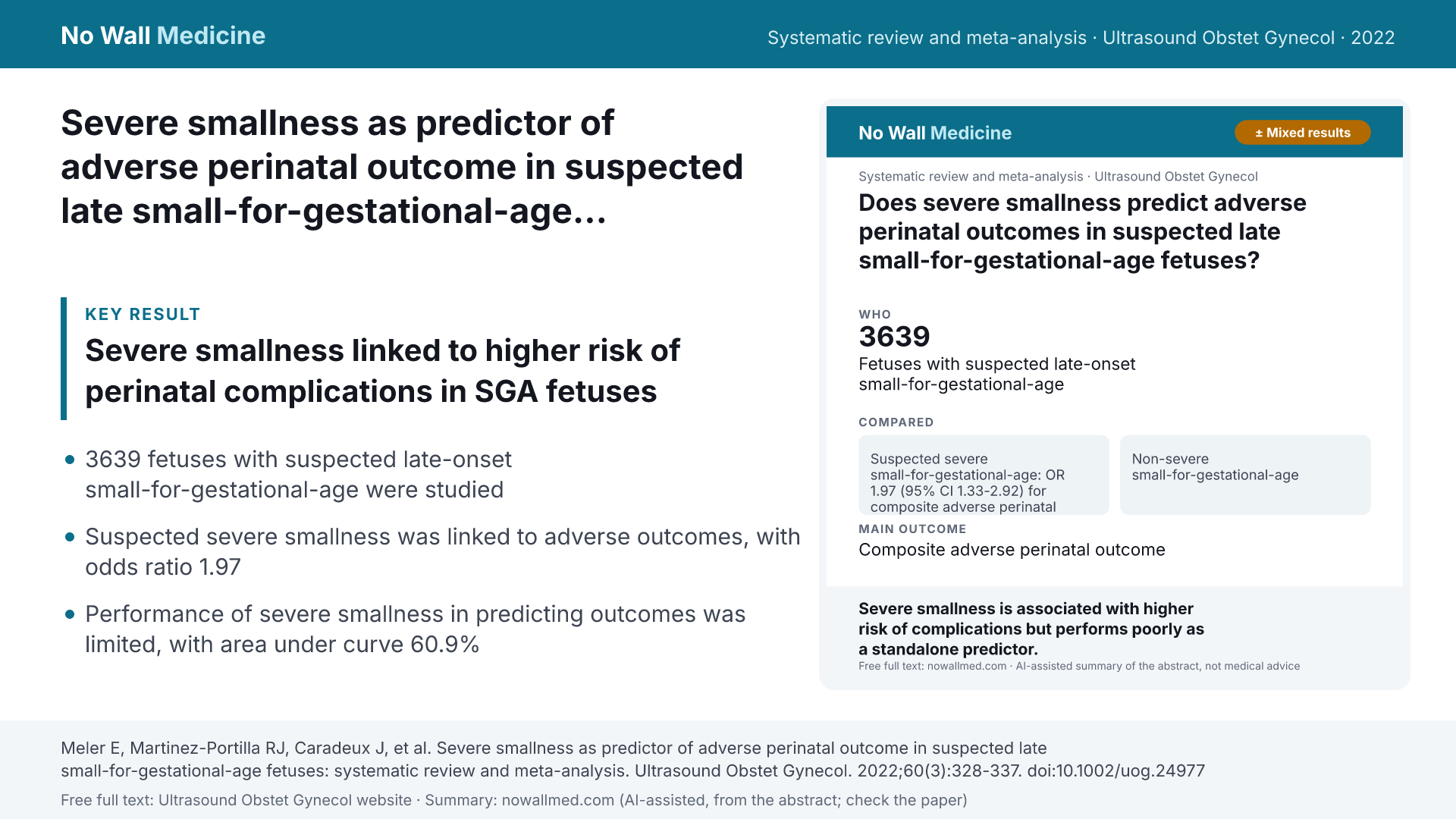
Severe smallness as predictor of adverse perinatal outcome in suspected late small-for-gestational-age fetuses: systematic review and meta-analysis
Key result: Severe smallness linked to higher risk of perinatal complications in SGA fetuses
Systematic review and meta-analysisMixed results
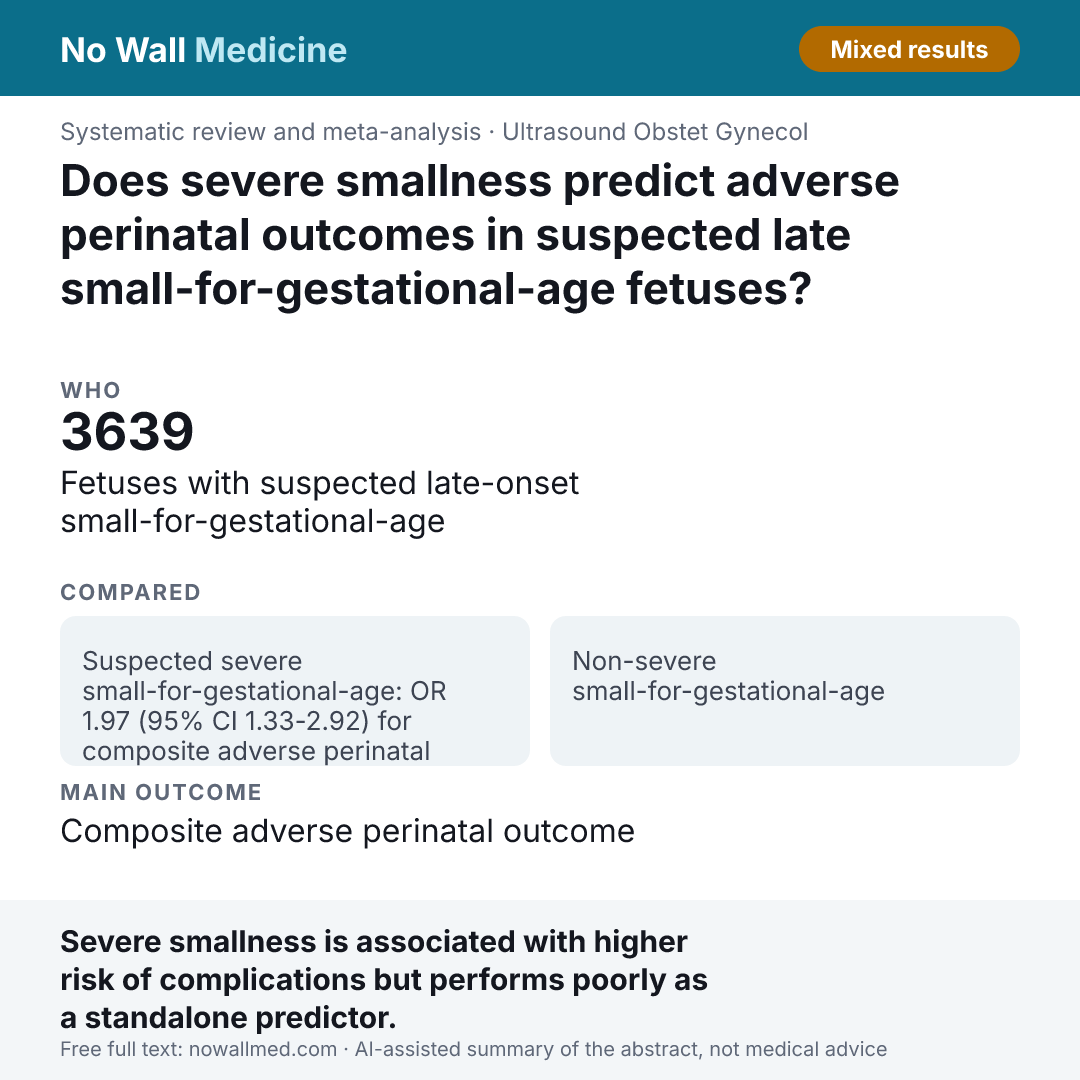
Does severe smallness predict adverse perinatal outcomes in suspected late small-for-gestational-age fetuses?
Who
3639
Fetuses with suspected late-onset small-for-gestational-age
Compared
Suspected severe small-for-gestational-age: OR 1.97 (95% CI 1.33-2.92) for composite adverse perinatal outcome
Non-severe small-for-gestational-age
Main outcome
Composite adverse perinatal outcome
Result: odds ratio 1.97 (95% CI 1.33-2.92)
Bottom line: Severe smallness is associated with higher risk of complications but performs poorly as a standalone predictor.
Ultrasound Obstet Gynecol · 2022-06-25 · Save PNG
Key points
- 3639 fetuses with suspected late-onset small-for-gestational-age were studied.
- Suspected severe smallness was linked to adverse outcomes, with odds ratio 1.97.
- Performance of severe smallness in predicting outcomes was limited, with area under curve 60.9%.
Limitation the authors note: The authors did not state a specific limitation in the abstract
Discussion prompts
- Would these patients look like yours? Who was left out?
- Is the main outcome one that matters to patients?
- Is the difference large enough to change what you do?
Cite: Meler E, Martinez-Portilla RJ, Caradeux J, et al. Severe smallness as predictor of adverse perinatal outcome in suspected late small-for-gestational-age fetuses: systematic review and meta-analysis. Ultrasound Obstet Gynecol. 2022;60(3):328-337. doi:10.1002/uog.24977
Free full text: Ultrasound Obstet Gynecol website · Summary and visual abstract: nowallmed.com/a/severe-smallness-as-predictor-of-adverse-perinatal-outcome-in-opymya/ (AI-assisted from the abstract; check the paper before relying on it).