Small-for-gestational-age screening accuracy and growth indicators in low-risk pregnant women
Implication of third-trimester screening accuracy for small-for-gestational age and additive value of third-trimester growth-trajectory indicators in predicting severe adverse perinatal outcome in low-risk population: pragmatic secondary analysis of IRIS study
Secondary analysis of a randomized trialMixed results
Does third-trimester small-for-gestational-age screening and growth-trajectory indicators predict severe adverse perinatal outcomes?
Who
11820
Low-risk pregnant women · Dutch national multicenter
Compared
True-positive SGA neonates: aOR 4.46 (95% CI, 2.28-8.75)
False-negative SGA neonates: aOR 2.61 (95% CI, 1.74-3.89)
False-positive SGA neonates: no difference
True-negative non-SGA neonates: no difference
Main outcome
Severe adverse perinatal outcome and obstetric intervention
Result: aOR 4.46 (95% CI, 2.28-8.75) for true-positive SGA
Bottom line: Small-for-gestational-age screening identifies high-risk neonates, but growth-trajectory indicators provide little additive value for predicting severe adverse perinatal outcomes.
Ultrasound Obstet Gynecol · 2023-07-05Download image
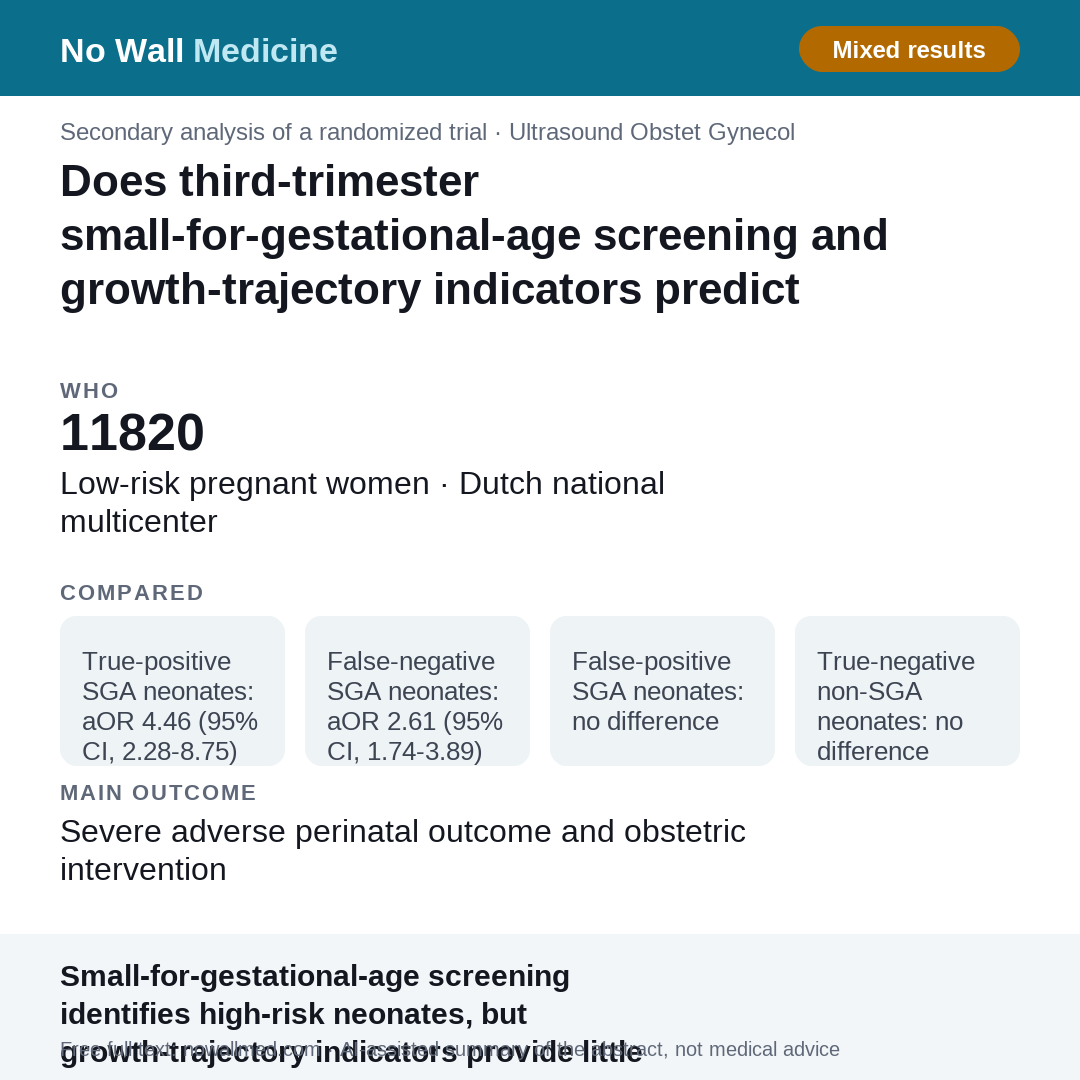
Clinical question: Does third-trimester small-for-gestational-age screening and growth-trajectory indicators predict severe adverse perinatal outcomes?
Why it matters: It is unknown how the accuracy of third-trimester small-for-gestational-age screening and specific growth-trajectory measurements impact the prediction of severe adverse perinatal outcomes in low-risk populations.
Key points
- Researchers analyzed 11,820 low-risk pregnant women to compare outcomes for babies suspected of being small-for-gestational-age, which means birth weight is below the expected range for their age.
- Babies identified as small-for-gestational-age had an increased risk of severe adverse perinatal outcomes, with an adjusted odds ratio of 4.46 for true positives and 2.61 for false negatives.
- In a subsample of 7,989, an abdominal circumference growth-velocity Z-score below the 10th percentile was associated with a 2.15 adjusted odds ratio for severe adverse perinatal outcomes.
Headline and key points written with AI from the paper’s abstract, with every number checked against it. Read the paper before relying on them.
Topics
Cite this article
van Roekel M, Henrichs J, Franx A, Verhoeven CJ, de Jonge A. Implication of third-trimester screening accuracy for small-for-gestational age and additive value of third-trimester growth-trajectory indicators in predicting severe adverse perinatal outcome in low-risk population: pragmatic secondary analysis of IRIS study. Ultrasound Obstet Gynecol. 2023. doi:10.1002/uog.26167
Spotted a mistake? Suggest a correction
Top studies every Monday
The week’s key trials and guidelines in your specialties, plus any topics you follow. By email, free.
Get the weekly digest