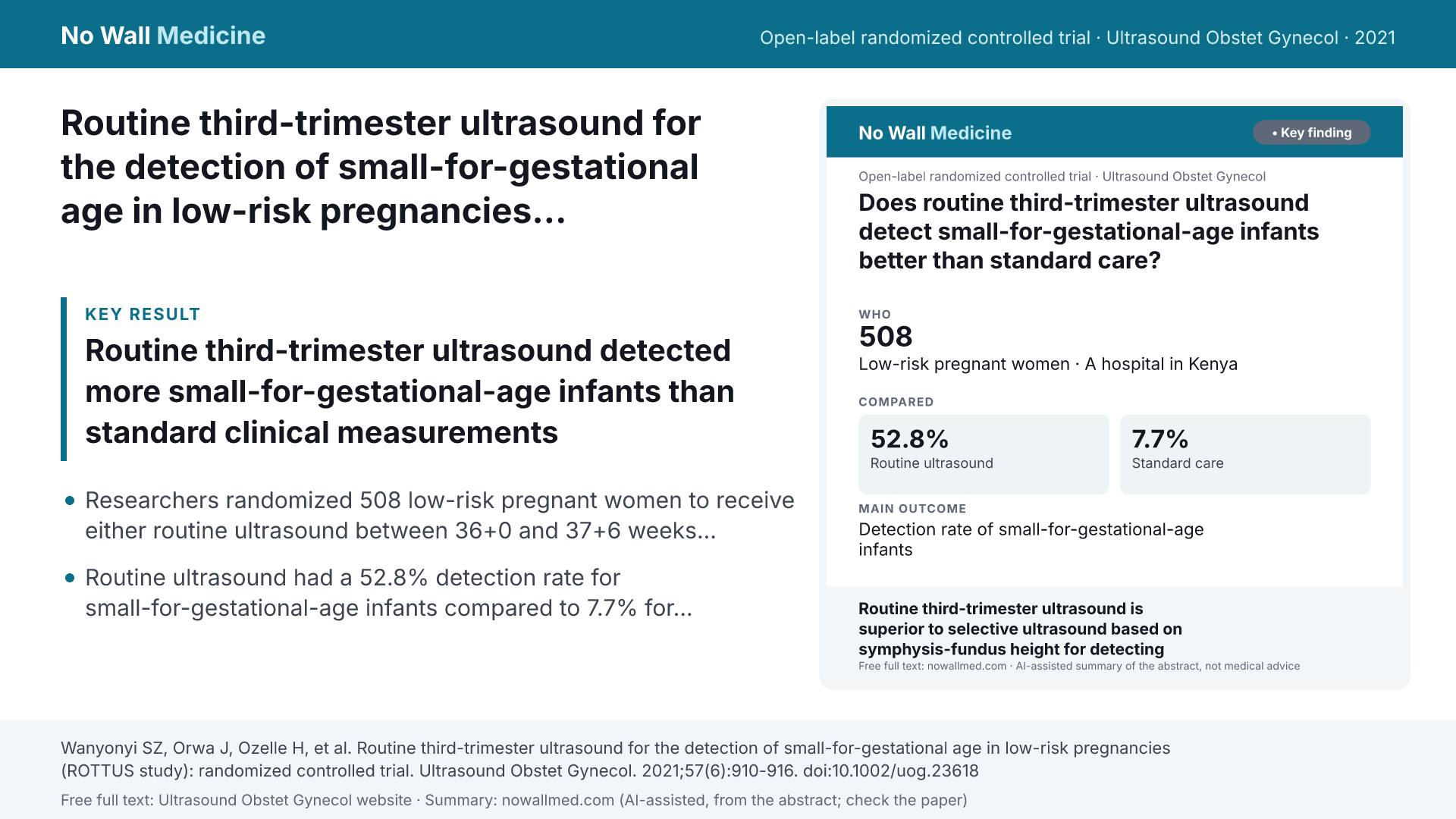
Routine third-trimester ultrasound detected more small-for-gestational-age infants than standard clinical measurements
Routine third-trimester ultrasound for the detection of small-for-gestational age in low-risk pregnancies (ROTTUS study): randomized controlled trial
Open-label randomized controlled trialBenefit found
Does routine third-trimester ultrasound detect small-for-gestational-age infants better than standard care?
Who
508
Low-risk pregnant women · A hospital in Kenya
Compared
52.8%Routine ultrasound (19/36)
7.7%Standard care (2/26)
Main outcome
Detection rate of small-for-gestational-age infants
Result: area under the ROC curve 0.92 (95% CI, 0.87-0.96) vs 0.68 (95% CI, 0.58-0.77)
Bottom line: Routine third-trimester ultrasound is superior to selective ultrasound based on symphysis-fundus height for detecting small-for-gestational-age infants.
Ultrasound Obstet Gynecol · 2021-02-24Download image
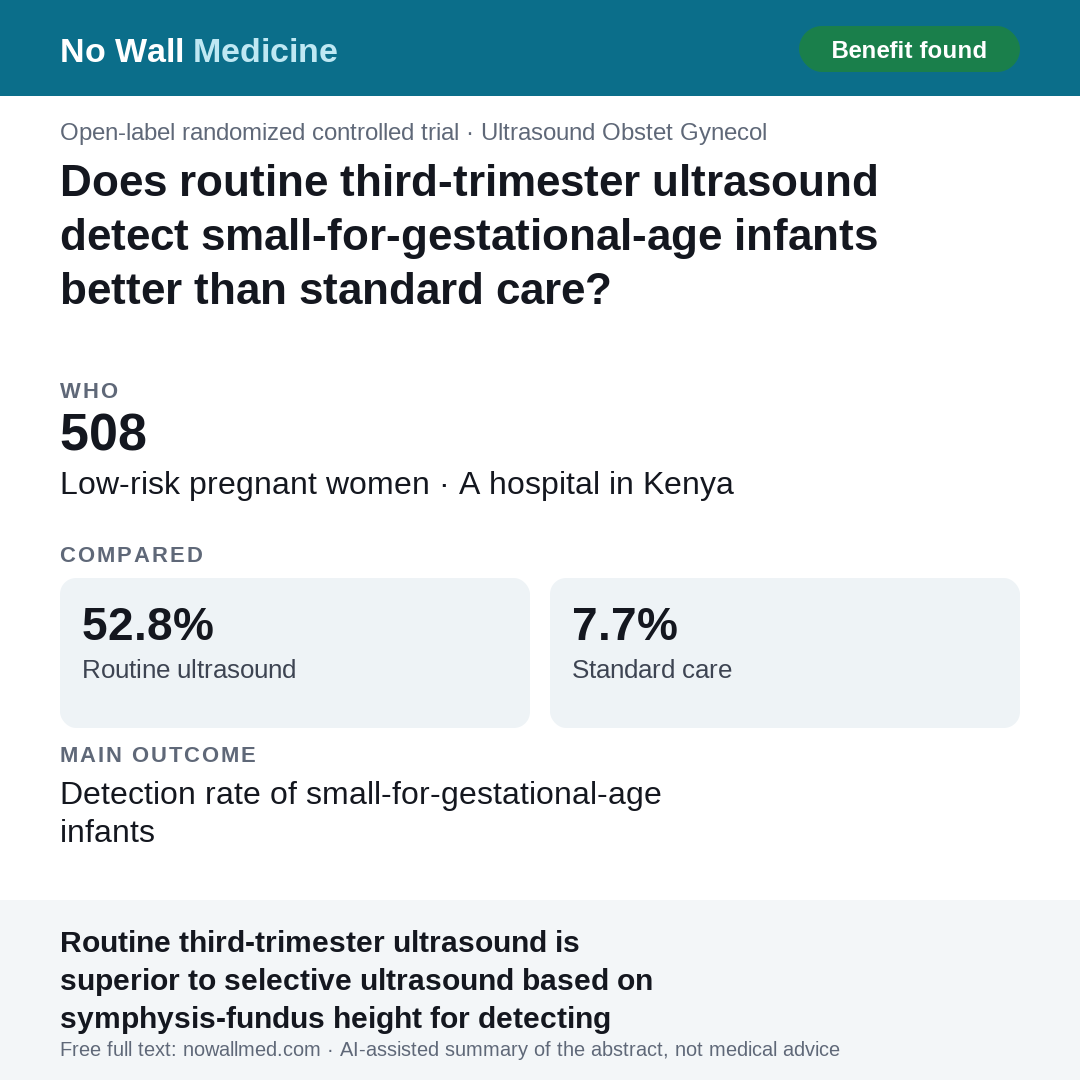
Clinical question: Does routine third-trimester ultrasound detect small-for-gestational-age infants better than standard care?
Why it matters: It was unknown if routine third-trimester ultrasound is more effective than standard clinical measurements for detecting small-for-gestational-age infants in low-risk pregnancies.
In absolute numbers
Routine ultrasound: 52.8% · Standard care: 7.7% → a difference of 45.1 percentage points, so about 3 people would need the treatment for 1 more to benefit (number needed to treat) over the trial’s follow-up.
Worked out by us from the two group results above, not reported by the authors. Check the paper for the exact outcome and timing.
Key points
- Researchers randomized 508 low-risk pregnant women to receive either routine ultrasound between 36+0 and 37+6 weeks or standard care using serial symphysis-fundus height measurements.
- Routine ultrasound had a 52.8% detection rate for small-for-gestational-age infants compared to 7.7% for standard care, and a 66.7% detection rate for severe cases compared to 8.3%.
- The area under the receiver-operating-characteristic curve for predicting small-for-gestational-age was 0.92 for routine ultrasound versus 0.68 for standard care.
Headline and key points written with AI from the paper’s abstract, with every number checked against it. Read the paper before relying on them.
Was this summary helpful?
Subject terms
Cite this article
Wanyonyi SZ, Orwa J, Ozelle H, et al. Routine third-trimester ultrasound for the detection of small-for-gestational age in low-risk pregnancies (ROTTUS study): randomized controlled trial. Ultrasound Obstet Gynecol. 2021. doi:10.1002/uog.23618
Spotted a mistake? Suggest a correction