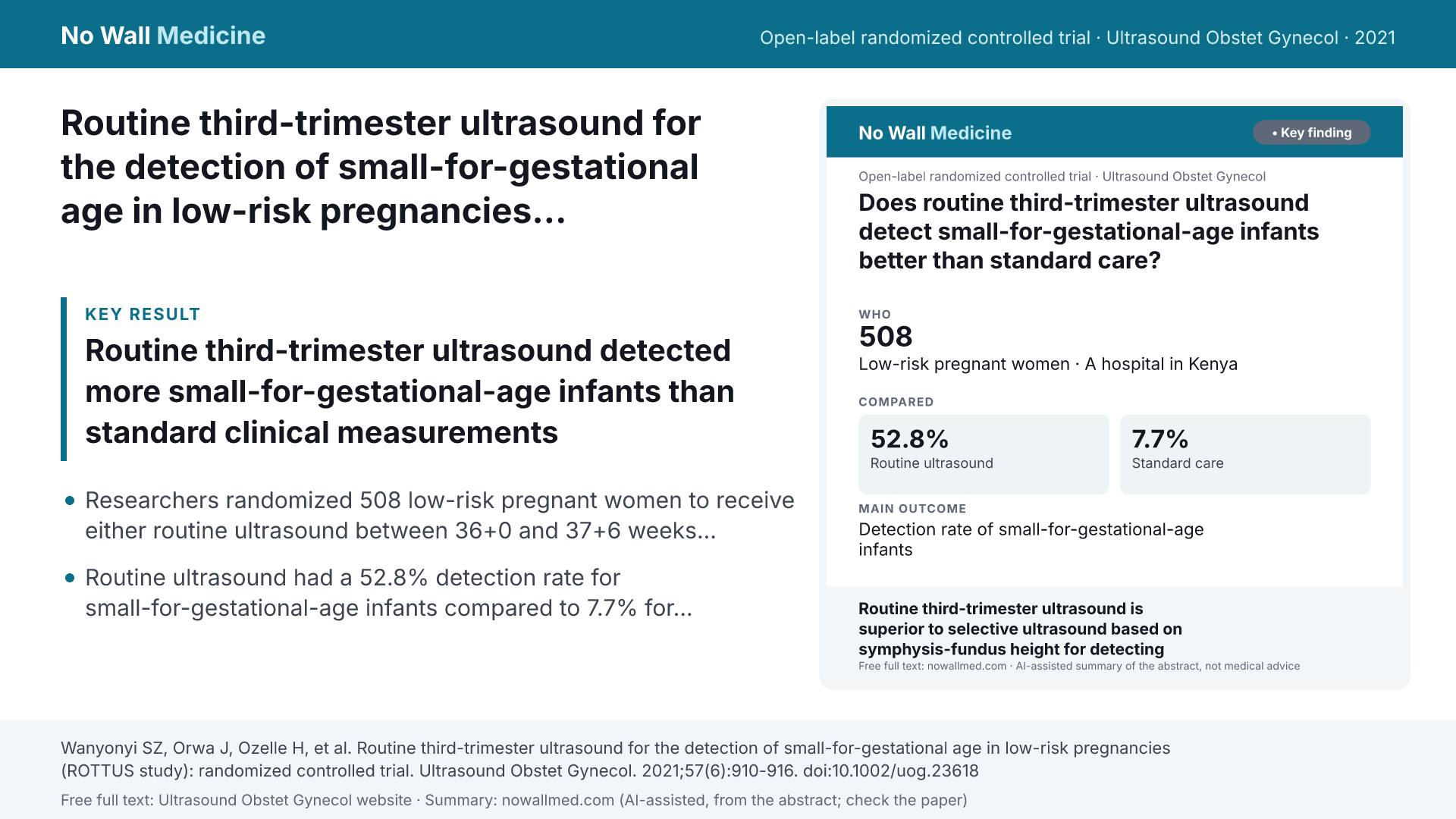
Routine third-trimester ultrasound for the detection of small-for-gestational age in low-risk pregnancies (ROTTUS study): randomized controlled trial
Key result: Routine third-trimester ultrasound detected more small-for-gestational-age infants than standard clinical measurements
Open-label randomized controlled trialKey finding
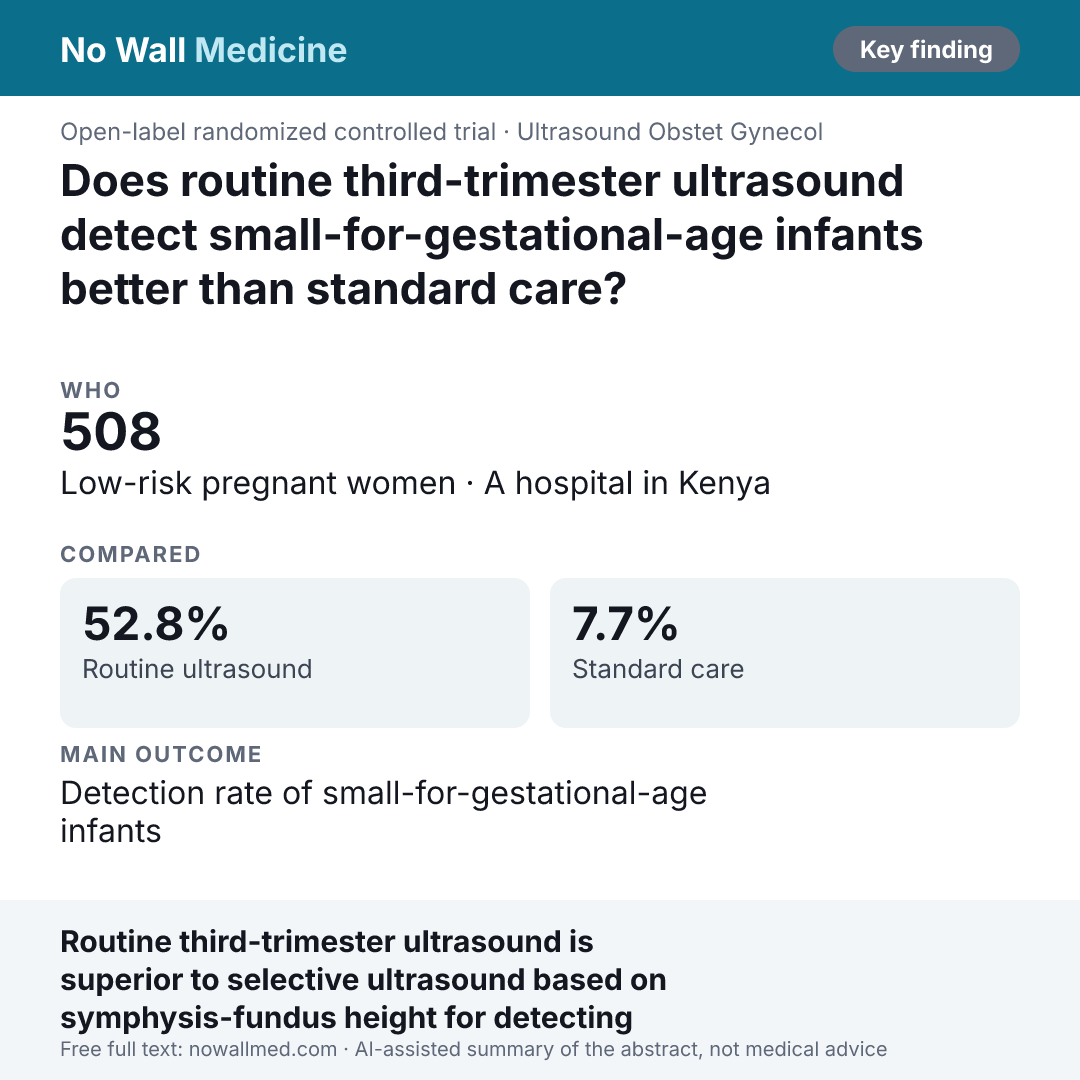
Does routine third-trimester ultrasound detect small-for-gestational-age infants better than standard care?
Who
508
Low-risk pregnant women · A hospital in Kenya
Compared
52.8%Routine ultrasound (19/36)
7.7%Standard care (2/26)
Main outcome
Detection rate of small-for-gestational-age infants
Result: area under the ROC curve 0.92 (95% CI, 0.87-0.96) vs 0.68 (95% CI, 0.58-0.77)
Bottom line: Routine third-trimester ultrasound is superior to selective ultrasound based on symphysis-fundus height for detecting small-for-gestational-age infants.
Ultrasound Obstet Gynecol · 2021-02-24 · Save PNG
Key points
- Researchers randomized 508 low-risk pregnant women to receive either routine ultrasound between 36+0 and 37+6 weeks or standard care using serial symphysis-fundus height measurements.
- Routine ultrasound had a 52.8% detection rate for small-for-gestational-age infants compared to 7.7% for standard care, and a 66.7% detection rate for severe cases compared to 8.3%.
- The area under the receiver-operating-characteristic curve for predicting small-for-gestational-age was 0.92 for routine ultrasound versus 0.68 for standard care.
Discussion prompts
- Would these patients look like yours? Who was left out?
- Is the main outcome one that matters to patients?
- Is the difference large enough to change what you do?
Cite: Wanyonyi SZ, Orwa J, Ozelle H, et al. Routine third-trimester ultrasound for the detection of small-for-gestational age in low-risk pregnancies (ROTTUS study): randomized controlled trial. Ultrasound Obstet Gynecol. 2021;57(6):910-916. doi:10.1002/uog.23618
Free full text: Ultrasound Obstet Gynecol website · Summary and visual abstract: nowallmed.com/a/routine-third-trimester-ultrasound-for-the-detection-of-small-for-anszsb/ (AI-assisted from the abstract; check the paper before relying on it).