Unidentified small-for-gestational-age fetuses were linked to specific maternal characteristics and ultrasound patterns
Characteristics associated with antenatally unidentified small-for-gestational-age fetuses: prospective cohort study nested within DESiGN randomized controlled trial
Prospective cohort studyMixed results
What characteristics are associated with antenatally unidentified small-for-gestational-age fetuses?
Who
15784
Singleton, non-anomalous small-for-gestational-age neonates born after 24 weeks · 13 United Kingdom sites
Compared
78.7%Unidentified small-for-gestational-age
Identified small-for-gestational-age
Main outcome
Clinical characteristics and ultrasound use patterns associated with unidentified small-for-gestational-age
Result: adjusted mean difference 19.0 (95% CI 17.8-20.1) centiles
Bottom line: Unidentified small-for-gestational-age was more common in women without serial ultrasound indications, those with cephalic presentation, and specific BMI ranges.
Ultrasound Obstet Gynecol · 2022-10-08Download image
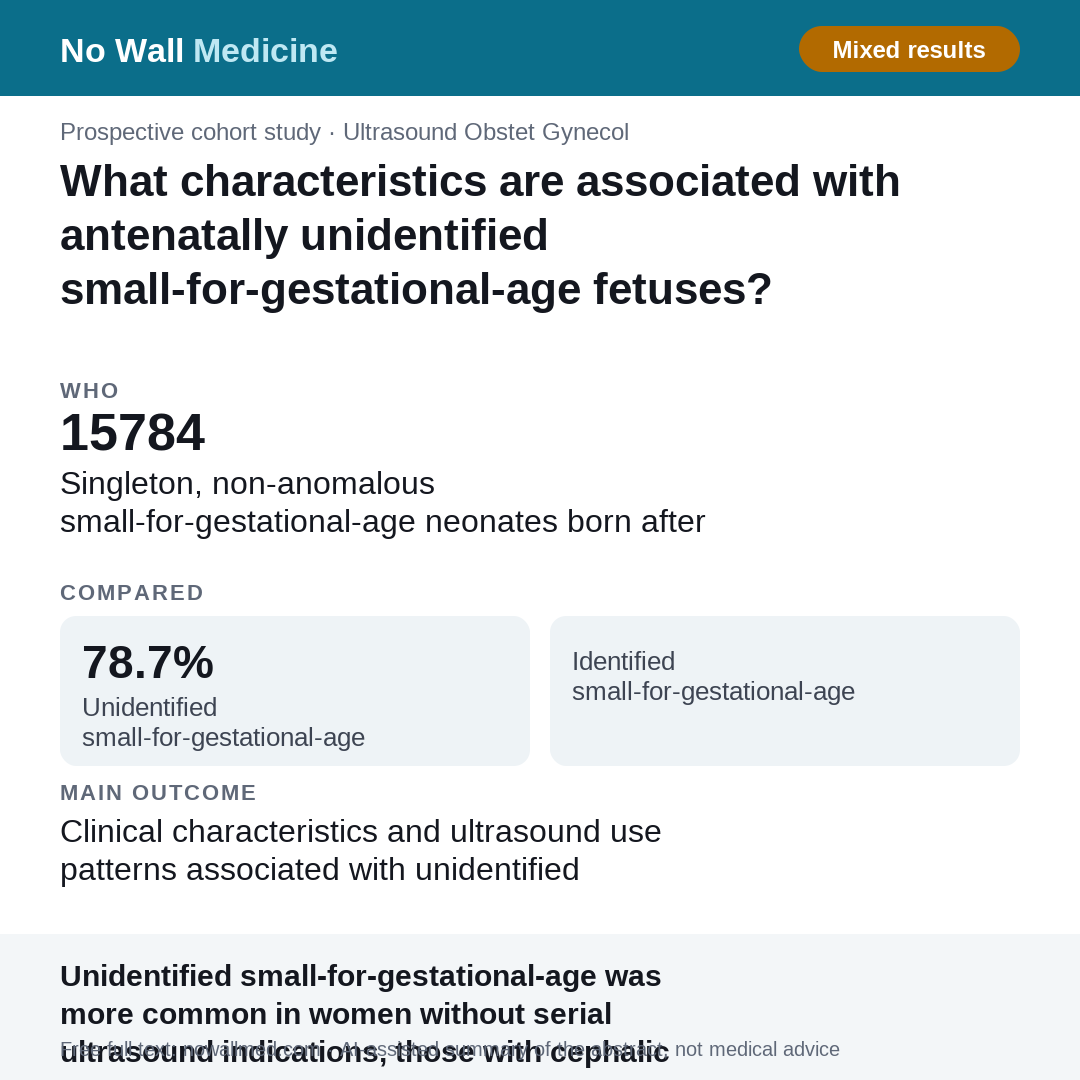
Clinical question: What characteristics are associated with antenatally unidentified small-for-gestational-age fetuses?
Why it matters: It is unknown which clinical characteristics and ultrasound patterns are associated with failing to identify small-for-gestational-age fetuses before birth.
Key points
- Researchers studied 15,784 babies born small-for-gestational-age, finding that 78.7% of these cases were not identified before birth.
- Unidentified small-for-gestational-age was associated with a body mass index of 25.0-29.9 kg/m2 and having no recorded growth scan in 47.1% of cases.
- In pregnancies where the small size was not identified, the estimated fetal weight was higher than the actual birth weight by a mean difference of 19.0 centiles.
Headline and key points written with AI from the paper’s abstract, with every number checked against it. Read the paper before relying on them.
Topics
Cite this article
Relph S, Vieira MC, Copas A, Alagna A, Page L, Winsloe C. Characteristics associated with antenatally unidentified small-for-gestational-age fetuses: prospective cohort study nested within DESiGN randomized controlled trial. Ultrasound Obstet Gynecol. 2022. doi:10.1002/uog.26091
Spotted a mistake? Suggest a correction
Top studies every Monday
The week’s key trials and guidelines in your specialties, plus any topics you follow. By email, free.
Get the weekly digest