Is It Cost-Effective to Induce Labour Early to Prevent Shoulder Dystocia? Evidence From the Big Baby Trial
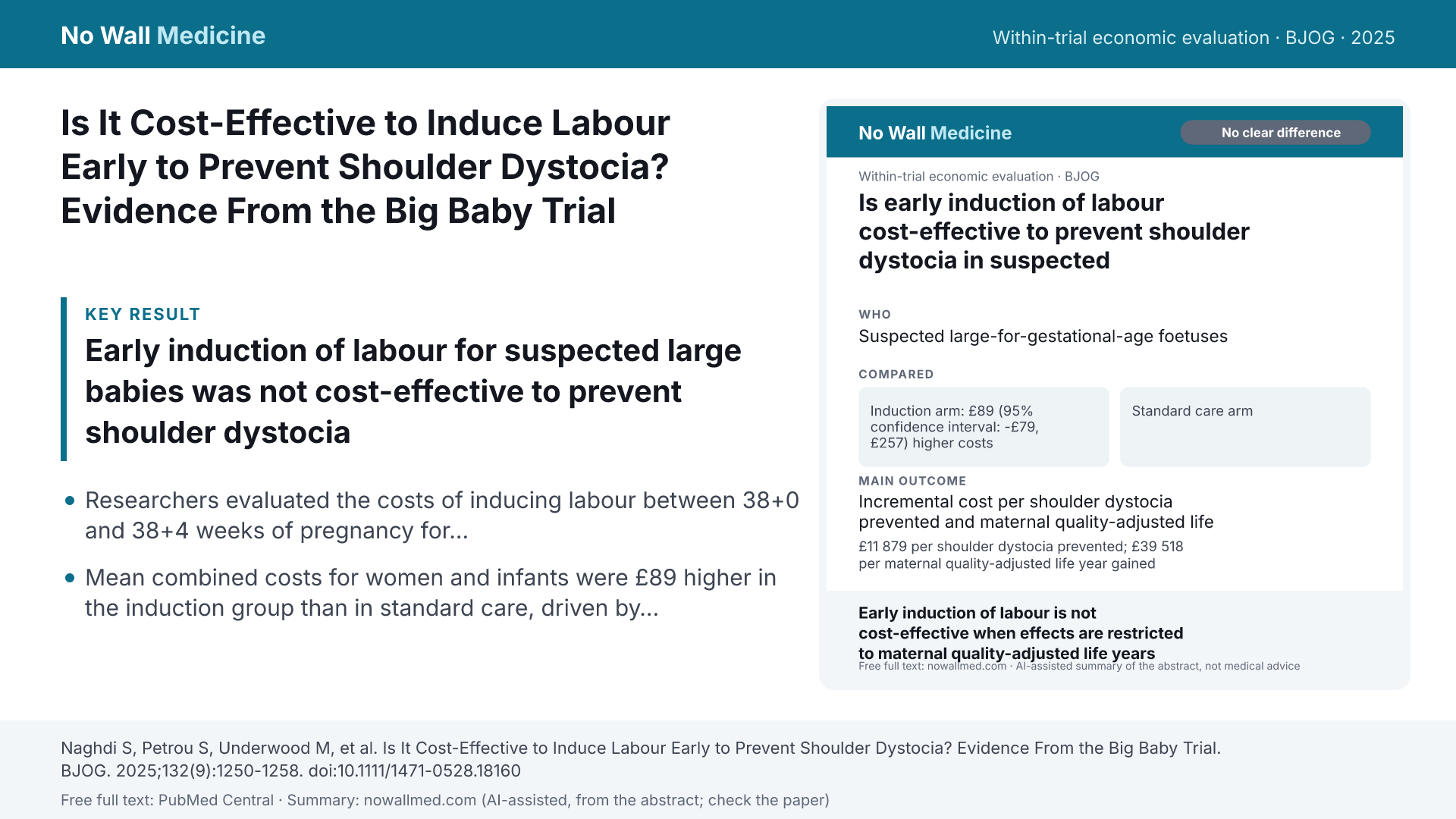
Key result: Early induction of labour for suspected large babies was not cost-effective to prevent shoulder dystocia
Within-trial economic evaluationNo clear difference
Is early induction of labour cost-effective to prevent shoulder dystocia in suspected large-for-gestational-age foetuses?
Who
Suspected large-for-gestational-age foetuses
Compared
Induction arm: £89 (95% confidence interval: -£79, £257) higher costs
Standard care arm
Main outcome
Incremental cost per shoulder dystocia prevented and maternal quality-adjusted life year gained
Result: £11 879 per shoulder dystocia prevented; £39 518 per maternal quality-adjusted life year gained
Bottom line: Early induction of labour is not cost-effective when effects are restricted to maternal quality-adjusted life years gained.
BJOG · 2025-05-01
Key points
- Researchers evaluated the costs of inducing labour between 38+0 and 38+4 weeks of pregnancy for suspected large-for-gestational-age foetuses.
- Mean combined costs for women and infants were £89 higher in the induction group than in standard care, driven by neonatal costs.
- The incremental cost to prevent one case of shoulder dystocia was £11 879, while the cost per maternal quality-adjusted life year gained was £39 518.
Discussion prompts
- Would these patients look like yours? Who was left out?
- Is the main outcome one that matters to patients?
- Is the difference large enough to change what you do?
Cite: Naghdi S, Petrou S, Underwood M, et al. Is It Cost-Effective to Induce Labour Early to Prevent Shoulder Dystocia? Evidence From the Big Baby Trial. BJOG. 2025;132(9):1250-1258. doi:10.1111/1471-0528.18160
Free full text: PubMed Central · Summary and visual abstract: nowallmed.com/a/is-it-cost-effective-to-induce-labour-early-to-prevent-shoulder-jmowlw/ (AI-assisted from the abstract; check the paper before relying on it).