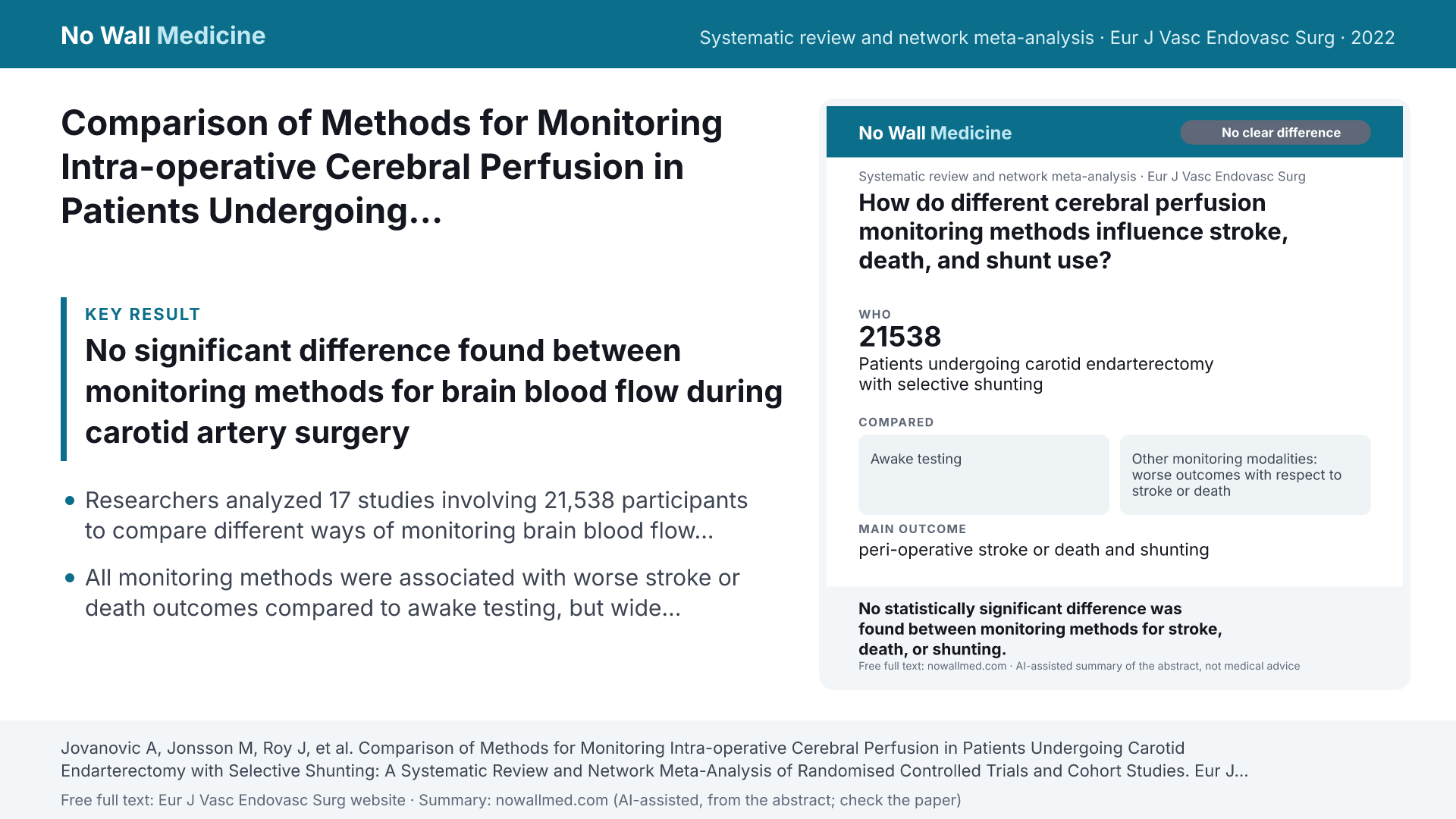
No significant difference found between monitoring methods for brain blood flow during carotid artery surgery
Comparison of Methods for Monitoring Intra-operative Cerebral Perfusion in Patients Undergoing Carotid Endarterectomy with Selective Shunting: A Systematic Review and Network Meta-Analysis of Randomised Controlled Trials and Cohort Studies
Systematic review and network meta-analysisNo clear difference
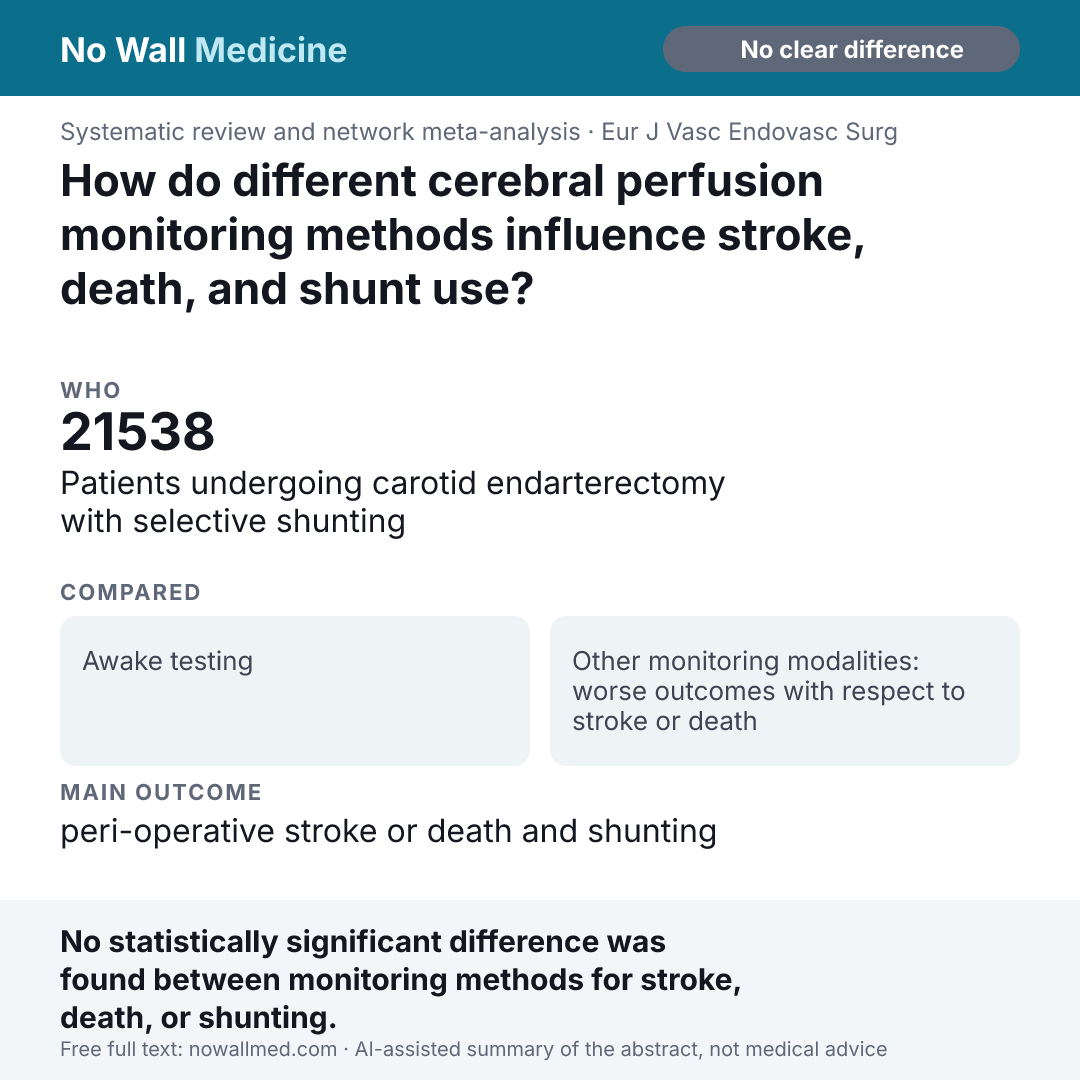
How do different cerebral perfusion monitoring methods influence stroke, death, and shunt use?
Who
21538
Patients undergoing carotid endarterectomy with selective shunting
Compared
Awake testing
Other monitoring modalities: worse outcomes with respect to stroke or death
Main outcome
peri-operative stroke or death and shunting
Bottom line: No statistically significant difference was found between monitoring methods for stroke, death, or shunting.
Limitation: There is a lack of high quality data on this topic in the literature.
Eur J Vasc Endovasc Surg · 2022-09-20 · Save PNG
Clinical question: How do different cerebral perfusion monitoring methods influence stroke, death, and shunt use?
Key points
- Researchers analyzed 17 studies involving 21,538 participants to compare different ways of monitoring brain blood flow during carotid endarterectomy, a surgery to clear the carotid artery.
- All monitoring methods were associated with worse stroke or death outcomes compared to awake testing, but wide credible intervals showed no statistically significant difference between methods.
- The odds of using an intraluminal shunt, a temporary tube to maintain blood flow, were lowest with combined electroencephalography and transcranial Doppler and highest with stump pressure.
Headline and key points written with AI from the paper’s abstract, with every number checked against it. Read the paper before relying on them.
Was this summary helpful?
Subject terms
Headline, design, result, key points, caveat and citation as plain text.
Cite this article
Jovanovic A, Jonsson M, Roy J, et al. Comparison of Methods for Monitoring Intra-operative Cerebral Perfusion in Patients Undergoing Carotid Endarterectomy with Selective Shunting: A Systematic Review and Network Meta-Analysis of Randomised Controlled Trials and Cohort Studies. Eur J Vasc Endovasc Surg. 2023;65(2):233-243. doi:10.1016/j.ejvs.2022.08.025
Spotted a mistake? Suggest a correction