Artificial intelligence guidance increased detection of clinically significant prostate cancer during targeted biopsies
Comparison of MRI artificial intelligence-guided cognitive fusion-targeted biopsy versus routine cognitive fusion-targeted prostate biopsy in prostate cancer diagnosis: a randomized controlled trial
Prospective, single-institution randomized controlled trialBenefit found
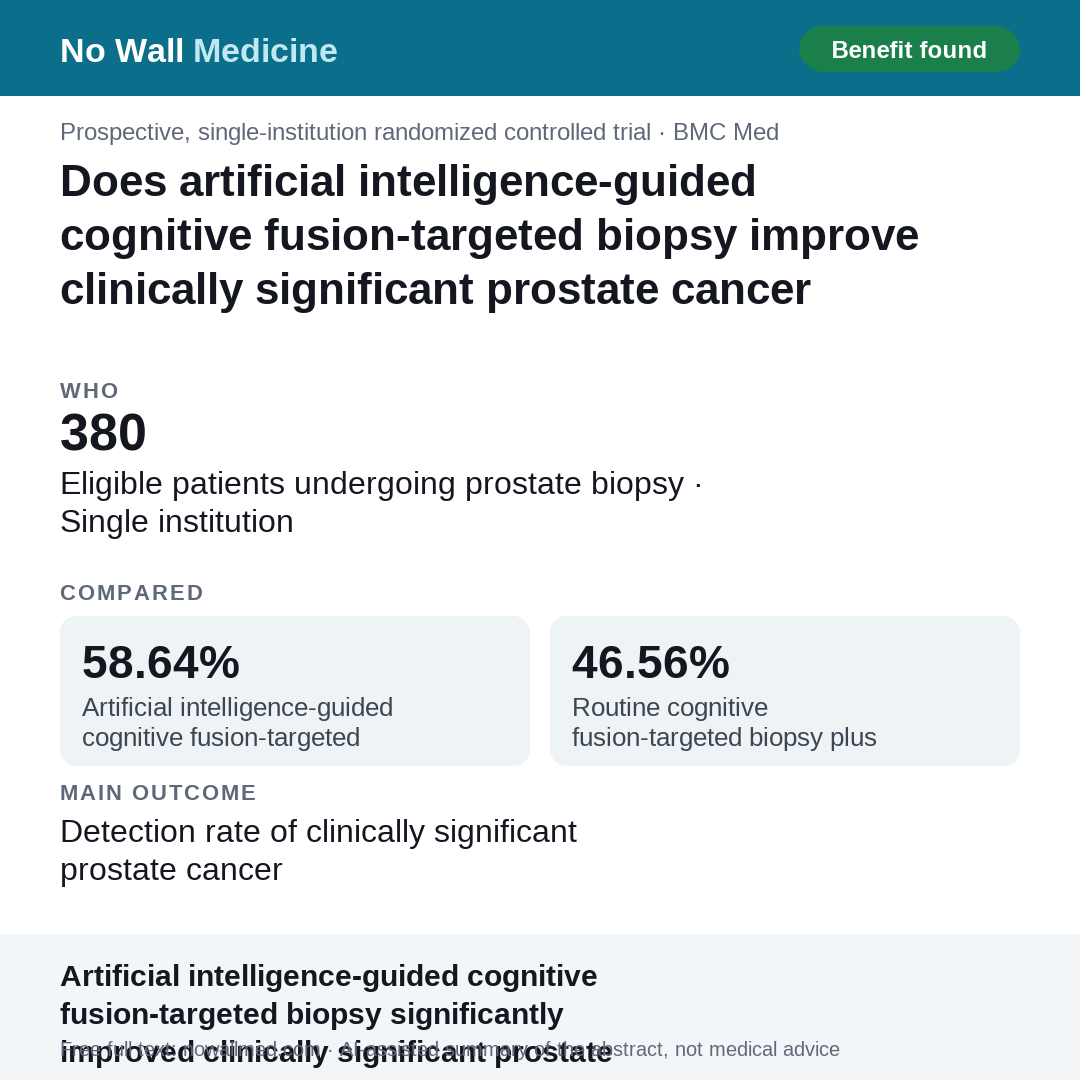
Does artificial intelligence-guided cognitive fusion-targeted biopsy improve clinically significant prostate cancer detection?
Who
380
Eligible patients undergoing prostate biopsy · Single institution
Compared
58.64%Artificial intelligence-guided cognitive fusion-targeted biopsy plus systematic biopsy
46.56%Routine cognitive fusion-targeted biopsy plus systematic biopsy
Main outcome
Detection rate of clinically significant prostate cancer
Bottom line: Artificial intelligence-guided cognitive fusion-targeted biopsy significantly improved clinically significant prostate cancer detection rates compared to routine biopsy.
BMC Med · 2024-11-13Download image
Clinical question: Does artificial intelligence-guided cognitive fusion-targeted biopsy improve clinically significant prostate cancer detection?
Why it matters: It is unknown if using artificial intelligence to guide MRI-based targeted biopsies improves the detection of clinically significant prostate cancer compared to routine methods.
Key points
- Researchers randomized 380 patients to receive either artificial intelligence-guided cognitive fusion-targeted biopsy or routine cognitive fusion-targeted biopsy plus systematic biopsy.
- The artificial intelligence group had a 58.64% detection rate of clinically significant prostate cancer at the patient level compared to 46.56% in the routine group.
- At the per-lesion level, the artificial intelligence group detected 61.47% of clinically significant prostate cancers compared to 47.79% in the routine group.
Headline and key points written with AI from the paper’s abstract, with every number checked against it. Read the paper before relying on them.
Was this summary helpful?
Subject terms
Cite this article
Deng R, Liu Y, Wang K, Ruan M, Li D, Wu J. Comparison of MRI artificial intelligence-guided cognitive fusion-targeted biopsy versus routine cognitive fusion-targeted prostate biopsy in prostate cancer diagnosis: a randomized controlled trial. BMC Med. 2024. doi:10.1186/s12916-024-03742-z
Spotted a mistake? Suggest a correction
Top studies every Monday
The week’s key trials and guidelines in your specialties, plus any topics you follow. By email, free.
Get the weekly digest