Radiofrequency neurosurgery for psychiatric disorders shows similar neuropsychological side effect risks to conventional neurosurgery
Comparison of neuropsychological side effects between contemporary radiofrequency ablative neurosurgery for psychiatric disorders and conventional neurosurgical procedures: systematic review and meta-analysis
Systematic review and meta-analysisNo clear difference
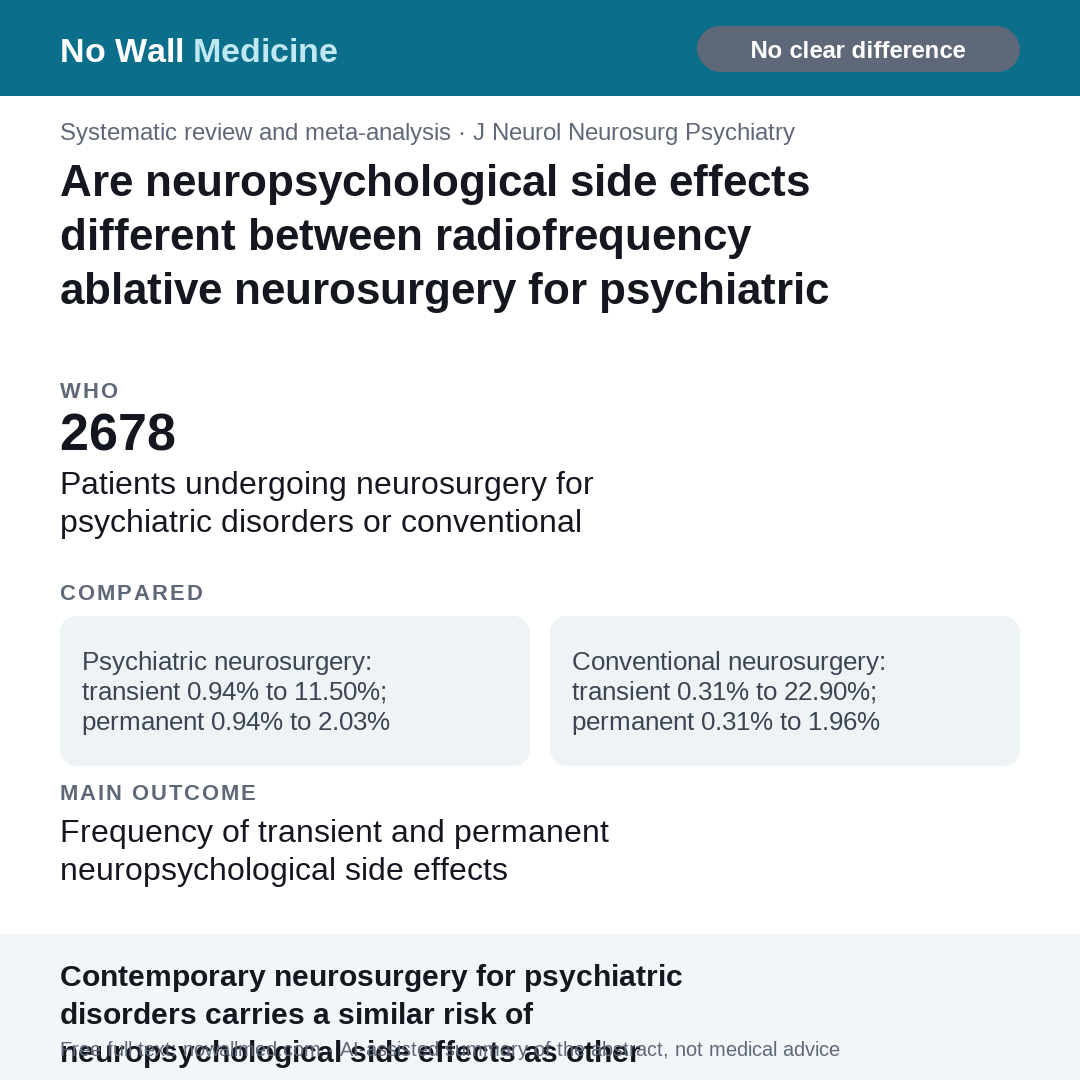
Are neuropsychological side effects different between radiofrequency ablative neurosurgery for psychiatric disorders and conventional neurosurgery?
Who
2678
Patients undergoing neurosurgery for psychiatric disorders or conventional neurosurgical procedures
Compared
Psychiatric neurosurgery: transient 0.94% to 11.50%; permanent 0.94% to 2.03%
Conventional neurosurgery: transient 0.31% to 22.90%; permanent 0.31% to 1.96%
Main outcome
Frequency of transient and permanent neuropsychological side effects
Bottom line: Contemporary neurosurgery for psychiatric disorders carries a similar risk of neuropsychological side effects as other conventional neurosurgical procedures.
J Neurol Neurosurg Psychiatry · 2026-05-14Download image
Clinical question: Are neuropsychological side effects different between radiofrequency ablative neurosurgery for psychiatric disorders and conventional neurosurgery?
Why it matters: Neurosurgery for psychiatric disorders is underused due to historical concerns regarding neuropsychological side effects, which are impairments in mental processes like memory or attention.
Key points
- Researchers analyzed 48 articles involving 2678 participants to compare neuropsychological side effects between psychiatric neurosurgery and epilepsy, vascular, and oncology surgeries.
- Transient side effects in the psychiatric group ranged from 0.94% to 11.50%, while permanent side effects ranged from 0.94% to 2.03%.
- The psychiatric group showed better memory and language outcomes than the epilepsy group, but worse executive and perceptual-motor function outcomes.
Headline and key points written with AI from the paper’s abstract, with every number checked against it. Read the paper before relying on them.
Abstract
Background
Psychiatric disorders are increasingly contributing to global disability. Despite advances in conservative management, the prevalence of treatment-resistant cases remains high. Meanwhile, neurosurgery for psychiatric disorders (NPD) remains underused, largely due to strict regulations and historical concerns, particularly those related to neuropsychological side effects (NPSE). Objective
To address this issue, we conducted a systematic review with meta-analysis to compare NPSE associated with radiofrequency ablative NPD to those observed in neuro-oncological, neurovascular and epilepsy surgeries. Methods
PubMed, Embase and LILACS databases were searched in April 2024 for articles published in English/Spanish from 1990 to 2022, following Preferred Reporting Items for Systematic Reviews and Meta-analyses guidelines. Results
A total of 48 articles with 2678 participants were included. The frequency of transient and permanent NPSE in the NPD group ranged from 0.94% to 11.50% and 0.94% to 2.03%, respectively, comparable to the other surgical groups (epilepsy: 0.31-11.70%; vascular: 0.52-22.90%; oncology: 0.94-17.60% for transient NPSE; epilepsy: 0.31-12%; vascular: 0.40-1.96% and oncology: 0.84-1.48% for permanent NPSE). Regarding permanent NPSE, arguably the most critical consideration, the NPD group showed better outcomes in memory, language and social cognition than the epilepsy group, but worse outcomes in executive and perceptual-motor functions. Compared with the vascular group, the NPD group had better executive function but worse complex attention. Finally, the NPD group had fewer permanent deficits than the oncology group in executive function, complex attention and perceptual-motor domains, although language performance was lower. Conclusions
Contemporary NPD apparently carries a similar risk of NPSE as other conventional neurosurgical procedures, challenging misconceptions and this unjustified barrier to its broader use.
Abstract reproduced under the article’s CC BY NC licence.
Topics
Cite this article
Vilela-Filho O, Bannach MA, Lino-Filho AM, Hamani C, Nuttin B, Hariz M. Comparison of neuropsychological side effects between contemporary radiofrequency ablative neurosurgery for psychiatric disorders and conventional neurosurgical procedures: systematic review and meta-analysis. J Neurol Neurosurg Psychiatry. 2026. doi:10.1136/jnnp-2025-337800
Spotted a mistake? Suggest a correction