Transcatheter aortic valve replacement shows similar mortality to surgery but higher device-related risks
Comparison of short- and long-term outcomes between transcatheter and surgical aortic valve replacement for bicuspid aortic valve stenosis: a systematic review and meta-analysis
Why it matters: It is unknown whether transcatheter or surgical methods provide better safety and efficacy for patients with bicuspid aortic valve stenosis.
Key points
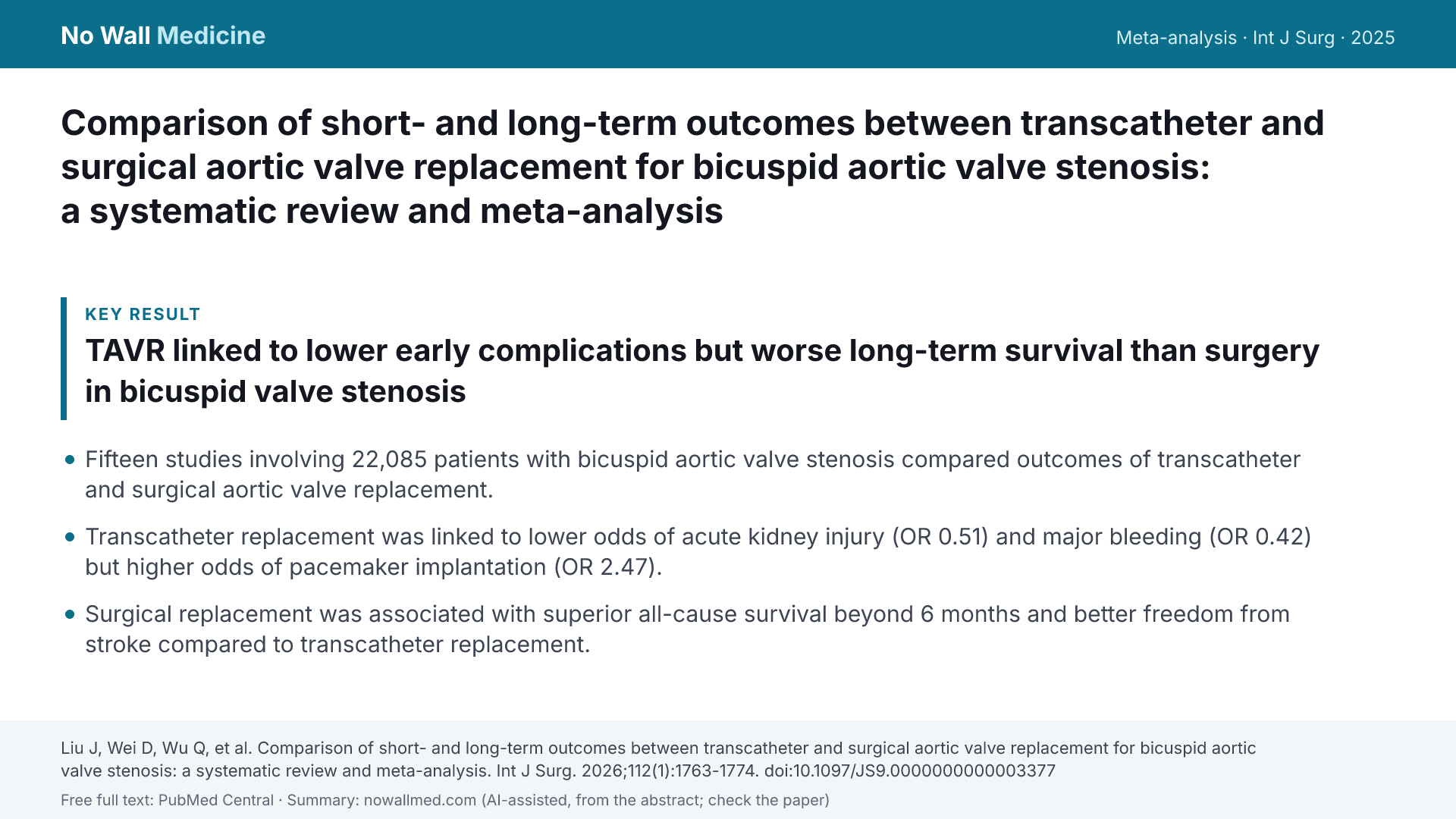
- Researchers analyzed 15 studies involving 22,085 patients to compare transcatheter aortic valve replacement (TAVR) and surgical aortic valve replacement (SAVR) for bicuspid aortic valve stenosis.
- TAVR was associated with lower risks of acute kidney injury (OR: 0.51) and major bleeding (OR: 0.42), but higher risks of permanent pacemaker implantation (OR: 2.47) and paravalvular leak (OR: 4.39).
- SAVR was associated with better all-cause survival beyond 6 months and better freedom from stroke compared to TAVR.
Headline and key points written with AI from the paper’s abstract, with every number checked against it. Read the paper before relying on them.
Was this summary helpful?
Subject terms
Cite this article
Liu J, Wei D, Wu Q, et al. Comparison of short- and long-term outcomes between transcatheter and surgical aortic valve replacement for bicuspid aortic valve stenosis: a systematic review and meta-analysis. Int J Surg. 2025. doi:10.1097/JS9.0000000000003377
Spotted a mistake? Suggest a correction