Comparison of short- and long-term outcomes between transcatheter and surgical aortic valve replacement for bicuspid aortic valve stenosis: a systematic review and meta-analysis
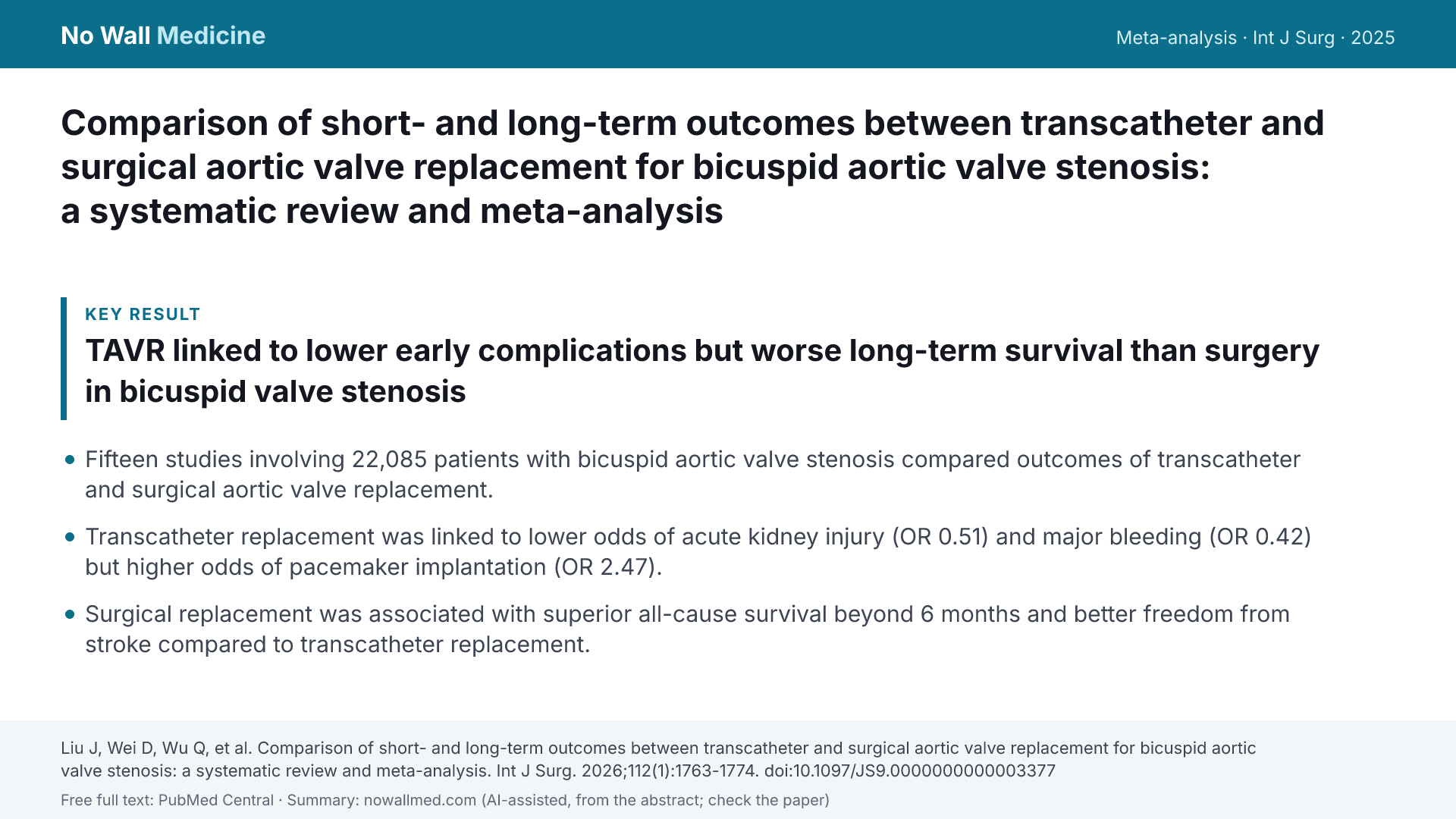
Key result: TAVR linked to lower early complications but worse long-term survival than surgery in bicuspid valve stenosis
Key points
- Fifteen studies involving 22,085 patients with bicuspid aortic valve stenosis compared outcomes of transcatheter and surgical aortic valve replacement.
- Transcatheter replacement was linked to lower odds of acute kidney injury (OR 0.51) and major bleeding (OR 0.42) but higher odds of pacemaker implantation (OR 2.47).
- Surgical replacement was associated with superior all-cause survival beyond 6 months and better freedom from stroke compared to transcatheter replacement.
Why it matters: Applies to patients with bicuspid aortic valve stenosis; highlights trade-offs between early procedural risks and long-term durability for treatment selection.
Limitation the authors note: The certainty of evidence was low for several key outcomes due to study limitations.
Discussion prompts
- Would these patients look like yours? Who was left out?
- Is the main outcome one that matters to patients?
- Is the difference large enough to change what you do?
Cite: Liu J, Wei D, Wu Q, et al. Comparison of short- and long-term outcomes between transcatheter and surgical aortic valve replacement for bicuspid aortic valve stenosis: a systematic review and meta-analysis. Int J Surg. 2026;112(1):1763-1774. doi:10.1097/JS9.0000000000003377
Free full text: PubMed Central · Summary and visual abstract: nowallmed.com/a/comparison-of-short-and-long-term-outcomes-between-transcatheter-and-1d809d4/ (AI-assisted from the abstract; check the paper before relying on it).