Comparison of the Working Alliance in Blended Cognitive Behavioral Therapy and Treatment as Usual for Depression in Europe: Secondary Data Analysis of the E-COMPARED Randomized Controlled Trial
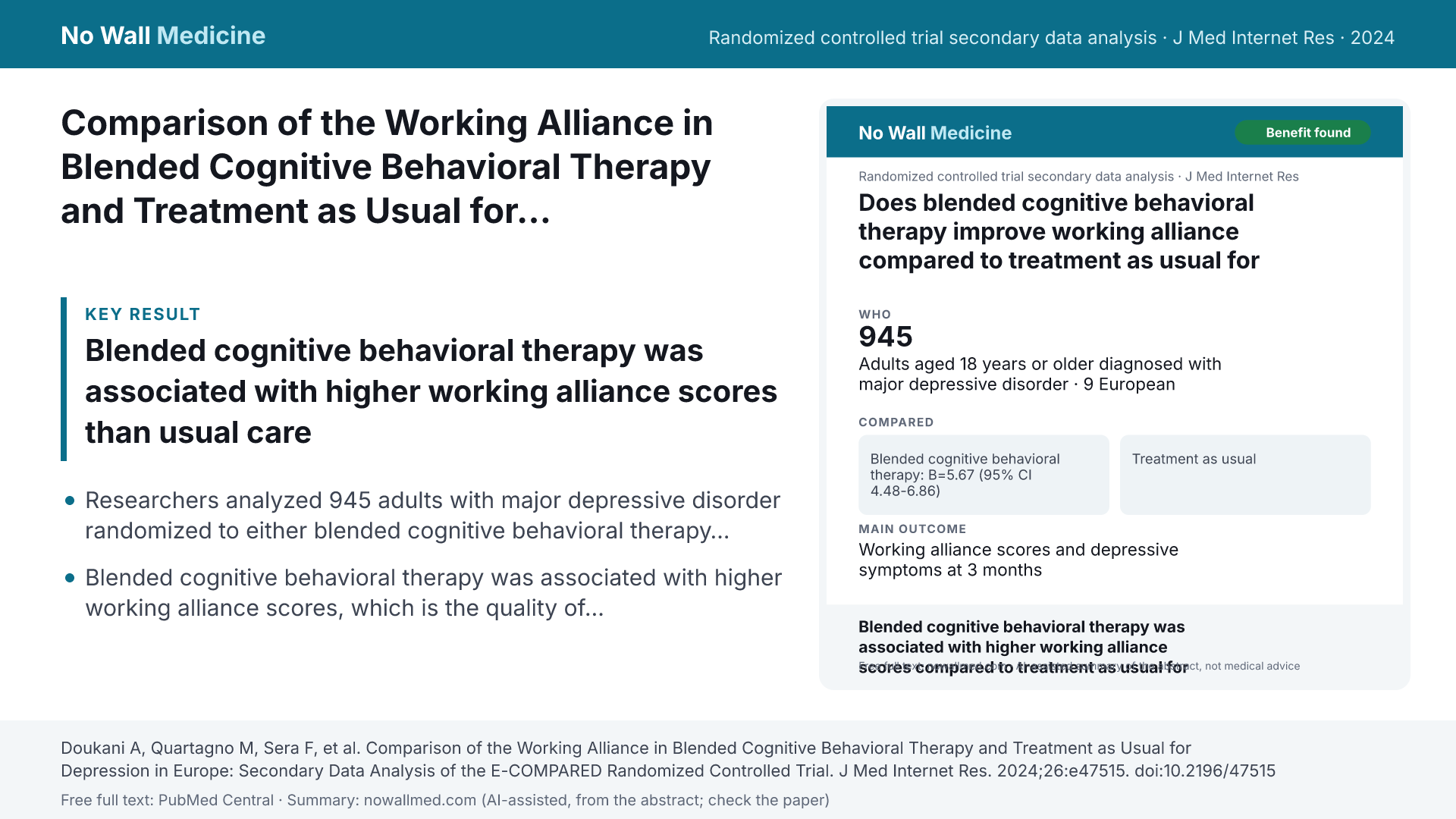
Key result: Blended cognitive behavioral therapy was associated with higher working alliance scores than usual care
Randomized controlled trial secondary data analysisBenefit found
Does blended cognitive behavioral therapy improve working alliance compared to treatment as usual for depression?
Who
945
Adults aged 18 years or older diagnosed with major depressive disorder · 9 European countries in primary care and specialized services
Compared
Blended cognitive behavioral therapy: B=5.67 (95% CI 4.48-6.86)
Treatment as usual
Main outcome
Working alliance scores and depressive symptoms at 3 months
Result: B=5.67, 95% CI 4.48-6.86
Bottom line: Blended cognitive behavioral therapy was associated with higher working alliance scores compared to treatment as usual for depression.
J Med Internet Res · 2024-05-31
Key points
- Researchers analyzed 945 adults with major depressive disorder randomized to either blended cognitive behavioral therapy or treatment as usual.
- Blended cognitive behavioral therapy was associated with higher working alliance scores, which is the quality of the relationship between patient and therapist, compared to usual care (B=5.67, 95% CI 4.48-6.86).
- Higher working alliance scores were associated with lower depression scores in both groups, and this association was stronger in the blended group when digital program usability was high.
Discussion prompts
- Would these patients look like yours? Who was left out?
- Is the main outcome one that matters to patients?
- Is the difference large enough to change what you do?
Cite: Doukani A, Quartagno M, Sera F, et al. Comparison of the Working Alliance in Blended Cognitive Behavioral Therapy and Treatment as Usual for Depression in Europe: Secondary Data Analysis of the E-COMPARED Randomized Controlled Trial. J Med Internet Res. 2024;26:e47515. doi:10.2196/47515
Free full text: PubMed Central · Summary and visual abstract: nowallmed.com/a/comparison-of-the-working-alliance-in-blended-cognitive-behavioral-oxo6fh/ (AI-assisted from the abstract; check the paper before relying on it).