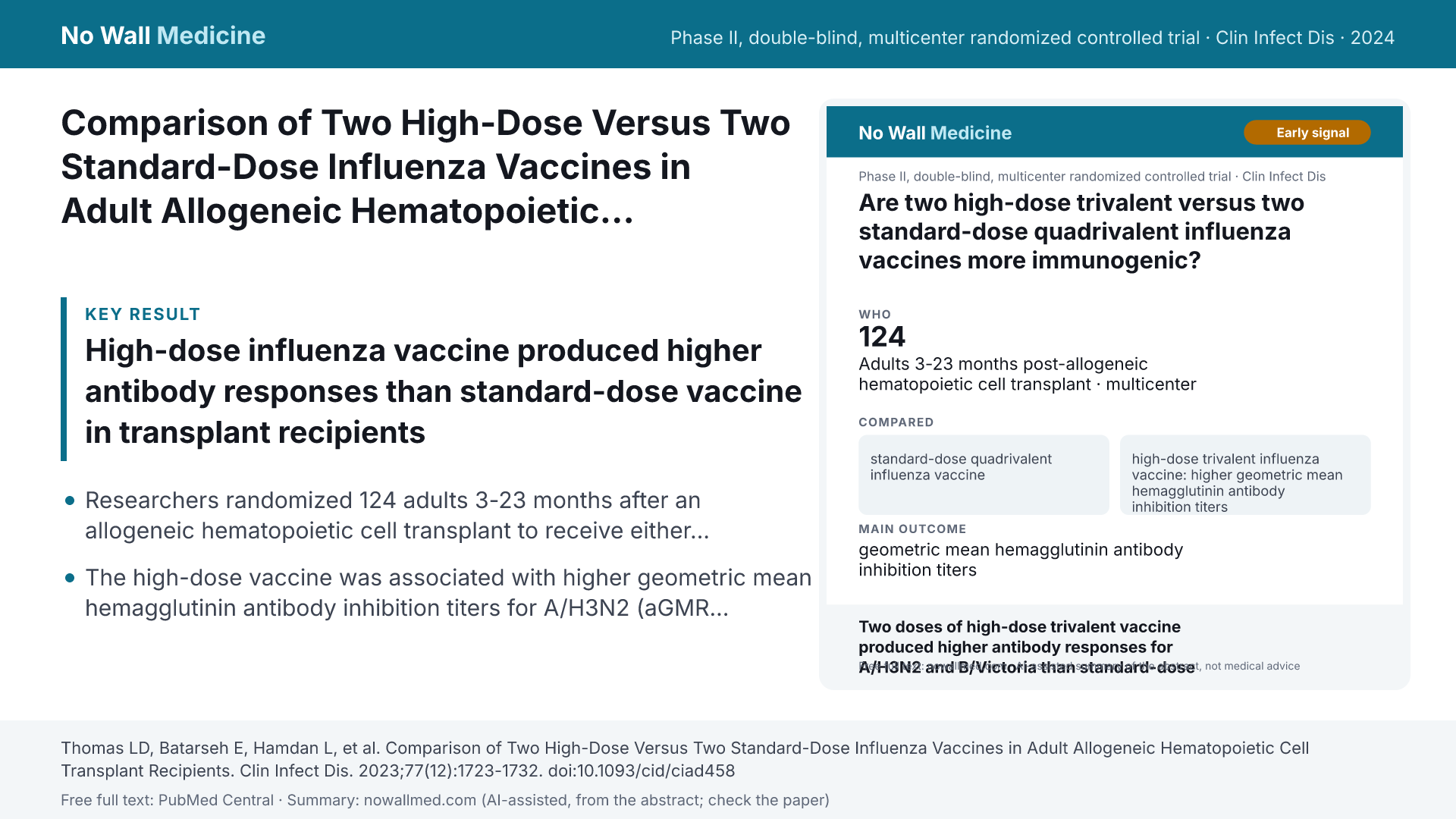
Comparison of Two High-Dose Versus Two Standard-Dose Influenza Vaccines in Adult Allogeneic Hematopoietic Cell Transplant Recipients
Key result: High-dose influenza vaccine produced higher antibody responses than standard-dose vaccine in transplant recipients
Key points
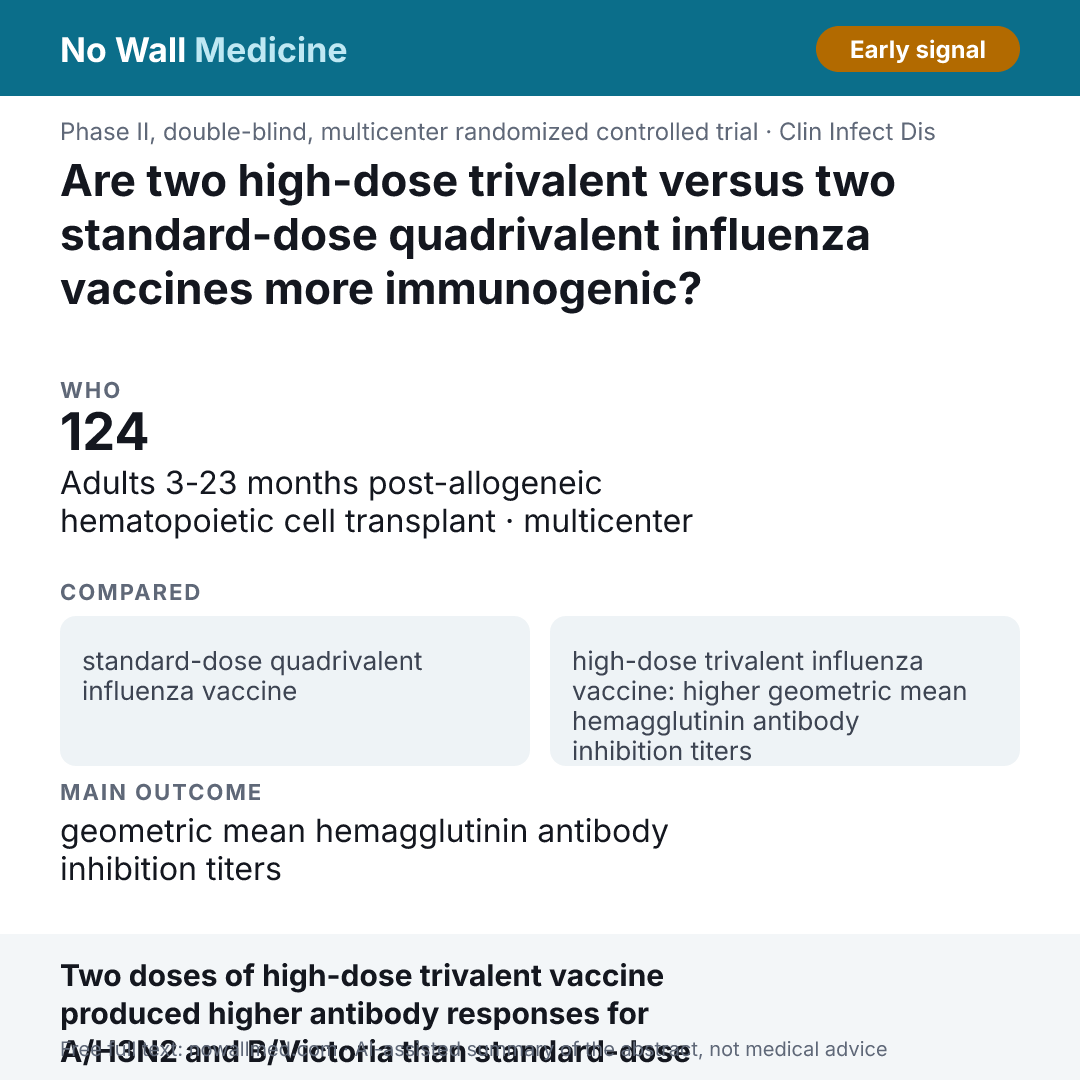
- Researchers randomized 124 adults 3-23 months after an allogeneic hematopoietic cell transplant to receive either two doses of high-dose trivalent or two doses of standard-dose quadrivalent influenza vaccine.
- The high-dose vaccine was associated with higher geometric mean hemagglutinin antibody inhibition titers for A/H3N2 (aGMR = 2.09; 95% CI: [1.19, 3.68]) and B/Victoria (aGMR = 1.61; 95% CI: [1.00, 2.58]).
- The increase in antibody titers for A/H1N1 was not statistically significant (aGMR = 1.16; 95% CI: [0.67, 2.02]), and injection-site reactions showed a trend of 50% for high-dose versus 33% for standard-dose.
Why it matters: Adults receiving allogeneic hematopoietic cell transplants have suboptimal immune responses to influenza vaccines, particularly within 2 years of their transplant.
Discussion prompts
- Would these patients look like yours? Who was left out?
- Is the main outcome one that matters to patients?
- Is the difference large enough to change what you do?
Cite: Thomas LD, Batarseh E, Hamdan L, et al. Comparison of Two High-Dose Versus Two Standard-Dose Influenza Vaccines in Adult Allogeneic Hematopoietic Cell Transplant Recipients. Clin Infect Dis. 2023;77(12):1723-1732. doi:10.1093/cid/ciad458
Free full text: PubMed Central · Summary and visual abstract: nowallmed.com/a/comparison-of-two-high-dose-versus-two-standard-dose-influenza-1hfjta5/ (AI-assisted from the abstract; check the paper before relying on it).