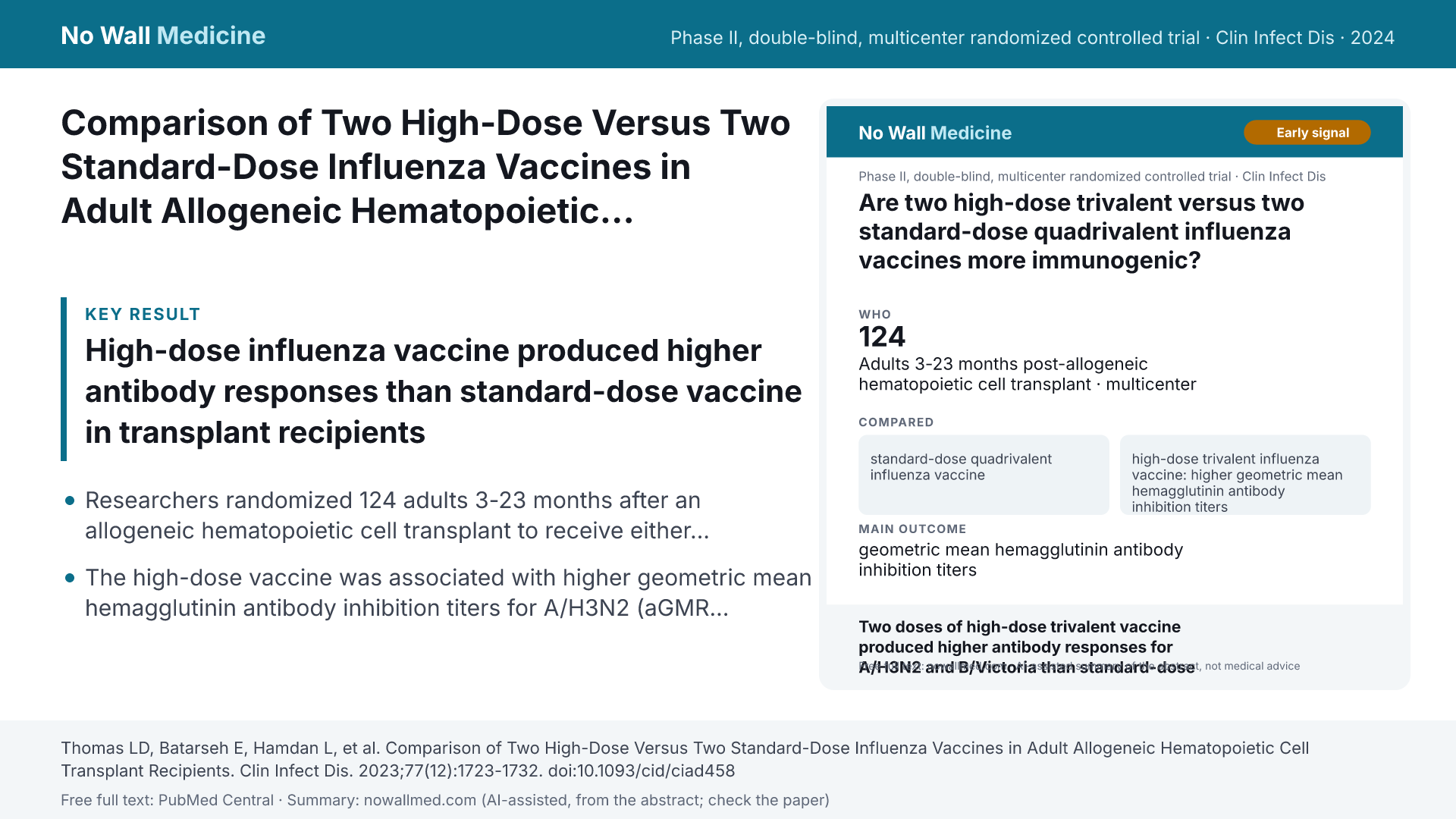
High-dose influenza vaccine produced higher antibody responses than standard-dose vaccine in transplant recipients
Comparison of Two High-Dose Versus Two Standard-Dose Influenza Vaccines in Adult Allogeneic Hematopoietic Cell Transplant Recipients
Phase II, double-blind, multicenter randomized controlled trialBenefit found
Are two high-dose trivalent versus two standard-dose quadrivalent influenza vaccines more immunogenic?
Who
124
Adults 3-23 months post-allogeneic hematopoietic cell transplant · multicenter
Compared
standard-dose quadrivalent influenza vaccine
high-dose trivalent influenza vaccine: higher geometric mean hemagglutinin antibody inhibition titers
Main outcome
geometric mean hemagglutinin antibody inhibition titers
Result: aGMR 2.09 (95% CI 1.19 to 3.68) for A/H3N2
Bottom line: Two doses of high-dose trivalent vaccine produced higher antibody responses for A/H3N2 and B/Victoria than standard-dose quadrivalent vaccine.
Clin Infect Dis · 2024-09-02Download image
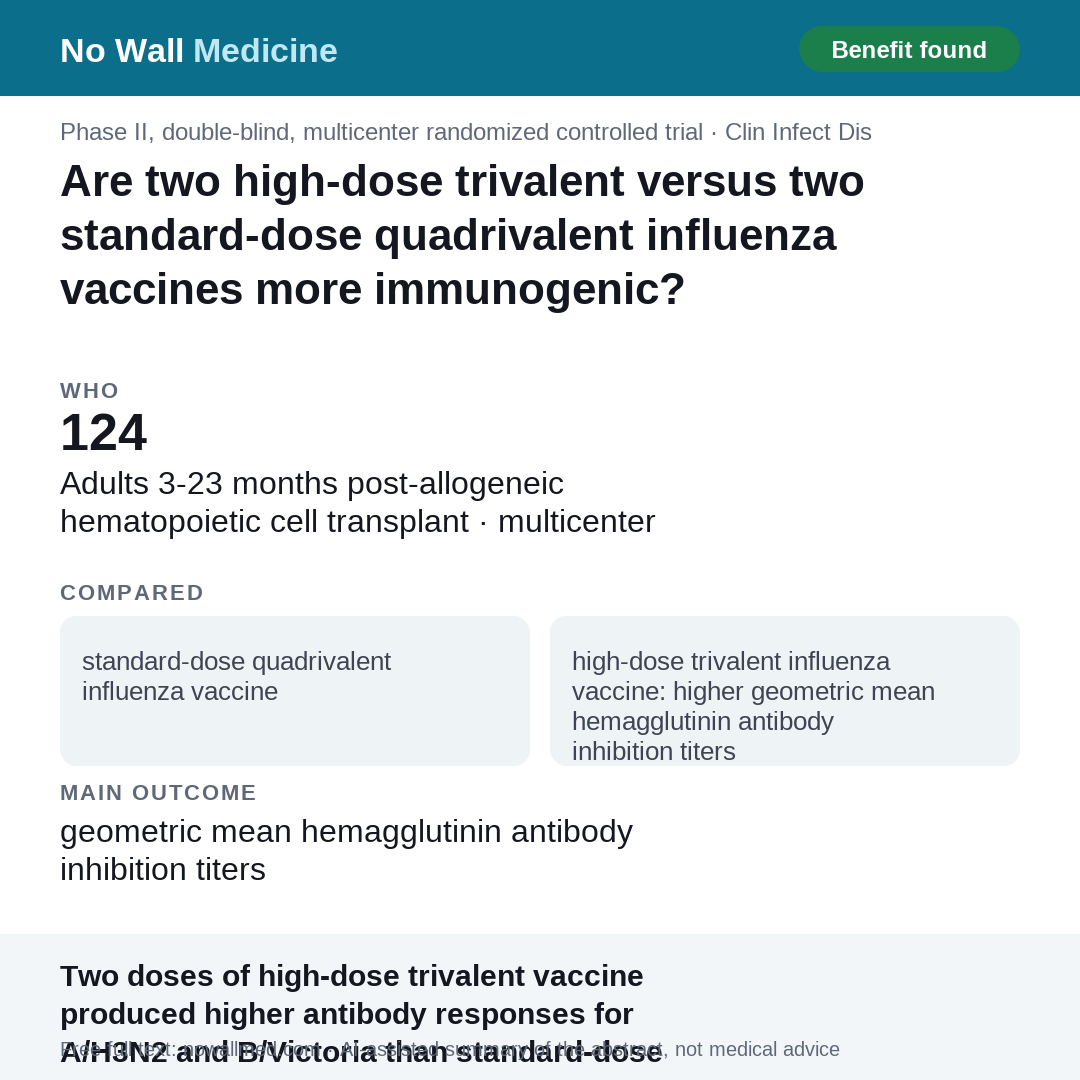
Clinical question: Are two high-dose trivalent versus two standard-dose quadrivalent influenza vaccines more immunogenic?
Why it matters: Adults receiving allogeneic hematopoietic cell transplants have suboptimal immune responses to influenza vaccines, particularly within 2 years of their transplant.
Key points
- Researchers randomized 124 adults 3-23 months after an allogeneic hematopoietic cell transplant to receive either two doses of high-dose trivalent or two doses of standard-dose quadrivalent influenza vaccine.
- The high-dose vaccine was associated with higher geometric mean hemagglutinin antibody inhibition titers for A/H3N2 (aGMR = 2.09; 95% CI: [1.19, 3.68]) and B/Victoria (aGMR = 1.61; 95% CI: [1.00, 2.58]).
- The increase in antibody titers for A/H1N1 was not statistically significant (aGMR = 1.16; 95% CI: [0.67, 2.02]), and injection-site reactions showed a trend of 50% for high-dose versus 33% for standard-dose.
Headline and key points written with AI from the paper’s abstract, with every number checked against it. Read the paper before relying on them.
Was this summary helpful?
Subject terms
Cite this article
Thomas LD, Batarseh E, Hamdan L, Haddadin Z, Dulek D, Kalams S. Comparison of Two High-Dose Versus Two Standard-Dose Influenza Vaccines in Adult Allogeneic Hematopoietic Cell Transplant Recipients. Clin Infect Dis. 2024. doi:10.1093/cid/ciad458
Spotted a mistake? Suggest a correction