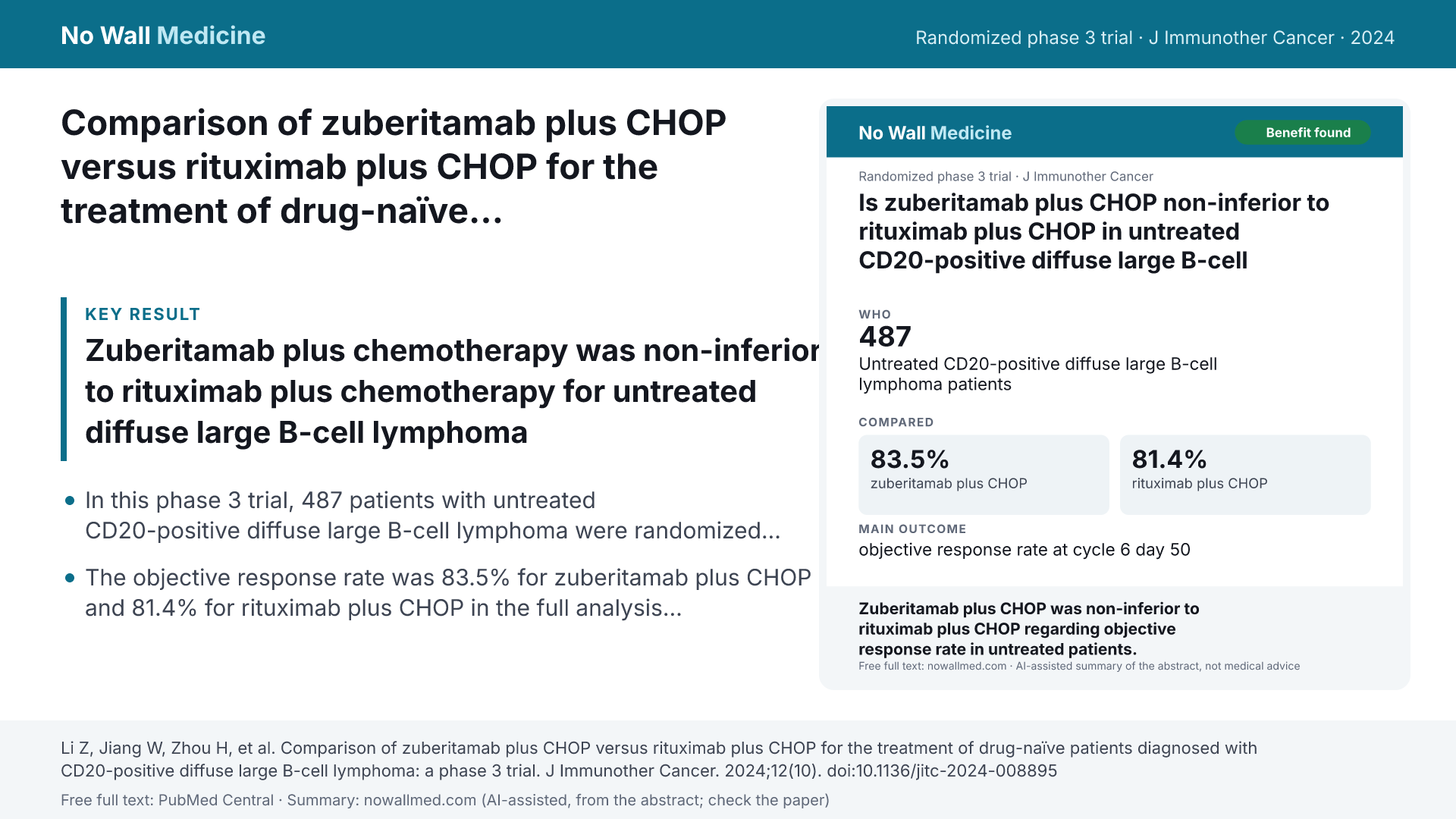
Zuberitamab plus chemotherapy was non-inferior to rituximab plus chemotherapy for untreated diffuse large B-cell lymphoma
Comparison of zuberitamab plus CHOP versus rituximab plus CHOP for the treatment of drug-naïve patients diagnosed with CD20-positive diffuse large B-cell lymphoma: a phase 3 trial
Randomized phase 3 trialBenefit found
Is zuberitamab plus CHOP non-inferior to rituximab plus CHOP in untreated CD20-positive diffuse large B-cell lymphoma?
Who
487
Untreated CD20-positive diffuse large B-cell lymphoma patients
Compared
83.5%zuberitamab plus CHOP
81.4%rituximab plus CHOP
Main outcome
objective response rate at cycle 6 day 50
Result: intergroup differences -5.2% and -3.3% (95% CI)
Bottom line: Zuberitamab plus CHOP was non-inferior to rituximab plus CHOP regarding objective response rate in untreated patients.
J Immunother Cancer · 2024-10-24Download image
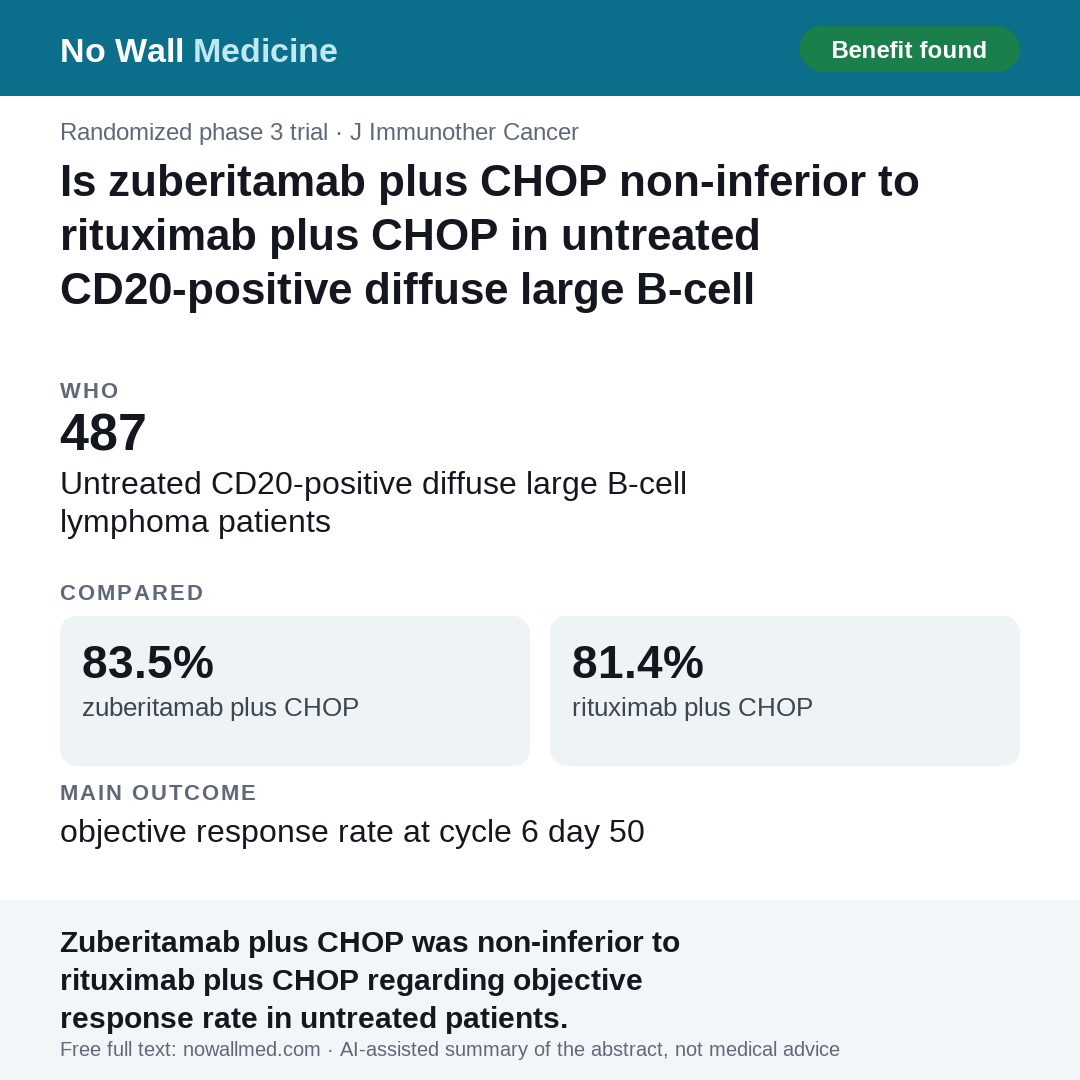
Clinical question: Is zuberitamab plus CHOP non-inferior to rituximab plus CHOP in untreated CD20-positive diffuse large B-cell lymphoma?
Why it matters: It was unknown if zuberitamab combined with chemotherapy is a non-inferior alternative to rituximab combined with chemotherapy for patients with untreated CD20-positive diffuse large B-cell lymphoma.
Key points
- In this phase 3 trial, 487 patients with untreated CD20-positive diffuse large B-cell lymphoma were randomized to receive either zuberitamab plus CHOP or rituximab plus CHOP.
- The objective response rate was 83.5% for zuberitamab plus CHOP and 81.4% for rituximab plus CHOP in the full analysis set, confirming non-inferiority.
- Infusion-related responses occurred more frequently in the zuberitamab group at 32.1% compared to 19.9% in the rituximab group.
Headline and key points written with AI from the paper’s abstract, with every number checked against it. Read the paper before relying on them.
Was this summary helpful?
Abstract
Background
In patients with untreated CD20-positive diffuse large B-cell lymphoma (DLBCL), a phase 3 trial was carried out to evaluate the efficacy and safety of zuberitamab plus CHOP (cyclophosphamide, doxorubicin, vincristine, and prednisone; Hi-CHOP) versus rituximab plus CHOP (R-CHOP) treatment regimens. Methods
In a 2:1 ratio, eligible patients were assigned randomly to receive treatment of six cycles of either 375 mg/m2 zuberitamab or rituximab together with conventional CHOP chemotherapy. The objective response rate (ORR) at C6D50 served as the primary endpoint, and a non-inferiority margin of 10% was established. The secondary endpoints included the complete response (CR) rate at C6D50, duration of response (DOR), progression-free survival (PFS) and event-free survival (EFS) judged by blinded-independent review committee (BIRC), overall survival (OS) and safety outcomes. Results
Of the 487 randomized patients, 423 patients including 287 in the Hi-CHOP and 136 in the R-CHOP groups completed the C6D50 assessment. For the full analysis set (FAS) and per-protocol set (PPS), BIRC-assessed ORR at C6D50 for the Hi-CHOP and R-CHOP groups were 83.5% versus 81.4% and 95.3% versus 93.7%, respectively. The non-inferiority was confirmed as the lower limit of the two-sided 95% CI for the intergroup differences of -5.2% and -3.3%; both were >-10% in the FAS and PPS. The BIRC-assessed CR rate of Hi-CHOP was significantly higher in PPS (85.7% vs 77.3%, p=0.038), but comparable in FAS (75.2% vs 67.9%, p=0.092). After a median follow-up of 29.6 months, patients in the Hi-CHOP group had a slight advantage with regard to the DOR (HR 0.74, p=0.173), PFS (HR 0.67, p=0.057), EFS (HR 0.90, p=0.517) and OS (HR 0.60, p=0.059). Patients with the germinal-center B cell-like subtype who received Hi-CHOP exhibited statistically significant improvements in ORR (p=0.034) and CR rate (p=0.038) at C6D50, EFS (p=0.046) and OS (p=0.014). Treatment-emergent adverse event occurrence rates were comparable across groups (all p>0.05). Infusion-related responses occurred more often in the Hi-CHOP group (32.1% vs 19.9%, p=0.006), all of grade 1-3 severity. Conclusions
Zuberitamab (375 mg/m2) plus CHOP was non-inferior to R-CHOP regarding ORR but exhibited a higher CR rate and was well tolerated in CD20-positive, previously untreated Chinese patients with DLBCL. Trial registration number
Chinese Clinical Trial Registry, ChiCTR2000040602, retrospectively registered.
Abstract reproduced under the article’s CC BY NC licence.
Subject terms
Cite this article
Li Z, Jiang W, Zhou H, et al. Comparison of zuberitamab plus CHOP versus rituximab plus CHOP for the treatment of drug-naïve patients diagnosed with CD20-positive diffuse large B-cell lymphoma: a phase 3 trial. J Immunother Cancer. 2024. doi:10.1136/jitc-2024-008895
Spotted a mistake? Suggest a correction