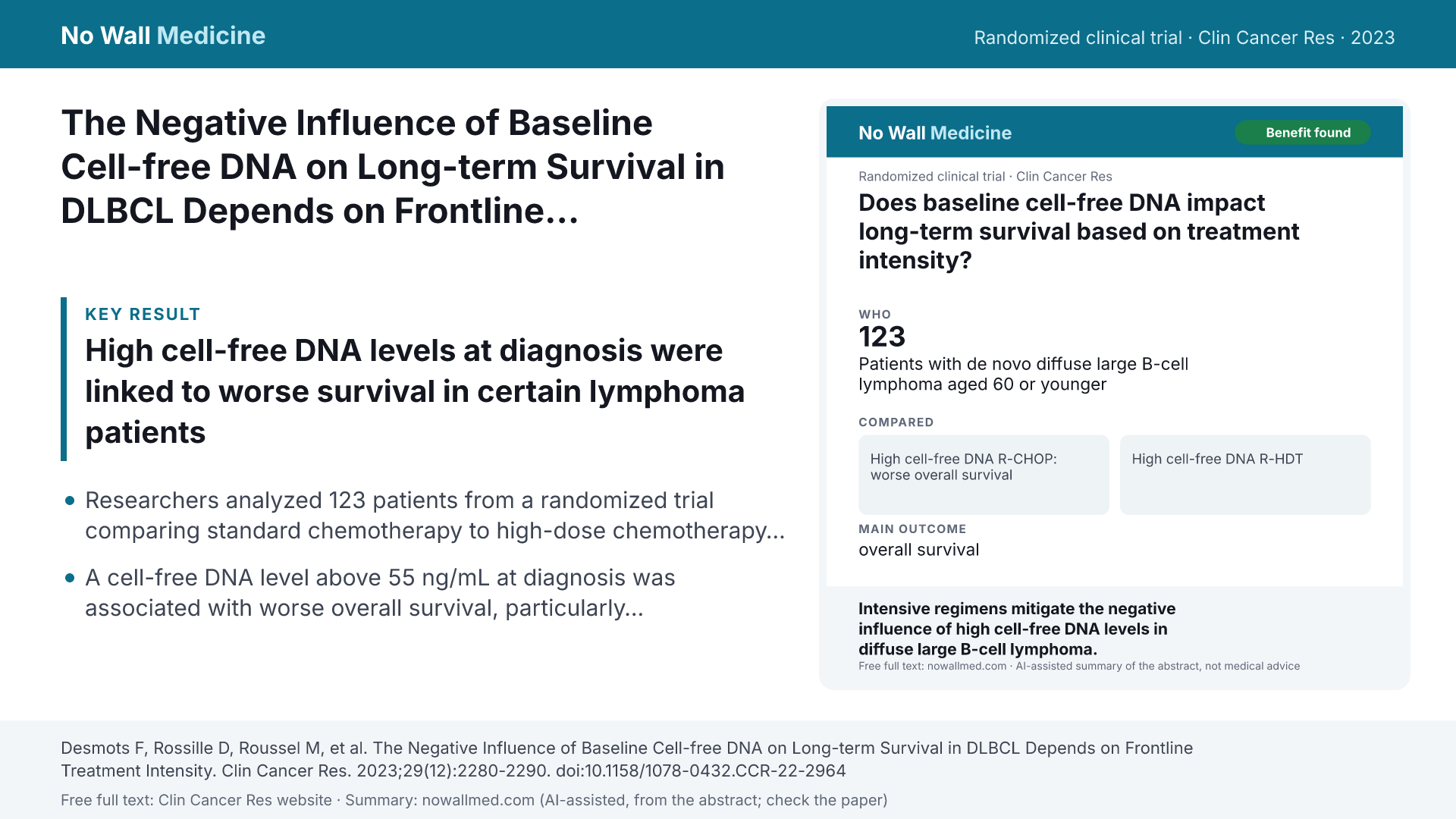
High cell-free DNA levels at diagnosis were linked to worse survival in certain lymphoma patients
The Negative Influence of Baseline Cell-free DNA on Long-term Survival in DLBCL Depends on Frontline Treatment Intensity
Randomized clinical trialBenefit found
Does baseline cell-free DNA impact long-term survival based on treatment intensity?
Who
123
Patients with de novo diffuse large B-cell lymphoma aged 60 or younger
Compared
High cell-free DNA R-CHOP: worse overall survival
High cell-free DNA R-HDT
Main outcome
overall survival
Result: hazard ratio 3.99 (95% confidence interval, 1.98-10.74)
Bottom line: Intensive regimens mitigate the negative influence of high cell-free DNA levels in diffuse large B-cell lymphoma.
Clin Cancer Res · 2023-04-05Download image
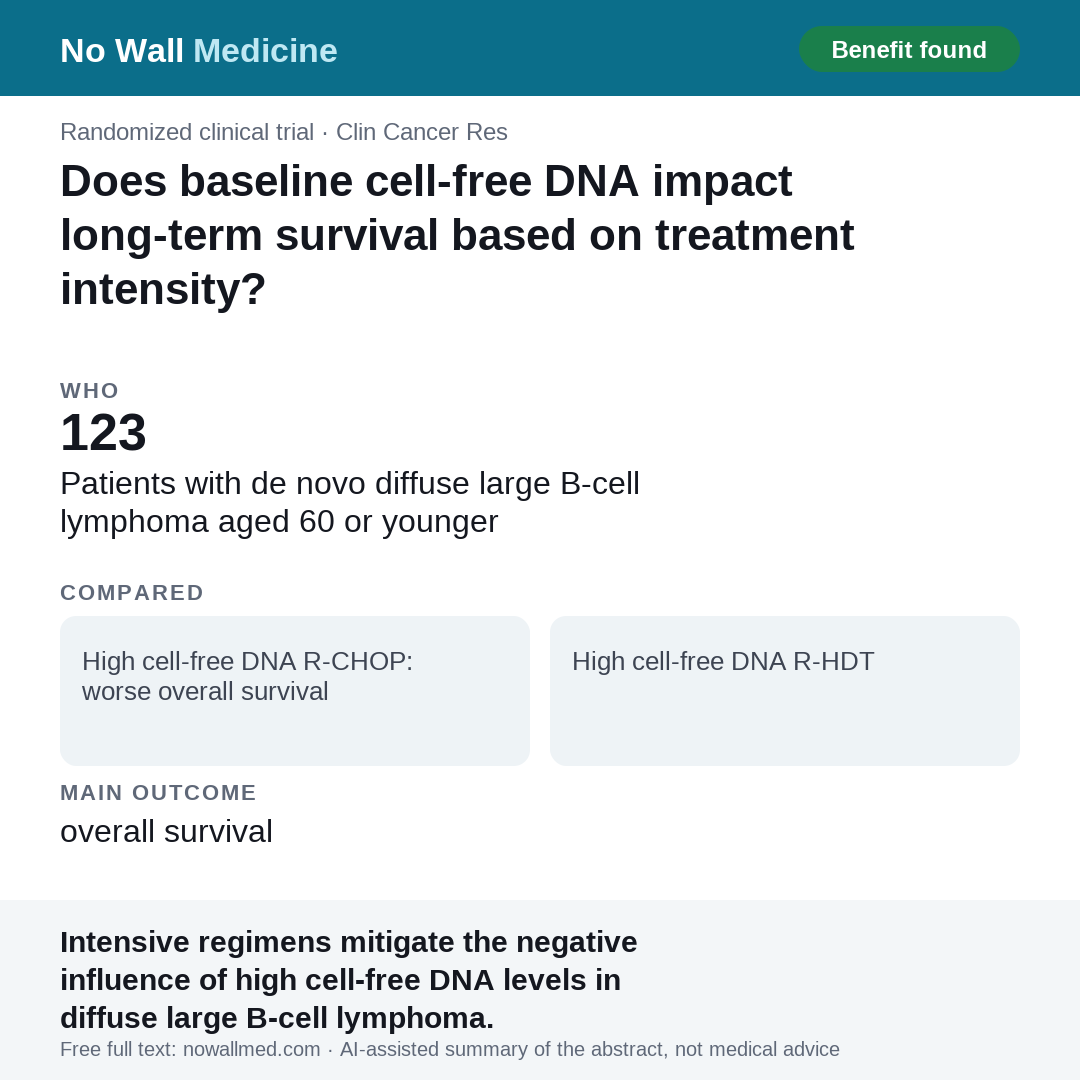
Clinical question: Does baseline cell-free DNA impact long-term survival based on treatment intensity?
Why it matters: It was unknown if the impact of baseline cell-free DNA levels on long-term survival in diffuse large B-cell lymphoma depends on the intensity of initial treatment.
Key points
- Researchers analyzed 123 patients from a randomized trial comparing standard chemotherapy to high-dose chemotherapy plus stem cell transplantation for diffuse large B-cell lymphoma.
- A cell-free DNA level above 55 ng/mL at diagnosis was associated with worse overall survival, particularly in patients receiving the standard R-CHOP chemotherapy regimen.
- In the R-CHOP group, patients with high cell-free DNA had a hazard ratio for death of 3.99 (95% confidence interval, 1.98-10.74).
Headline and key points written with AI from the paper’s abstract, with every number checked against it. Read the paper before relying on them.
Was this summary helpful?
Subject terms
Cite this article
Desmots F, Rossille D, Roussel M, et al. The Negative Influence of Baseline Cell-free DNA on Long-term Survival in DLBCL Depends on Frontline Treatment Intensity. Clin Cancer Res. 2023. doi:10.1158/1078-0432.CCR-22-2964
Spotted a mistake? Suggest a correction