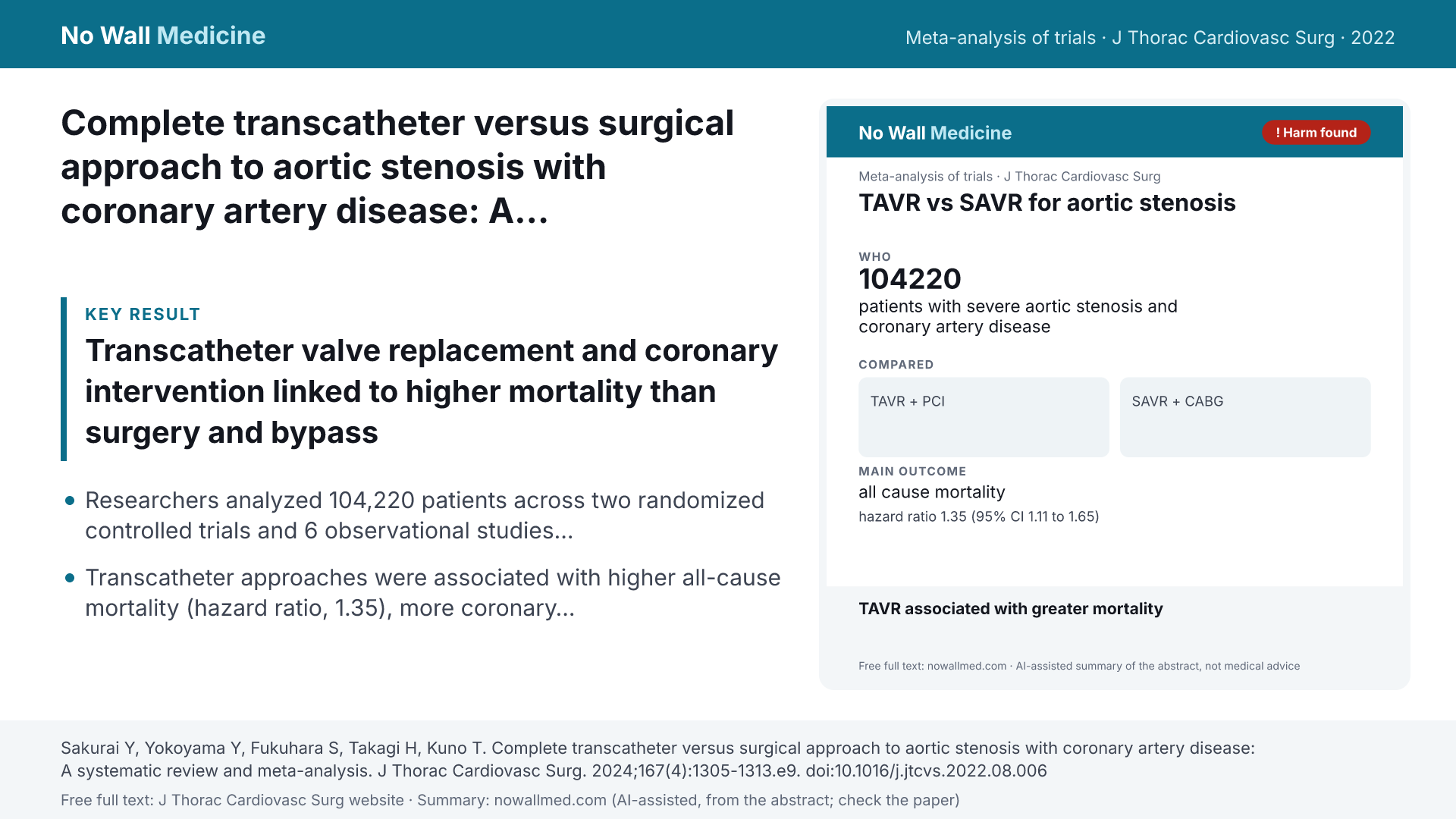
Transcatheter valve replacement and coronary intervention linked to higher mortality than surgery and bypass
Complete transcatheter versus surgical approach to aortic stenosis with coronary artery disease: A systematic review and meta-analysis
Meta-analysis of trialsHarm found
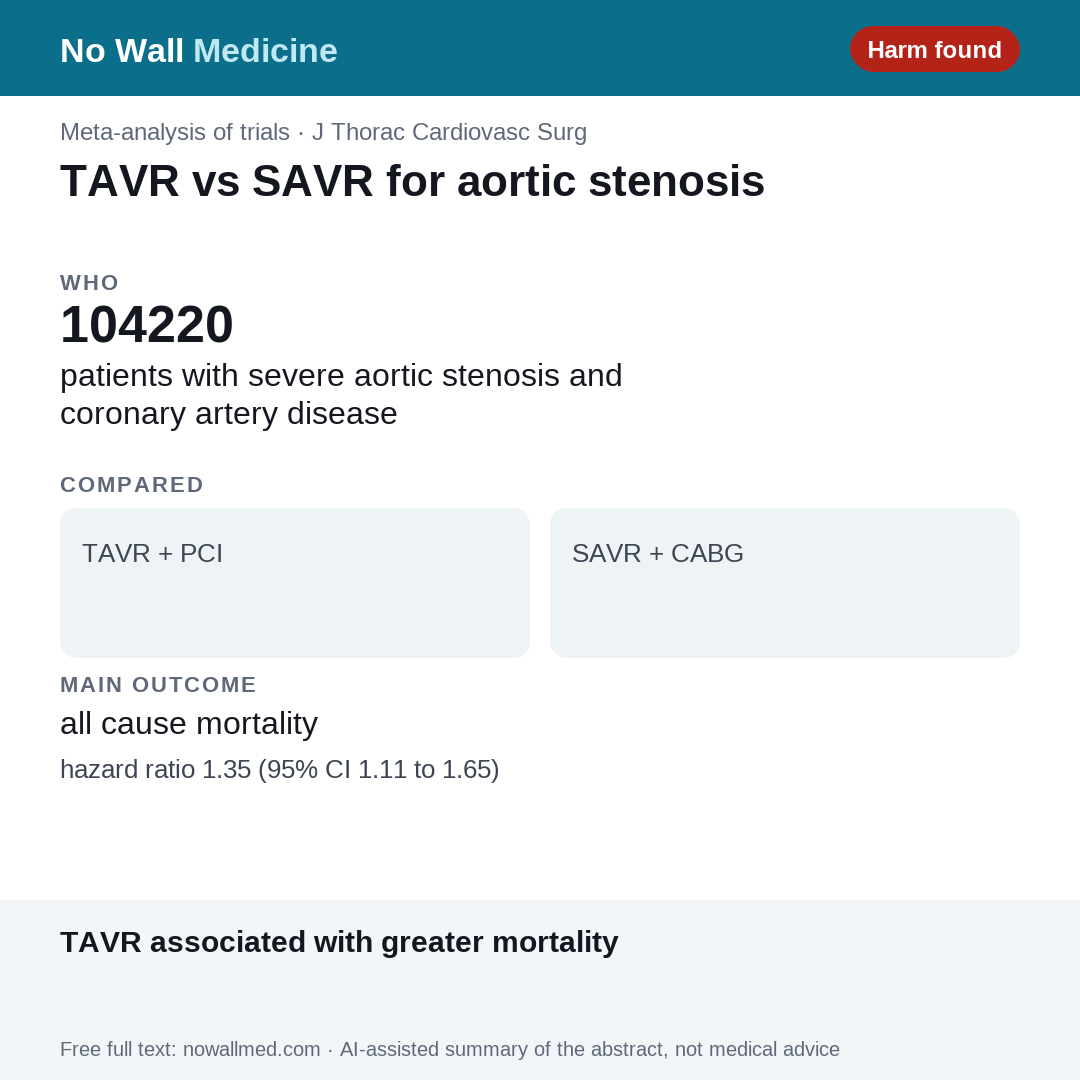
TAVR vs SAVR for aortic stenosis
Who
104220
patients with severe aortic stenosis and coronary artery disease
Compared
TAVR + PCI
SAVR + CABG
Main outcome
all cause mortality
Result: hazard ratio 1.35 (95% CI 1.11 to 1.65)
Bottom line: TAVR associated with greater mortality
J Thorac Cardiovasc Surg · 2022-08-18Download image
Why it matters: It is unknown whether a complete transcatheter approach is as safe as a surgical approach for patients with both severe aortic stenosis and coronary artery disease.
Key points
- Researchers analyzed 104,220 patients across two randomized controlled trials and 6 observational studies comparing transcatheter aortic valve replacement plus percutaneous coronary intervention to surgical aortic valve replacement plus coronary artery bypass grafting.
- Transcatheter approaches were associated with higher all-cause mortality (hazard ratio, 1.35), more coronary reinterventions (hazard ratio, 4.14), higher 30-day permanent pacemaker implantation (odds ratio, 3.79), and more vascular complications (odds ratio, 6.97).
- The transcatheter approach was associated with a lower rate of 30-day acute kidney injury (odds ratio, 0.32), while rehospitalization, heart attack, and stroke rates were similar between groups.
Headline and key points written with AI from the paper’s abstract, with every number checked against it. Read the paper before relying on them.
Was this summary helpful?
Subject terms
Cite this article
Sakurai Y, Yokoyama Y, Fukuhara S, Takagi H, Kuno T. Complete transcatheter versus surgical approach to aortic stenosis with coronary artery disease: A systematic review and meta-analysis. J Thorac Cardiovasc Surg. 2022. doi:10.1016/j.jtcvs.2022.08.006
Spotted a mistake? Suggest a correction