Cognitive restructuring and in-person delivery are linked to better insomnia treatment remission
Components and Delivery Formats of Cognitive Behavioral Therapy for Chronic Insomnia in Adults: A Systematic Review and Component Network Meta-Analysis
Meta-analysis of 241 trialsBenefit found
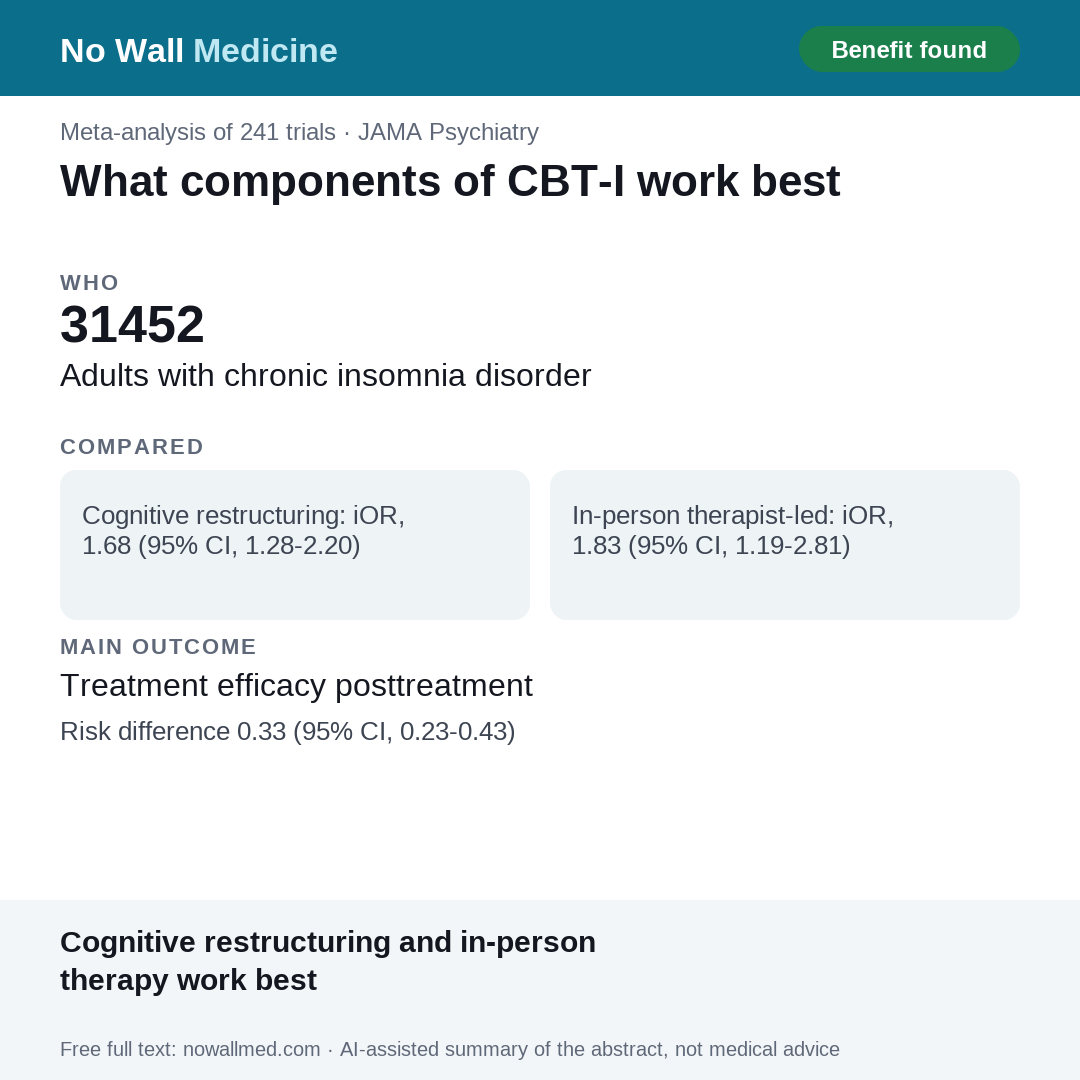
What components of CBT-I work best
Who
31452
Adults with chronic insomnia disorder
Compared
Cognitive restructuring: iOR, 1.68 (95% CI, 1.28-2.20)
In-person therapist-led: iOR, 1.83 (95% CI, 1.19-2.81)
Main outcome
Treatment efficacy posttreatment
Result: Risk difference 0.33 (95% CI, 0.23-0.43)
Bottom line: Cognitive restructuring and in-person therapy work best
Limitation: Potential undetected interactions
JAMA Psychiatry · 2024-01-17Download image
Why it matters: The specific effects of individual components and different delivery methods within cognitive behavioral therapy for insomnia remain unclear.
Key points
- Researchers analyzed 241 randomized clinical trials involving 31,452 participants to evaluate different parts of cognitive behavioral therapy for insomnia.
- Cognitive restructuring (iOR, 1.68), third-wave components (iOR, 1.49), sleep restriction (iOR, 1.49), and stimulus control (iOR, 1.43) were associated with treatment remission.
- In-person therapist-led programs were associated with the highest benefit (iOR, 1.83), while sleep hygiene education (iOR, 1.01) was not essential.
Limitation the authors note: The authors state that potential undetected interactions between components could undermine the conclusions.
Headline and key points written with AI from the paper’s abstract, with every number checked against it. Read the paper before relying on them.
Was this summary helpful?
Subject terms
Cite this article
Furukawa Y, Sakata M, Yamamoto R, Nakajima S, Kikuchi S, Inoue M. Components and Delivery Formats of Cognitive Behavioral Therapy for Chronic Insomnia in Adults: A Systematic Review and Component Network Meta-Analysis. JAMA Psychiatry. 2024. doi:10.1001/jamapsychiatry.2023.5060
Spotted a mistake? Suggest a correction
Top studies every Monday
The week’s key trials and guidelines in your specialties, plus any topics you follow. By email, free.
Get the weekly digest