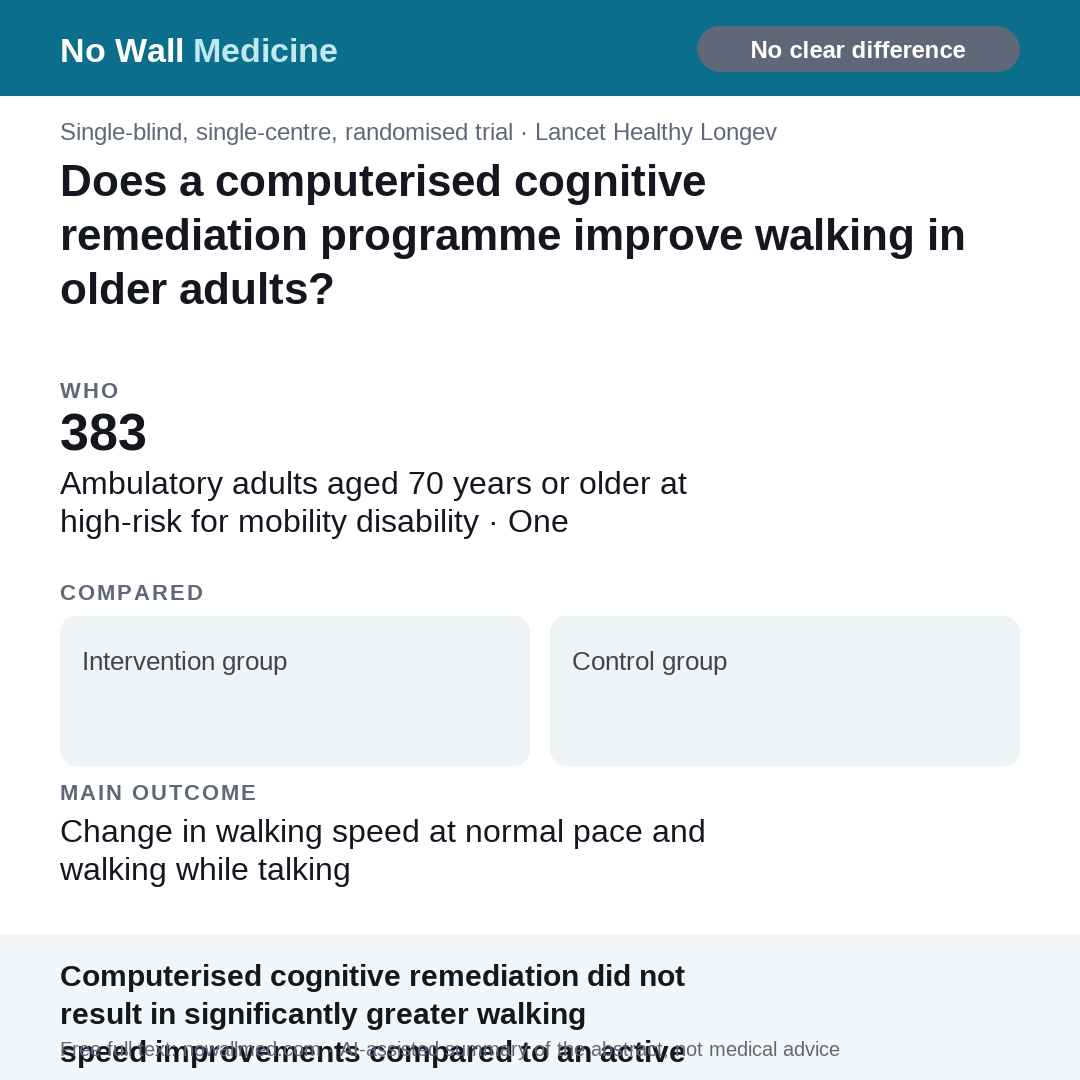
Computerised cognitive remediation did not result in greater walking speed improvements than an active control
Computerised cognitive remediation to enhance mobility in older adults: a single-blind, single-centre, randomised trial
Single-blind, single-centre, randomised trialNo clear difference
Does a computerised cognitive remediation programme improve walking in older adults?
Who
383
Ambulatory adults aged 70 years or older at high-risk for mobility disability · One academic centre in the USA
Compared
Intervention group
Control group
Main outcome
Change in walking speed at normal pace and walking while talking
Result: no significant difference in normal walking speed (-1·03 cm/s [SD 1·30]; 95% CI -3·60 to 1·54)
Bottom line: Computerised cognitive remediation did not result in significantly greater walking speed improvements compared to an active control.
Limitation: The trial was terminated due to the COVID-19 pandemic.
Funded by: National Institute on Aging
Lancet Healthy Longev · 2021-09-02Download image
Clinical question: Does a computerised cognitive remediation programme improve walking in older adults?
Why it matters: It was unknown if a computerised cognitive remediation programme could improve walking in adults aged 70 years or older at high risk for mobility disability.
Key points
- Researchers studied 372 older adults aged 77.0 years who were at high risk for mobility disability.
- The 8-week computerised programme showed no significant difference in normal walking speed (-1.03 cm/s) or walking while talking (0.59 cm/s) compared to the control group.
- While both groups showed within-group improvements in walking, executive function, and physical function, the intervention group did not outperform the control group.
Limitation the authors note: The trial was terminated early due to the COVID-19 pandemic.
Headline and key points written with AI from the paper’s abstract, with every number checked against it. Read the paper before relying on them.
Was this summary helpful?
Subject terms
Cite this article
Verghese J, Mahoney JR, Ayers E, Ambrose A, Wang C, Holtzer R. Computerised cognitive remediation to enhance mobility in older adults: a single-blind, single-centre, randomised trial. Lancet Healthy Longev. 2021. doi:10.1016/s2666-7568(21)00173-2
Spotted a mistake? Suggest a correction
Top studies every Monday
The week’s key trials and guidelines in your specialties, plus any topics you follow. By email, free.
Get the weekly digest