Patient spokespersons show varied understandings of surrogate decision-making versus patient advocacy
Conceptualization of Surrogate Decision-making Among Spokespersons for Chronically Ill Patients
Qualitative thematic analysisMixed results
How do patient spokespersons distinguish surrogate decision-making from patient advocacy?
Who
36
Designated spokespersons of adult patients with severe illness · A tertiary medical center
Compared
27.8%Spokespersons who did not distinguish roles
50.0%Most common surrogate decision-making definition
22.2%Most common advocacy definition
Main outcome
Conceptualization of surrogate decision-making versus patient advocacy
Bottom line: Spokespersons often conflate surrogate decision-making with advocacy, which may impact how advance care planning effectiveness is measured.
JAMA Netw Open · 2022-12-01Download image
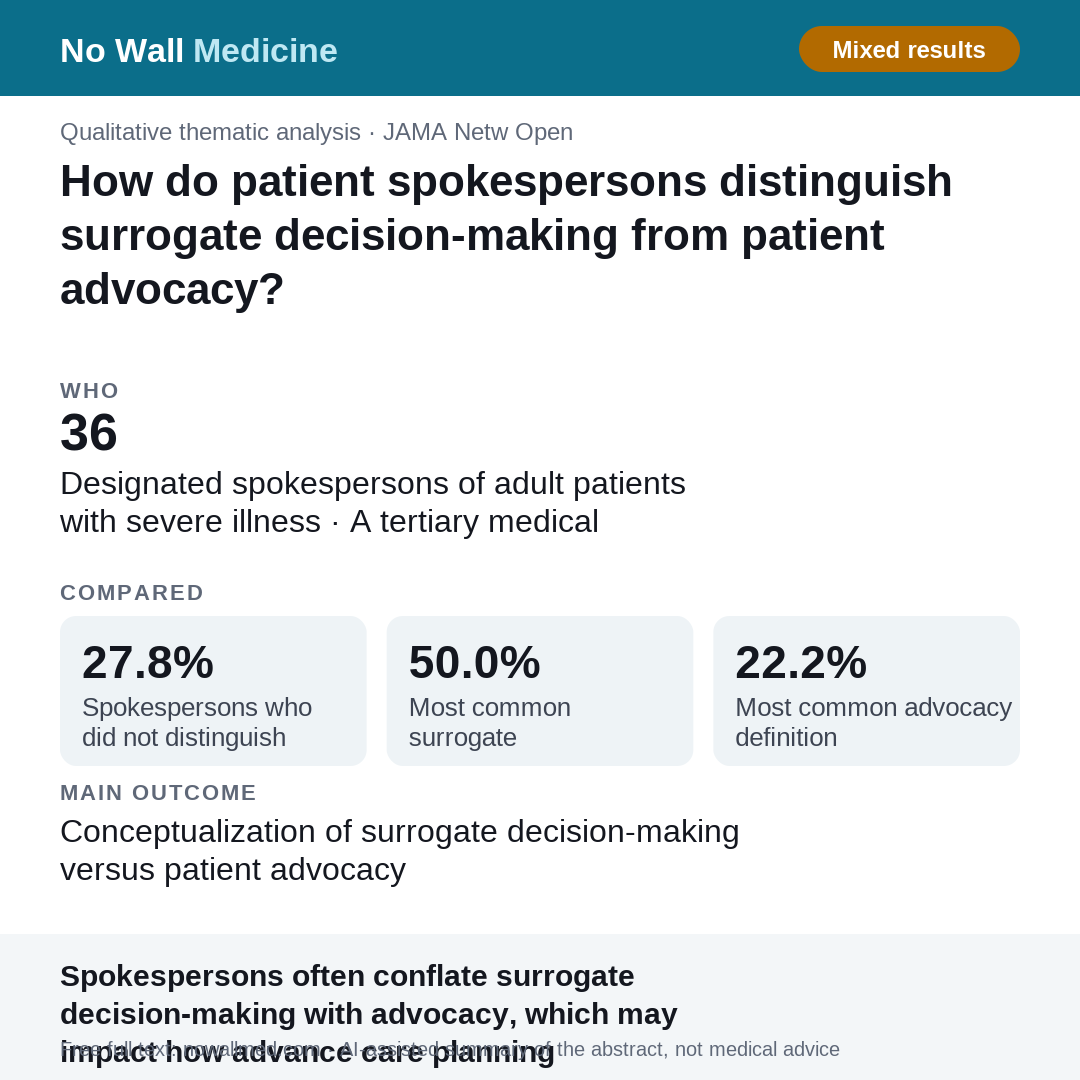
Clinical question: How do patient spokespersons distinguish surrogate decision-making from patient advocacy?
Why it matters: Researchers and clinicians may misinterpret the effectiveness of advance care planning if they assume spokespersons share the same definition of surrogate decision-making as they do.
Key points
- Researchers conducted interviews with 36 patient spokespersons, including 32 women with a mean age of 62.1 years, to explore their views on decision-making roles.
- A total of 10 spokespersons, or 27.8%, did not distinguish surrogate decision-making from patient advocacy.
- The most common definition of surrogate decision-making was acting as the final decision-maker, reported by 18 participants or 50.0%.
Headline and key points written with AI from the paper’s abstract, with every number checked against it. Read the paper before relying on them.
Was this summary helpful?
Subject terms
Cite this article
Van Scoy LJ, Green MJ, Smith T, VanDyke E, Foy AJ, Badzek L. Conceptualization of Surrogate Decision-making Among Spokespersons for Chronically Ill Patients. JAMA Netw Open. 2022. doi:10.1001/jamanetworkopen.2022.45608
Spotted a mistake? Suggest a correction
Top studies every Monday
The week’s key trials and guidelines in your specialties, plus any topics you follow. By email, free.
Get the weekly digest