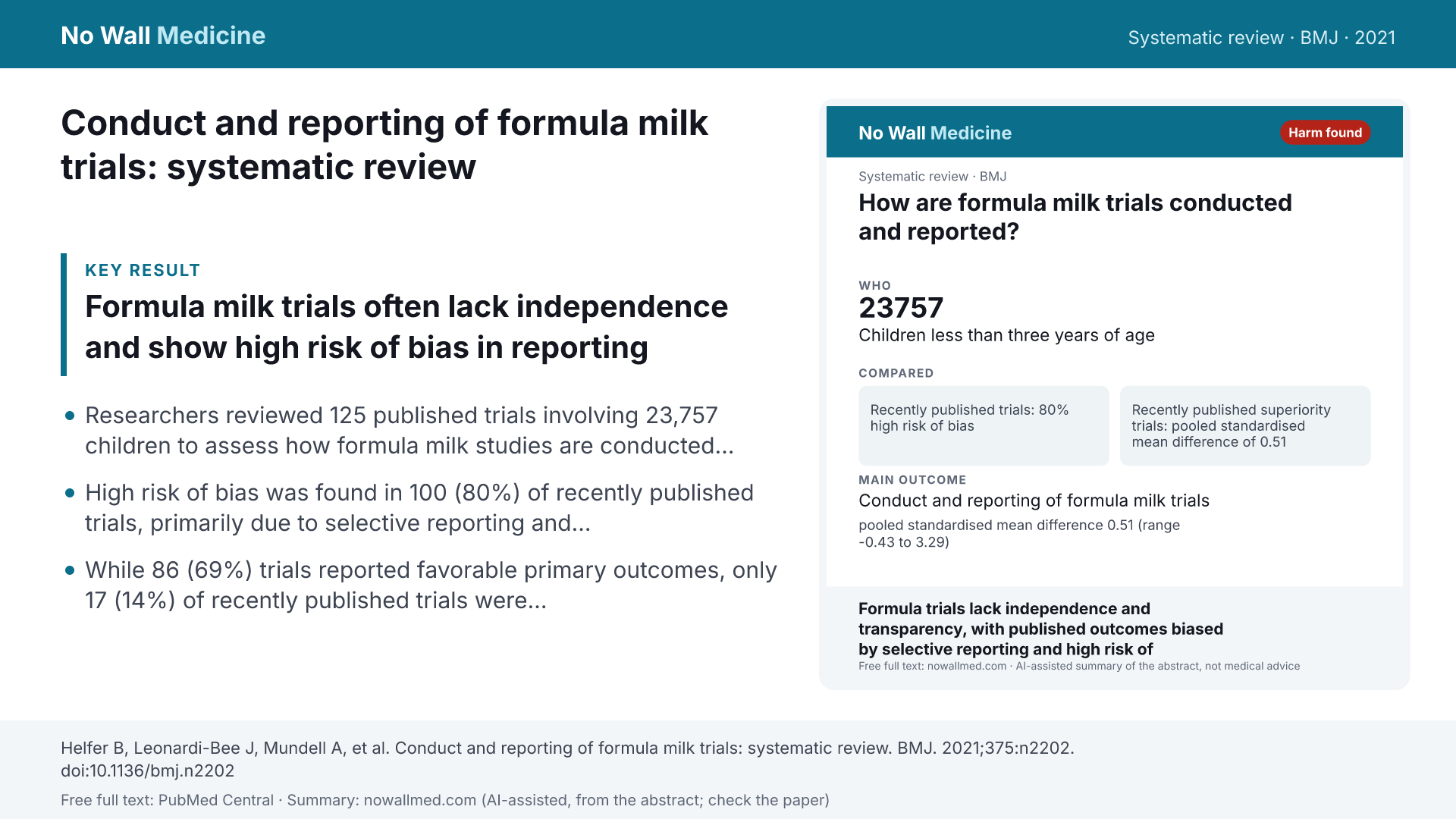
Conduct and reporting of formula milk trials: systematic review
Key result: Formula milk trials often lack independence and show high risk of bias in reporting
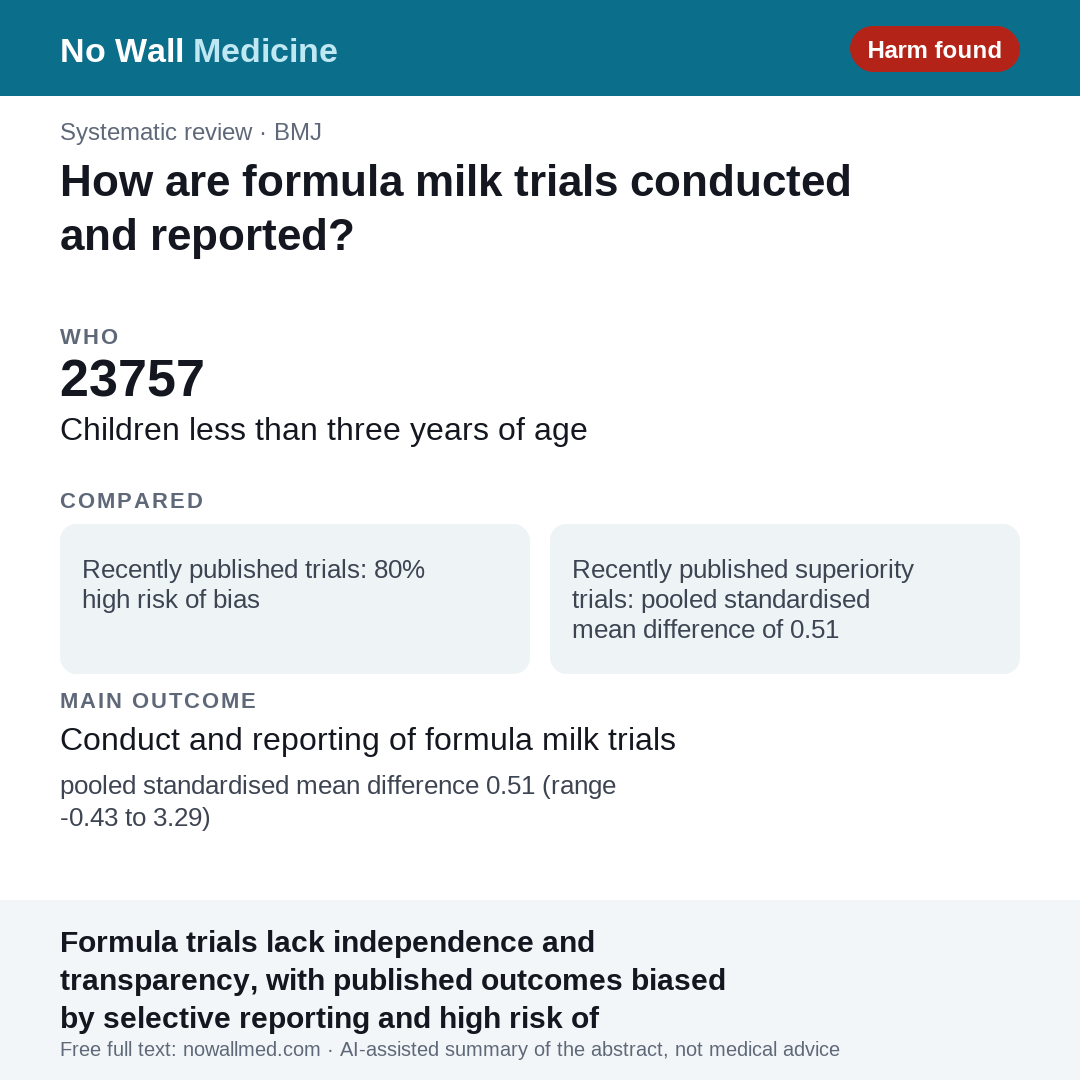
Systematic reviewHarm found
How are formula milk trials conducted and reported?
Who
23757
Children less than three years of age
Compared
Recently published trials: 80% high risk of bias
Recently published superiority trials: pooled standardised mean difference of 0.51
Main outcome
Conduct and reporting of formula milk trials
Result: pooled standardised mean difference 0.51 (range -0.43 to 3.29)
Bottom line: Formula trials lack independence and transparency, with published outcomes biased by selective reporting and high risk of bias.
BMJ · 2021-10-13Download image
Key points
- Researchers reviewed 125 published trials involving 23,757 children to assess how formula milk studies are conducted and reported.
- High risk of bias was found in 100 (80%) of recently published trials, primarily due to selective reporting and inappropriate exclusions.
- While 86 (69%) trials reported favorable primary outcomes, only 17 (14%) of recently published trials were conducted independently of formula companies.
Why it matters: It is unknown how transparently and independently formula milk trials are conducted and whether their reported outcomes are biased.
Discussion prompts
- Would these patients look like yours? Who was left out?
- Is the main outcome one that matters to patients?
- Is the difference large enough to change what you do?
Cite: Helfer B, Leonardi-Bee J, Mundell A, et al. Conduct and reporting of formula milk trials: systematic review. BMJ. 2021. doi:10.1136/bmj.n2202
Free full text: PubMed Central · Summary and visual abstract: nowallmed.com/a/conduct-and-reporting-of-formula-milk-trials-systematic-1ud955p/ (AI-assisted from the abstract; check the paper before relying on it).