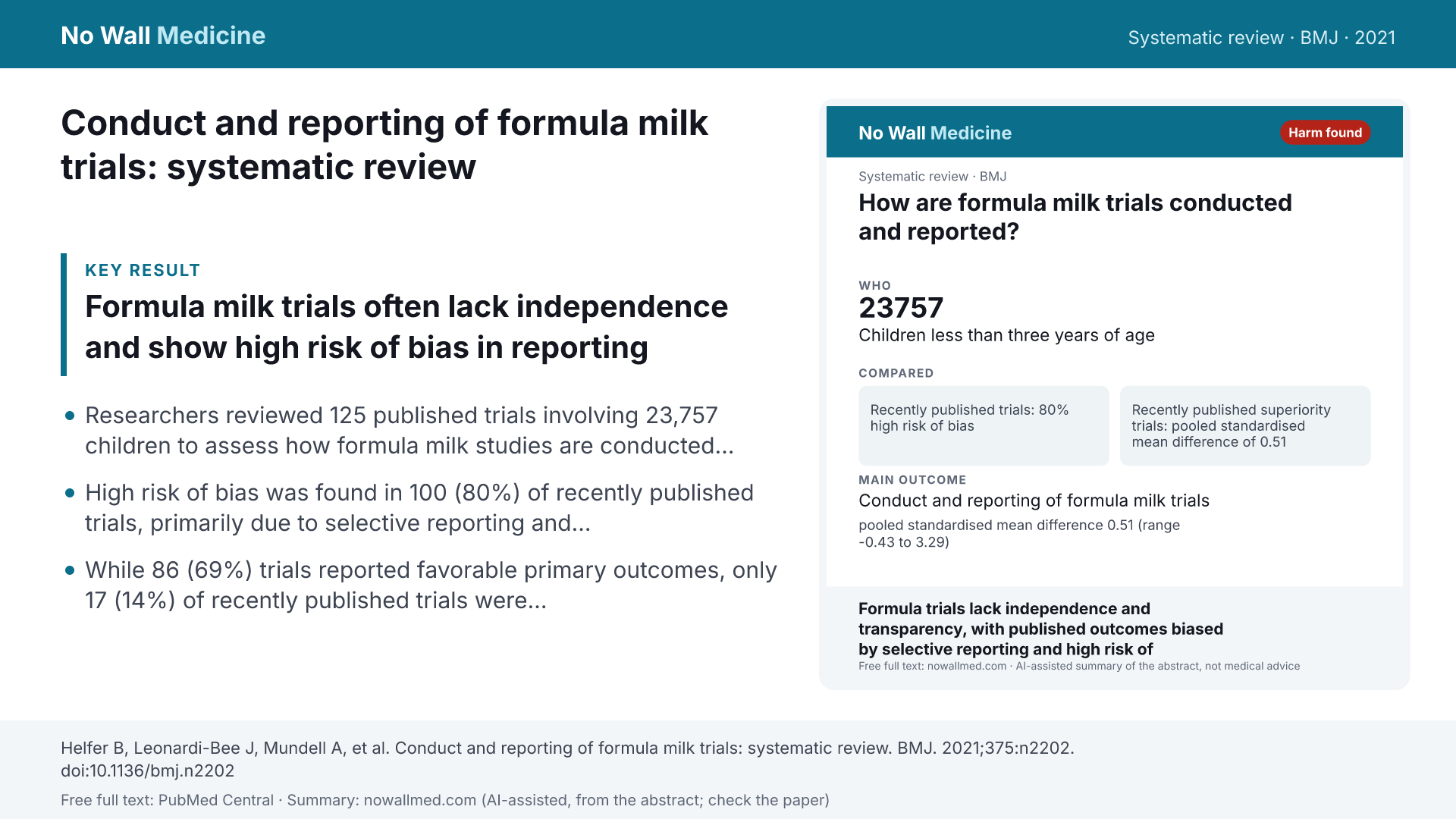
Formula milk trials often lack independence and show high risk of bias in reporting
Conduct and reporting of formula milk trials: systematic review
Systematic reviewHarm found
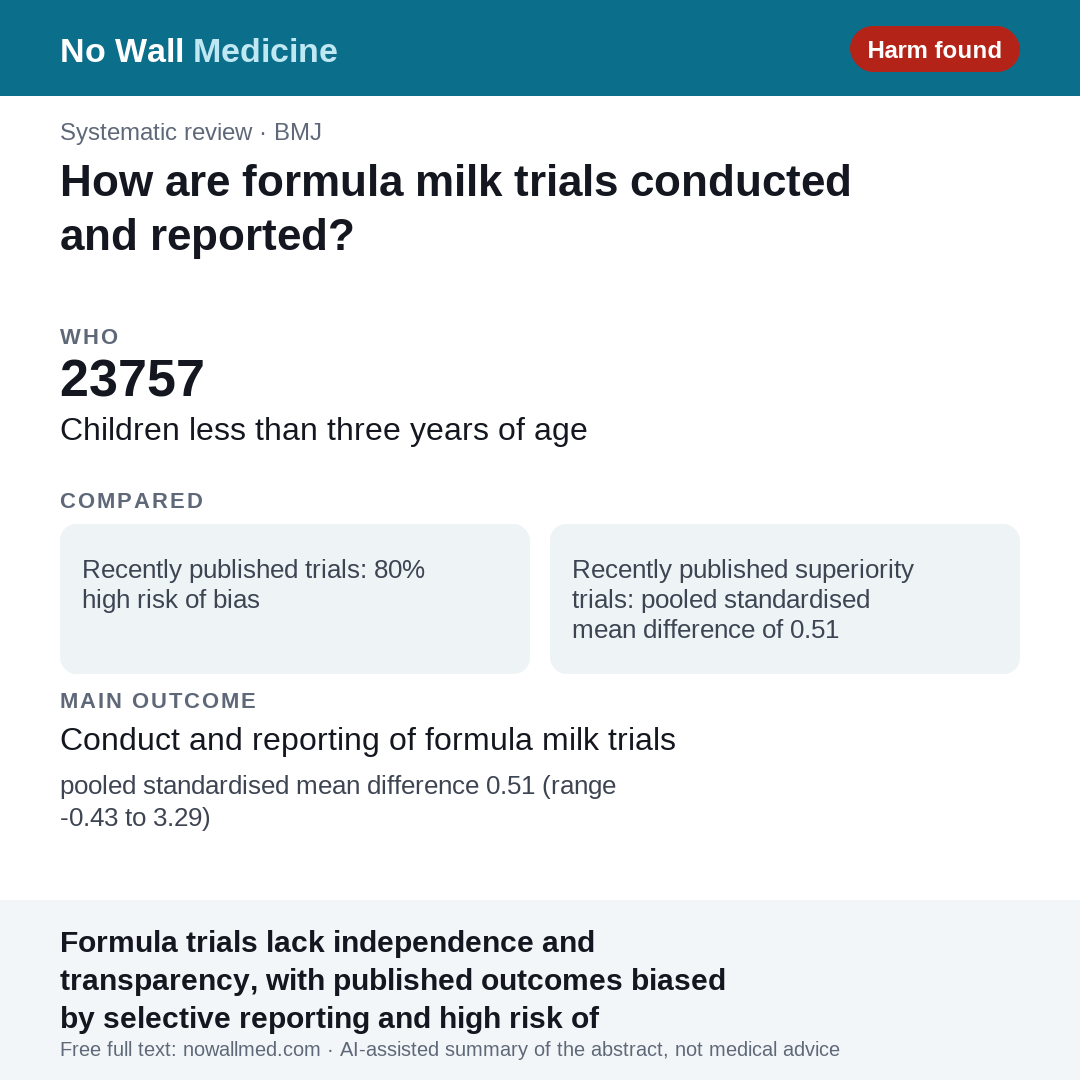
How are formula milk trials conducted and reported?
Who
23757
Children less than three years of age
Compared
Recently published trials: 80% high risk of bias
Recently published superiority trials: pooled standardised mean difference of 0.51
Main outcome
Conduct and reporting of formula milk trials
Result: pooled standardised mean difference 0.51 (range -0.43 to 3.29)
Bottom line: Formula trials lack independence and transparency, with published outcomes biased by selective reporting and high risk of bias.
BMJ · 2021-10-13Download image
Clinical question: How are formula milk trials conducted and reported?
Why it matters: It is unknown how transparently and independently formula milk trials are conducted and whether their reported outcomes are biased.
Key points
- Researchers reviewed 125 published trials involving 23,757 children to assess how formula milk studies are conducted and reported.
- High risk of bias was found in 100 (80%) of recently published trials, primarily due to selective reporting and inappropriate exclusions.
- While 86 (69%) trials reported favorable primary outcomes, only 17 (14%) of recently published trials were conducted independently of formula companies.
Headline and key points written with AI from the paper’s abstract, with every number checked against it. Read the paper before relying on them.
Was this summary helpful?
Abstract
Objective
To systematically review the conduct and reporting of formula trials. Design
Systematic review. Data sources
Medline, Embase, and Cochrane Central Register of Controlled Trials (CENTRAL) were searched from 1 January 2006 to 31 December 2020. Review methods
Intervention trials comparing at least two formula products in children less than three years of age were included, but not trials of human breast milk or fortifiers of breast milk. Data were extracted in duplicate and primary outcome data were synthesised for meta-analysis with a random effects model weighted by the inverse variance method. Risk of bias was evaluated with Cochrane risk of bias version 2.0, and risk of undermining breastfeeding was evaluated according to published consensus guidance. Primary outcomes of the trials included in the systematic review were identified from clinical trial registries, protocols, or trial publications. Results
22 201 titles were screened and 307 trials were identified that were published between 2006 and 2020, of which 73 (24%) trials in 13 197 children were prospectively registered. Another 111 unpublished but registered trials in 17 411 children were identified. Detailed analysis was undertaken for 125 trials (23 757 children) published since 2015. Seventeen (14%) of these recently published trials were conducted independently of formula companies, 26 (21%) were prospectively registered with a clear aim and primary outcome, and authors or sponsors shared prospective protocols for 11 (9%) trials. Risk of bias was low in five (4%) and high in 100 (80%) recently published trials, mainly because of inappropriate exclusions from analysis and selective reporting. For 68 recently published superiority trials, a pooled standardised mean difference of 0.51 (range -0.43 to 3.29) was calculated with an asymmetrical funnel plot (Egger's test P<0.001), which reduced to 0.19 after correction for asymmetry. Primary outcomes were reported by authors as favourable in 86 (69%) trials, and 115 (92%) abstract conclusions were favourable. One of 38 (3%) trials in partially breastfed infants reported adequate support for breastfeeding and 14 of 87 (16%) trials in non-breastfed infants confirmed the decision not to breastfeed was firmly established before enrolment in the trial. Conclusions
The results show that formula trials lack independence or transparency, and published outcomes are biased by selective reporting. Systematic review registration
PROSPERO 2018 CRD42018091928.
Abstract reproduced under the article’s CC BY NC licence.
Subject terms
Cite this article
Helfer B, Leonardi-Bee J, Mundell A, et al. Conduct and reporting of formula milk trials: systematic review. BMJ. 2021. doi:10.1136/bmj.n2202
Spotted a mistake? Suggest a correction