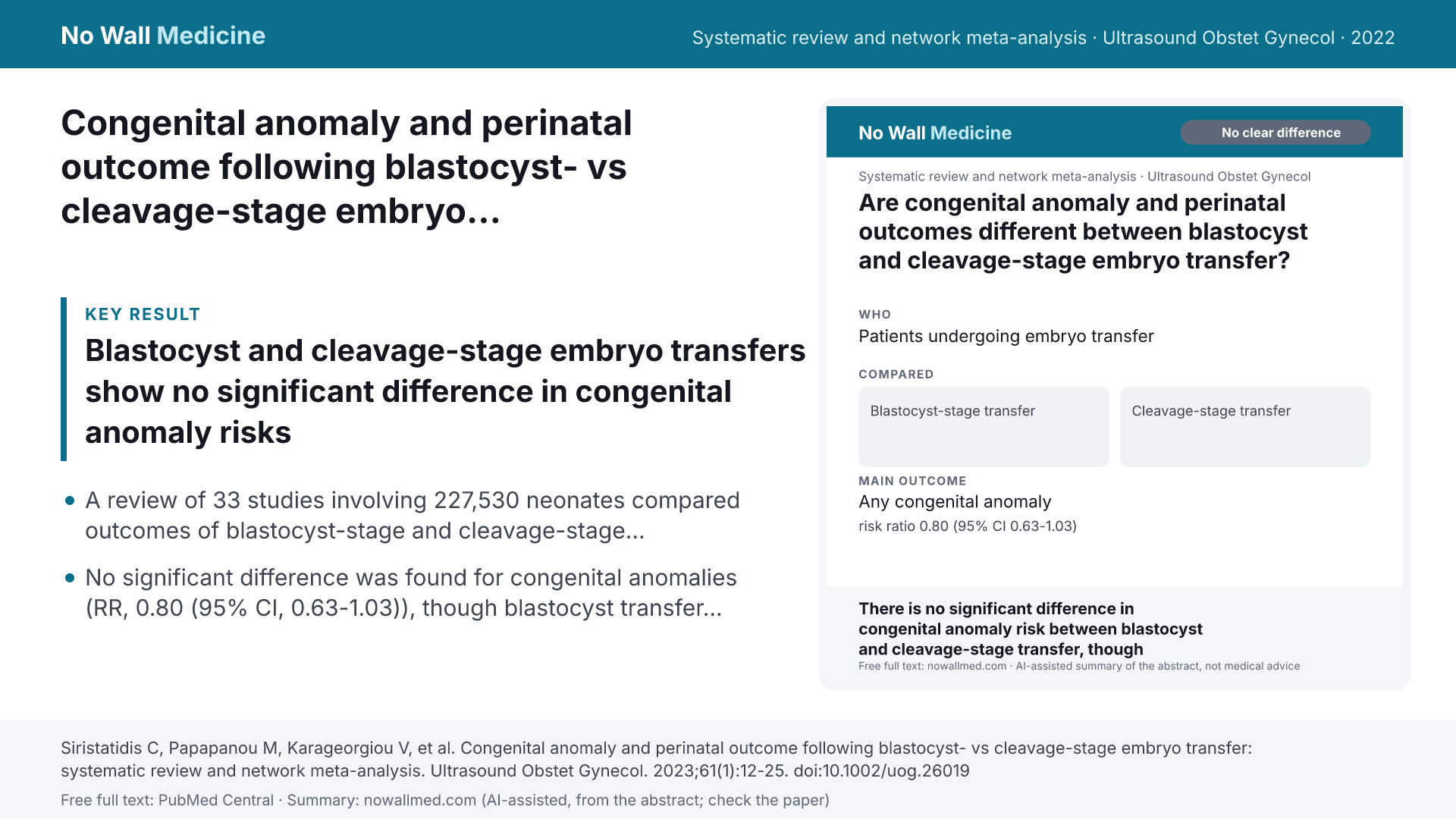
Blastocyst and cleavage-stage embryo transfers show no significant difference in congenital anomaly risks
Congenital anomaly and perinatal outcome following blastocyst- vs cleavage-stage embryo transfer: systematic review and network meta-analysis
Systematic review and network meta-analysisNo clear difference
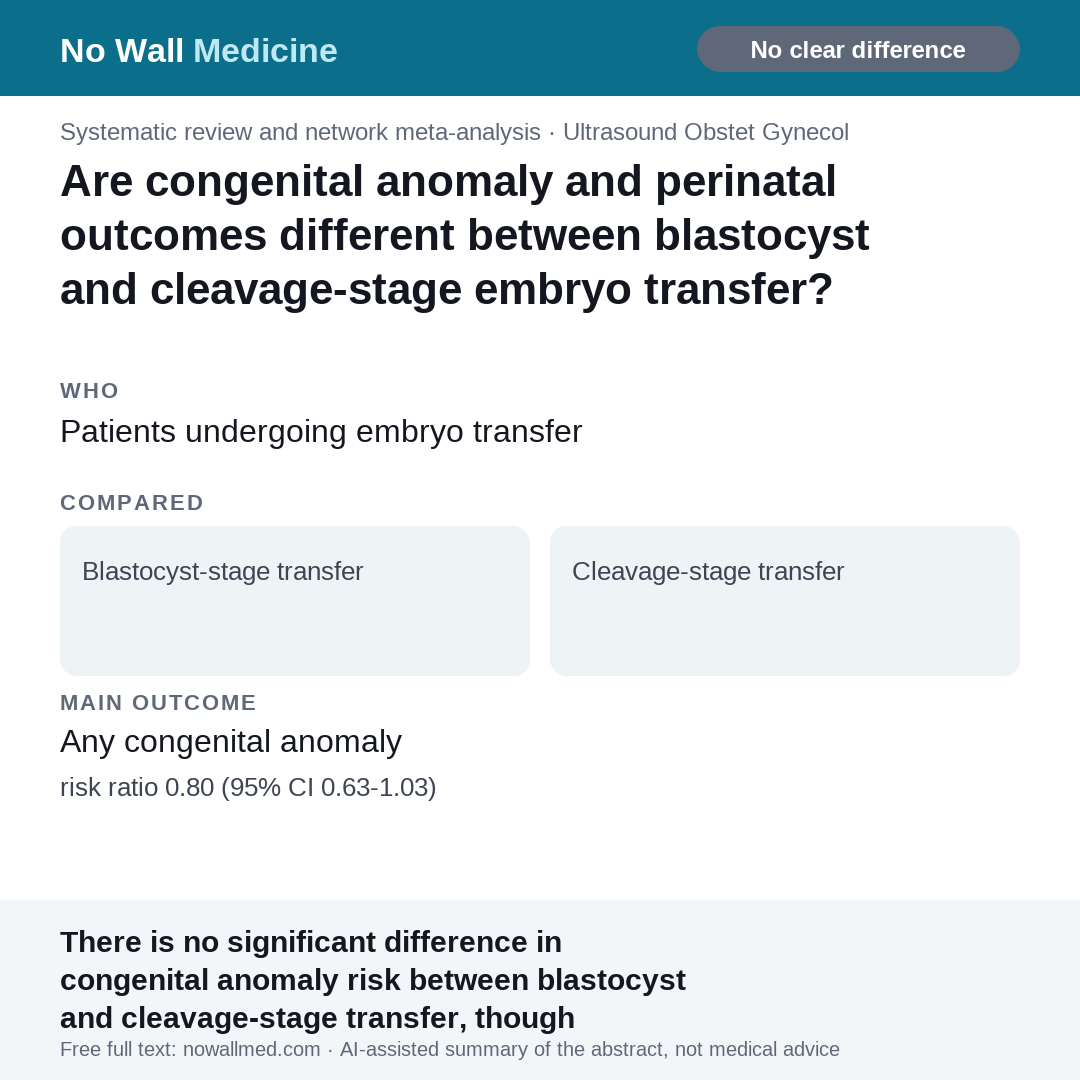
Are congenital anomaly and perinatal outcomes different between blastocyst and cleavage-stage embryo transfer?
Who
Patients undergoing embryo transfer
Compared
Blastocyst-stage transfer
Cleavage-stage transfer
Main outcome
Any congenital anomaly
Result: risk ratio 0.80 (95% CI 0.63-1.03)
Bottom line: There is no significant difference in congenital anomaly risk between blastocyst and cleavage-stage transfer, though blastocyst transfer shows increased male neonate probability.
Limitation: All outcomes were assessed to be of very-low certainty of evidence.
Ultrasound Obstet Gynecol · 2022-06-26Download image
Clinical question: Are congenital anomaly and perinatal outcomes different between blastocyst and cleavage-stage embryo transfer?
Why it matters: It is unknown if transferring embryos at the blastocyst stage versus the cleavage stage affects the risk of birth defects or other pregnancy outcomes.
Key points
- A review of 33 studies involving 227,530 neonates compared outcomes of blastocyst-stage and cleavage-stage embryo transfers.
- No significant difference was found for congenital anomalies (RR, 0.80 (95% CI, 0.63-1.03)), though blastocyst transfer was associated with an increased probability of male neonates (RR, 1.07 (95% CI, 1.06-1.09)).
- Frozen-blastocyst transfer was associated with a lower risk for low birth weight (RR, 0.76 (95% CI, 0.60-0.95)) compared to fresh-blastocyst transfer.
Limitation the authors note: The authors stated that all outcomes were assessed to be of very-low certainty of evidence.
Headline and key points written with AI from the paper’s abstract, with every number checked against it. Read the paper before relying on them.
Was this summary helpful?
Subject terms
Cite this article
Siristatidis C, Papapanou M, Karageorgiou V, Martins WP, Bellos I, Teixeira DM. Congenital anomaly and perinatal outcome following blastocyst- vs cleavage-stage embryo transfer: systematic review and network meta-analysis. Ultrasound Obstet Gynecol. 2022. doi:10.1002/uog.26019
Spotted a mistake? Suggest a correction