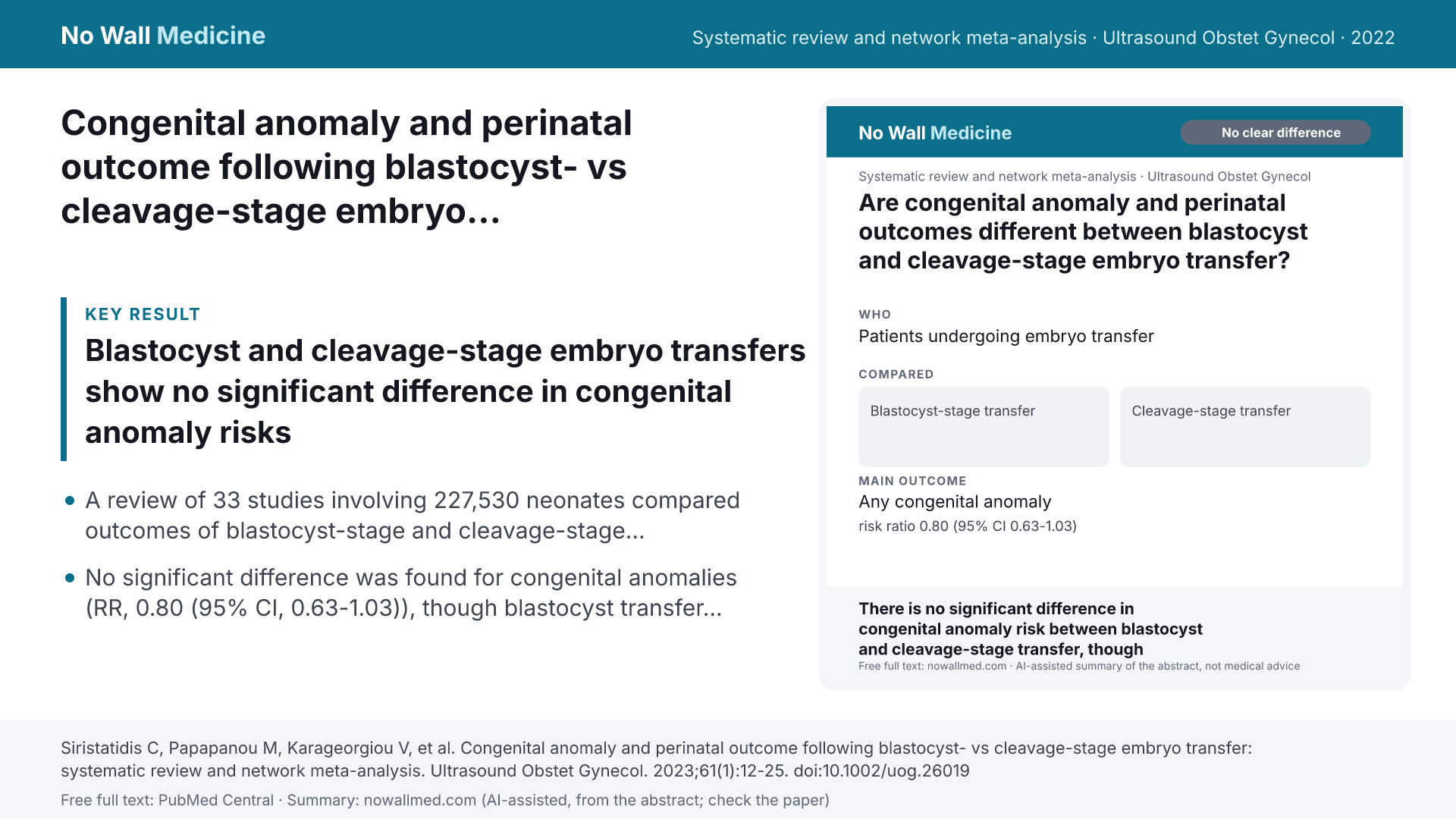
Congenital anomaly and perinatal outcome following blastocyst- vs cleavage-stage embryo transfer: systematic review and network meta-analysis
Key result: Blastocyst and cleavage-stage embryo transfers show no significant difference in congenital anomaly risks
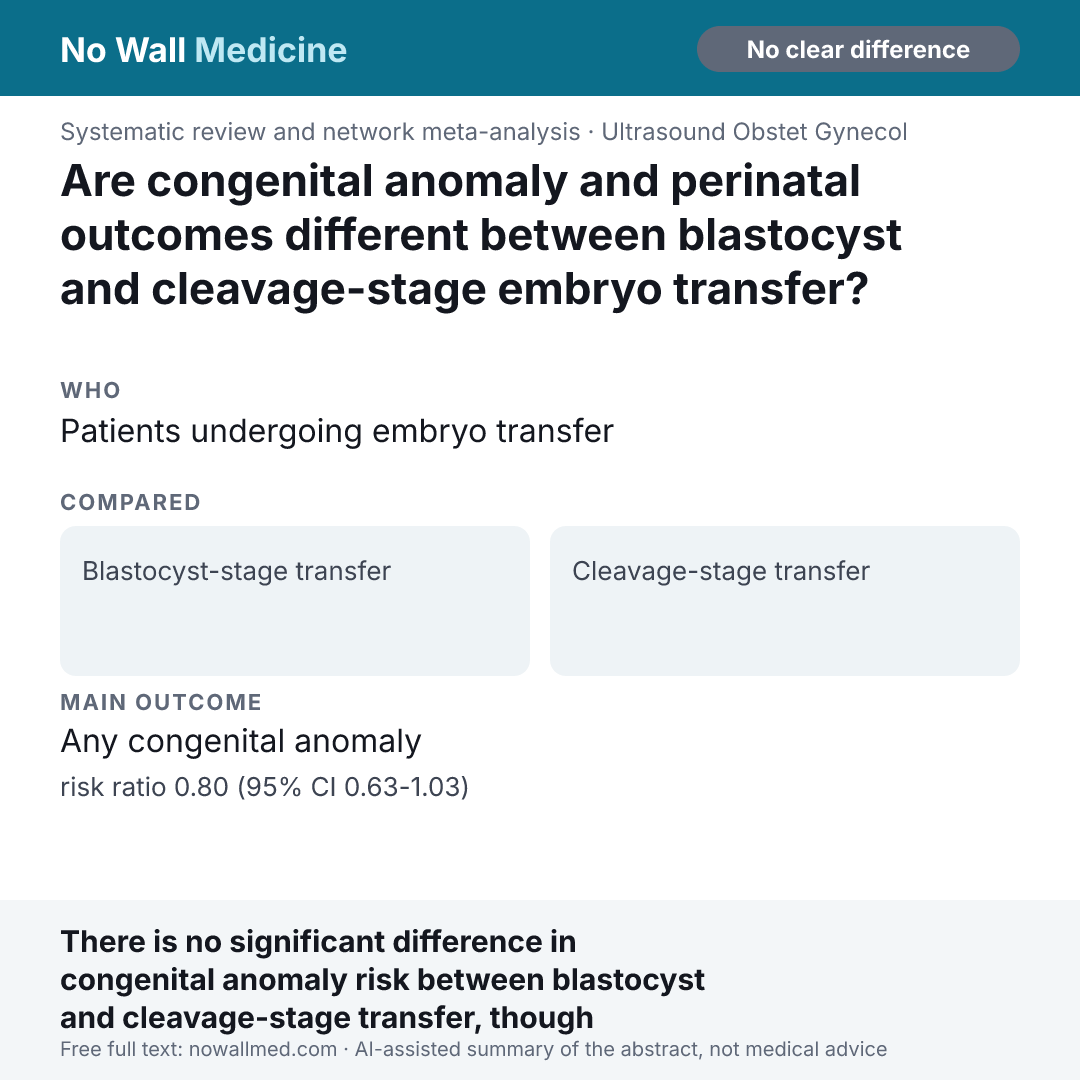
Systematic review and network meta-analysisNo clear difference
Are congenital anomaly and perinatal outcomes different between blastocyst and cleavage-stage embryo transfer?
Who
Patients undergoing embryo transfer
Compared
Blastocyst-stage transfer
Cleavage-stage transfer
Main outcome
Any congenital anomaly
Result: risk ratio 0.80 (95% CI 0.63-1.03)
Bottom line: There is no significant difference in congenital anomaly risk between blastocyst and cleavage-stage transfer, though blastocyst transfer shows increased male neonate probability.
Limitation: All outcomes were assessed to be of very-low certainty of evidence.
Ultrasound Obstet Gynecol · 2022-06-26 · Save PNG
Key points
- A review of 33 studies involving 227,530 neonates compared outcomes of blastocyst-stage and cleavage-stage embryo transfers.
- No significant difference was found for congenital anomalies (RR, 0.80 (95% CI, 0.63-1.03)), though blastocyst transfer was associated with an increased probability of male neonates (RR, 1.07 (95% CI, 1.06-1.09)).
- Frozen-blastocyst transfer was associated with a lower risk for low birth weight (RR, 0.76 (95% CI, 0.60-0.95)) compared to fresh-blastocyst transfer.
Limitation the authors note: The authors stated that all outcomes were assessed to be of very-low certainty of evidence.
Discussion prompts
- Would these patients look like yours? Who was left out?
- Is the main outcome one that matters to patients?
- Is the difference large enough to change what you do?
Cite: Siristatidis C, Papapanou M, Karageorgiou V, et al. Congenital anomaly and perinatal outcome following blastocyst- vs cleavage-stage embryo transfer: systematic review and network meta-analysis. Ultrasound Obstet Gynecol. 2023;61(1):12-25. doi:10.1002/uog.26019
Free full text: PubMed Central · Summary and visual abstract: nowallmed.com/a/congenital-anomaly-and-perinatal-outcome-following-blastocyst-vs-2dlcof/ (AI-assisted from the abstract; check the paper before relying on it).