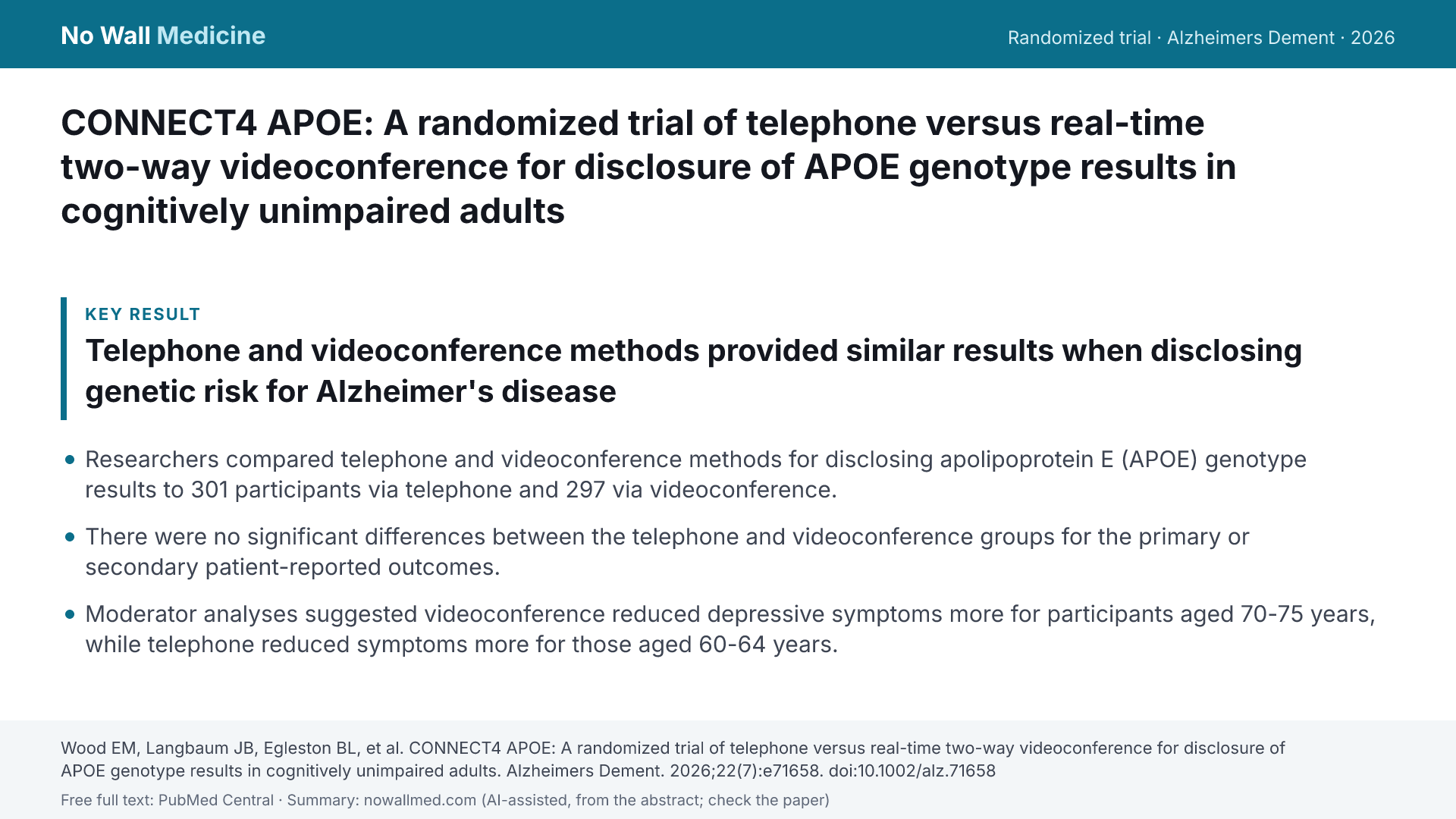
Telephone and videoconference methods provided similar results when disclosing genetic risk for Alzheimer's disease
CONNECT4 APOE: A randomized trial of telephone versus real-time two-way videoconference for disclosure of APOE genotype results in cognitively unimpaired adults
Why it matters: Data are needed to inform best practices for disclosing apolipoprotein E (APOE) results as testing indications increase.
Key points
- Researchers compared telephone and videoconference methods for disclosing apolipoprotein E (APOE) genotype results to 301 participants via telephone and 297 via videoconference.
- There were no significant differences between the telephone and videoconference groups for the primary or secondary patient-reported outcomes.
- Moderator analyses suggested videoconference reduced depressive symptoms more for participants aged 70-75 years, while telephone reduced symptoms more for those aged 60-64 years.
Headline and key points written with AI from the paper’s abstract, with every number checked against it. Read the paper before relying on them.
Was this summary helpful?
Subject terms
Cite this article
Wood EM, Langbaum JB, Egleston BL, et al. CONNECT4 APOE: A randomized trial of telephone versus real-time two-way videoconference for disclosure of APOE genotype results in cognitively unimpaired adults. Alzheimers Dement. 2026. doi:10.1002/alz.71658
Spotted a mistake? Suggest a correction