CONNECT4 APOE: A randomized trial of telephone versus real-time two-way videoconference for disclosure of APOE genotype results in cognitively unimpaired adults
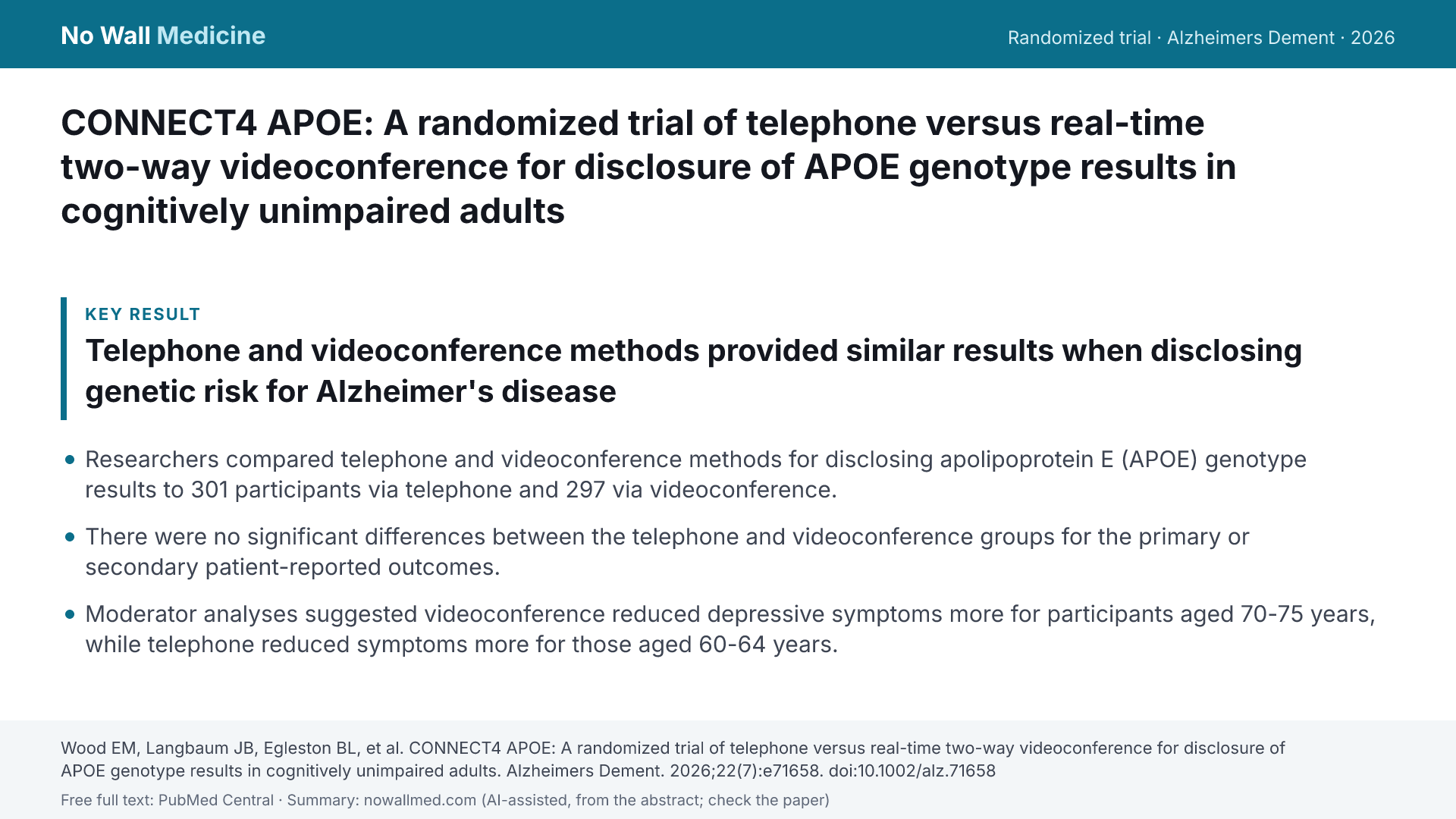
Key result: Telephone and videoconference methods provided similar results when disclosing genetic risk for Alzheimer's disease
Key points
- Researchers compared telephone and videoconference methods for disclosing apolipoprotein E (APOE) genotype results to 301 participants via telephone and 297 via videoconference.
- There were no significant differences between the telephone and videoconference groups for the primary or secondary patient-reported outcomes.
- Moderator analyses suggested videoconference reduced depressive symptoms more for participants aged 70-75 years, while telephone reduced symptoms more for those aged 60-64 years.
Why it matters: Data are needed to inform best practices for disclosing apolipoprotein E (APOE) results as testing indications increase.
Discussion prompts
- Would these patients look like yours? Who was left out?
- Is the main outcome one that matters to patients?
- Is the difference large enough to change what you do?
Cite: Wood EM, Langbaum JB, Egleston BL, et al. CONNECT4 APOE: A randomized trial of telephone versus real-time two-way videoconference for disclosure of APOE genotype results in cognitively unimpaired adults. Alzheimers Dement. 2026;22(7):e71658. doi:10.1002/alz.71658
Free full text: PubMed Central · Summary and visual abstract: nowallmed.com/a/connect4-apoe-a-randomized-trial-of-telephone-versus-real-time-two-13odp3u/ (AI-assisted from the abstract; check the paper before relying on it).