Constant-torque stretching increases ankle range of motion more than other methods immediately after treatment
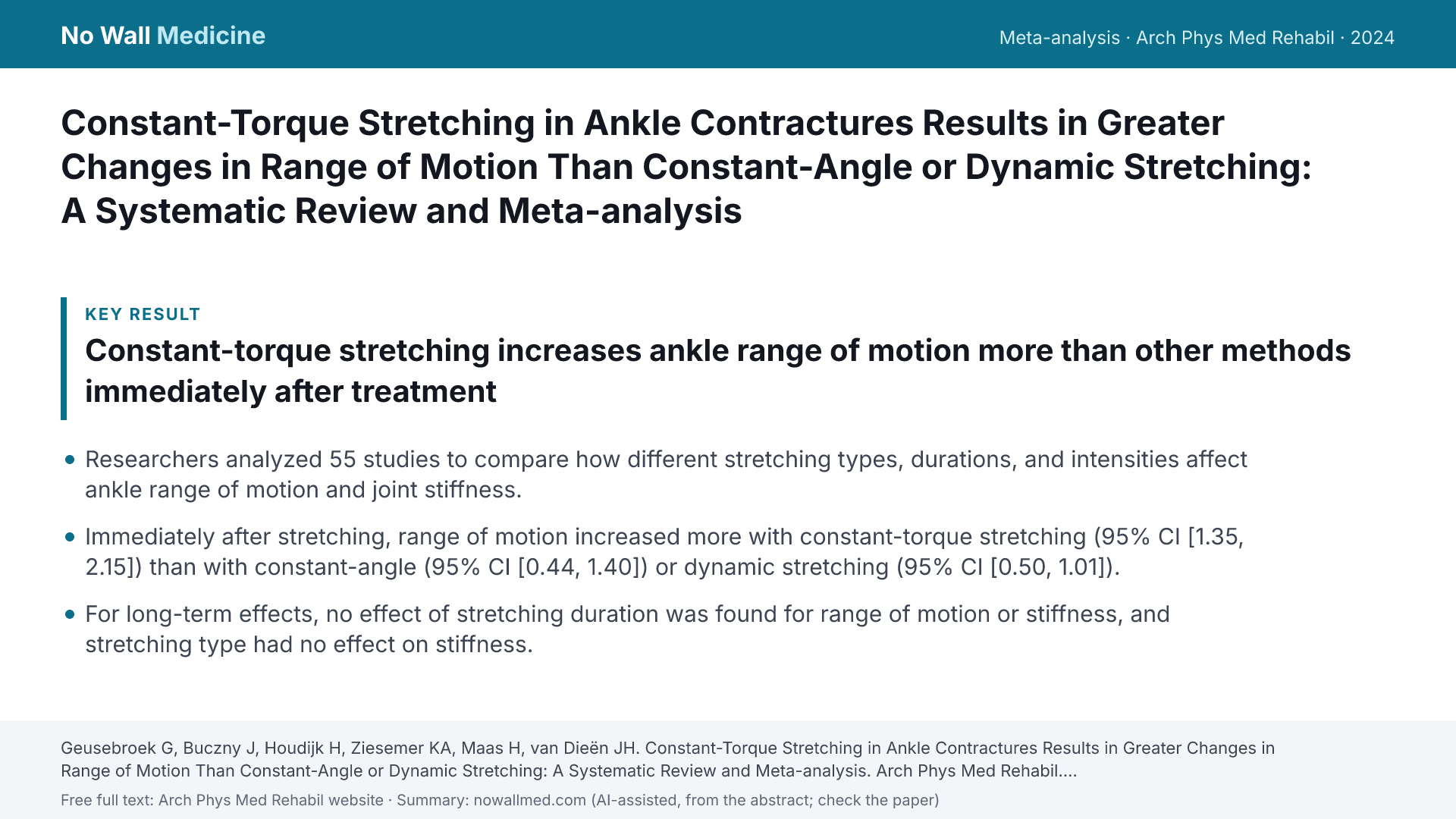
Constant-Torque Stretching in Ankle Contractures Results in Greater Changes in Range of Motion Than Constant-Angle or Dynamic Stretching: A Systematic Review and Meta-analysis
Systematic review and meta-analysisBenefit found
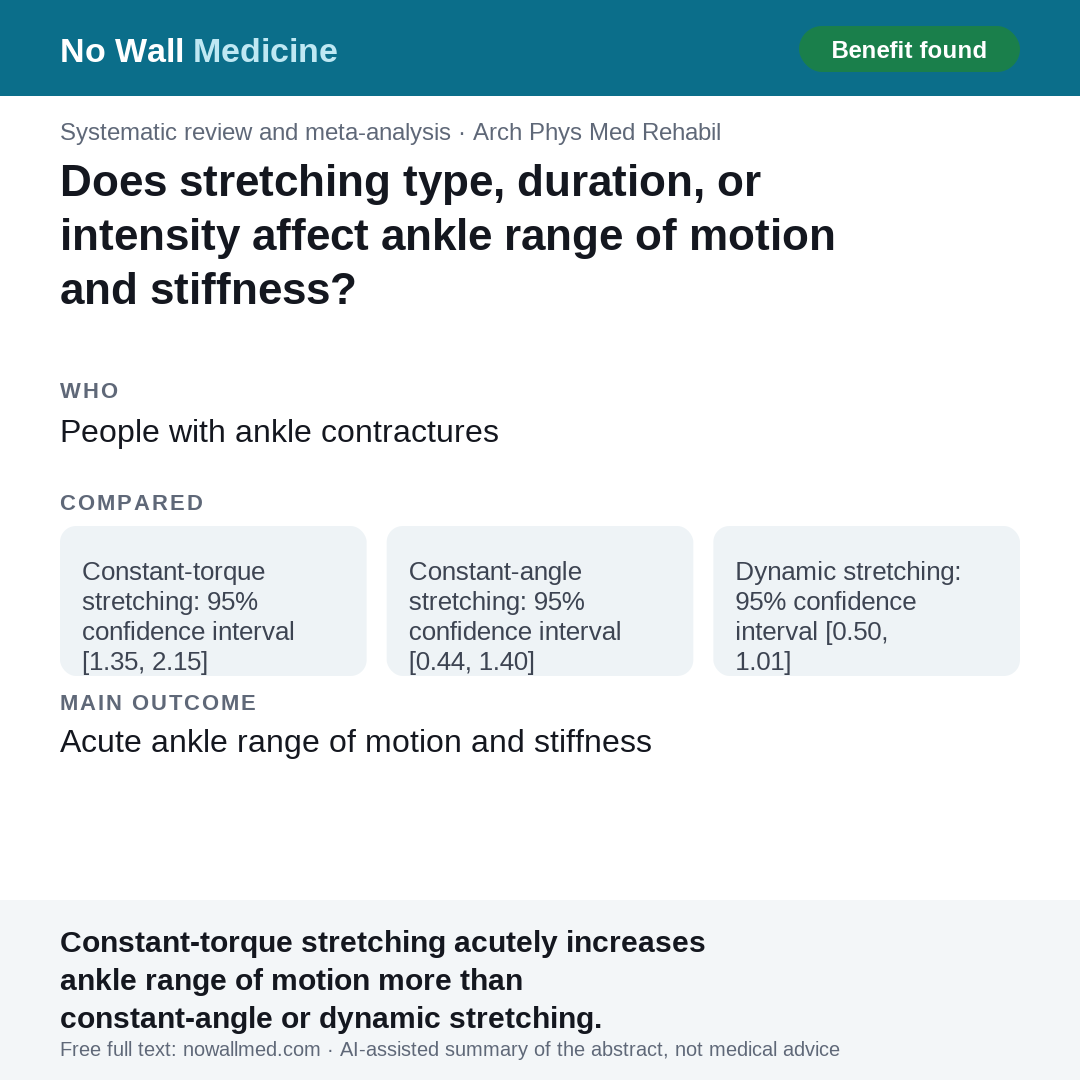
Does stretching type, duration, or intensity affect ankle range of motion and stiffness?
Who
People with ankle contractures
Compared
Constant-torque stretching: 95% confidence interval [1.35, 2.15]
Constant-angle stretching: 95% confidence interval [0.44, 1.40]
Dynamic stretching: 95% confidence interval [0.50, 1.01]
Main outcome
Acute ankle range of motion and stiffness
Bottom line: Constant-torque stretching acutely increases ankle range of motion more than constant-angle or dynamic stretching.
Arch Phys Med Rehabil · 2024-12-17Download image
Clinical question: Does stretching type, duration, or intensity affect ankle range of motion and stiffness?
Why it matters: It is unknown how different stretching types, durations, and intensities affect ankle range of motion and stiffness in the short and long term.
Key points
- Researchers analyzed 55 studies to compare how different stretching types, durations, and intensities affect ankle range of motion and joint stiffness.
- Immediately after stretching, range of motion increased more with constant-torque stretching (95% CI [1.35, 2.15]) than with constant-angle (95% CI [0.44, 1.40]) or dynamic stretching (95% CI [0.50, 1.01]).
- For long-term effects, no effect of stretching duration was found for range of motion or stiffness, and stretching type had no effect on stiffness.
Limitation the authors note: Most studies did not quantify stretching intensity and there was not enough information to assess the long-term effects of stretching type.
Headline and key points written with AI from the paper’s abstract, with every number checked against it. Read the paper before relying on them.
Was this summary helpful?
Subject terms
Cite this article
Geusebroek G, Buczny J, Houdijk H, Ziesemer KA, Maas H, van Dieën JH. Constant-Torque Stretching in Ankle Contractures Results in Greater Changes in Range of Motion Than Constant-Angle or Dynamic Stretching: A Systematic Review and Meta-analysis. Arch Phys Med Rehabil. 2024. doi:10.1016/j.apmr.2024.12.004
Spotted a mistake? Suggest a correction