Constant-Torque Stretching in Ankle Contractures Results in Greater Changes in Range of Motion Than Constant-Angle or Dynamic Stretching: A Systematic Review and Meta-analysis
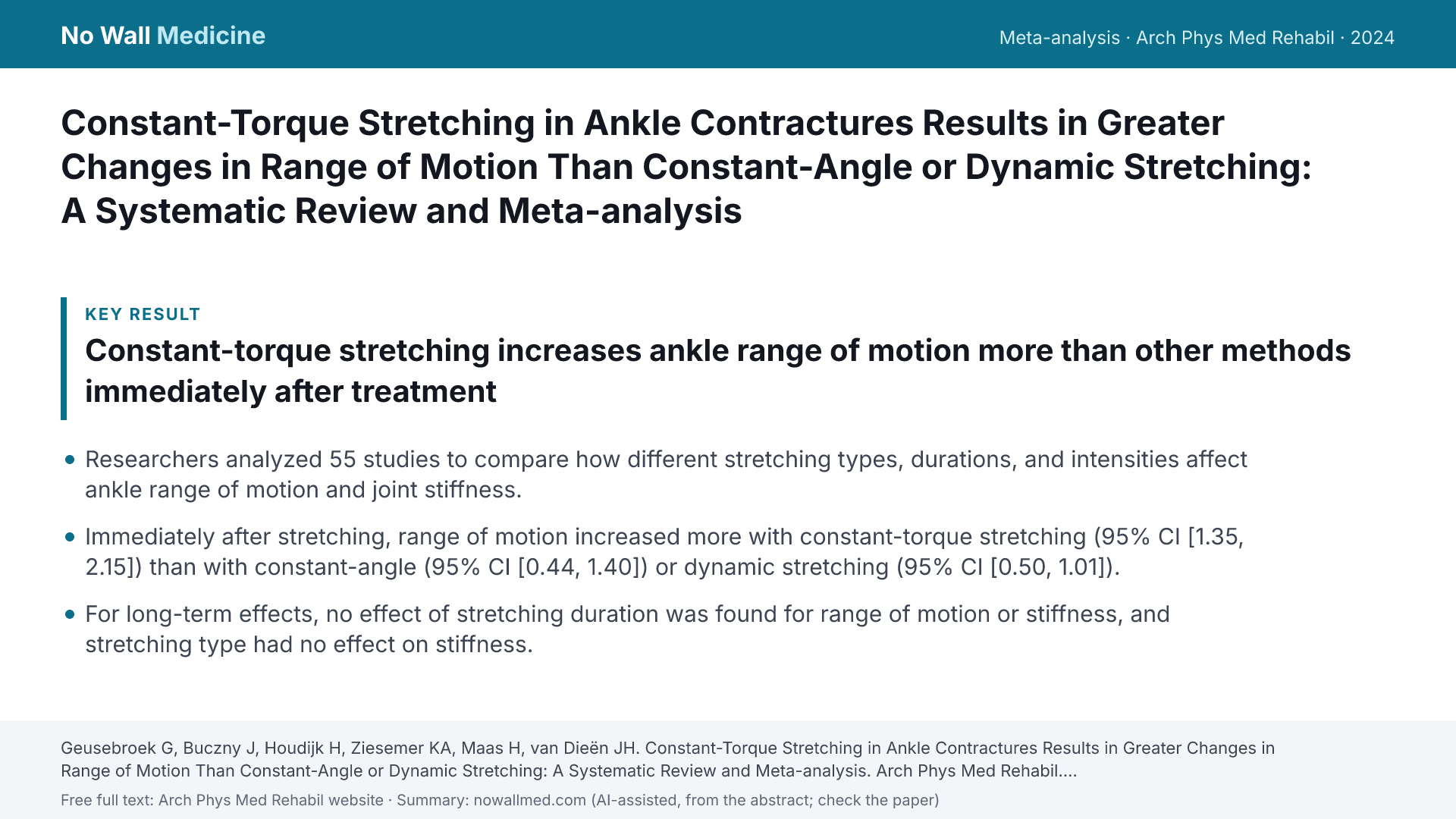
Key result: Constant-torque stretching increases ankle range of motion more than other methods immediately after treatment
Key points
- Researchers analyzed 55 studies to compare how different stretching types, durations, and intensities affect ankle range of motion and joint stiffness.
- Immediately after stretching, range of motion increased more with constant-torque stretching (95% CI [1.35, 2.15]) than with constant-angle (95% CI [0.44, 1.40]) or dynamic stretching (95% CI [0.50, 1.01]).
- For long-term effects, no effect of stretching duration was found for range of motion or stiffness, and stretching type had no effect on stiffness.
Limitation the authors note: Most studies did not quantify stretching intensity and there was not enough information to assess the long-term effects of stretching type.
Discussion prompts
- Would these patients look like yours? Who was left out?
- Is the main outcome one that matters to patients?
- Is the difference large enough to change what you do?
Cite: Geusebroek G, Buczny J, Houdijk H, Ziesemer KA, Maas H, van Dieën JH. Constant-Torque Stretching in Ankle Contractures Results in Greater Changes in Range of Motion Than Constant-Angle or Dynamic Stretching: A Systematic Review and Meta-analysis. Arch Phys Med Rehabil. 2025;106(7):1108-1125. doi:10.1016/j.apmr.2024.12.004
Free full text: Arch Phys Med Rehabil website · Summary and visual abstract: nowallmed.com/a/constant-torque-stretching-in-ankle-contractures-results-in-greater-1l5skwq/ (AI-assisted from the abstract; check the paper before relying on it).