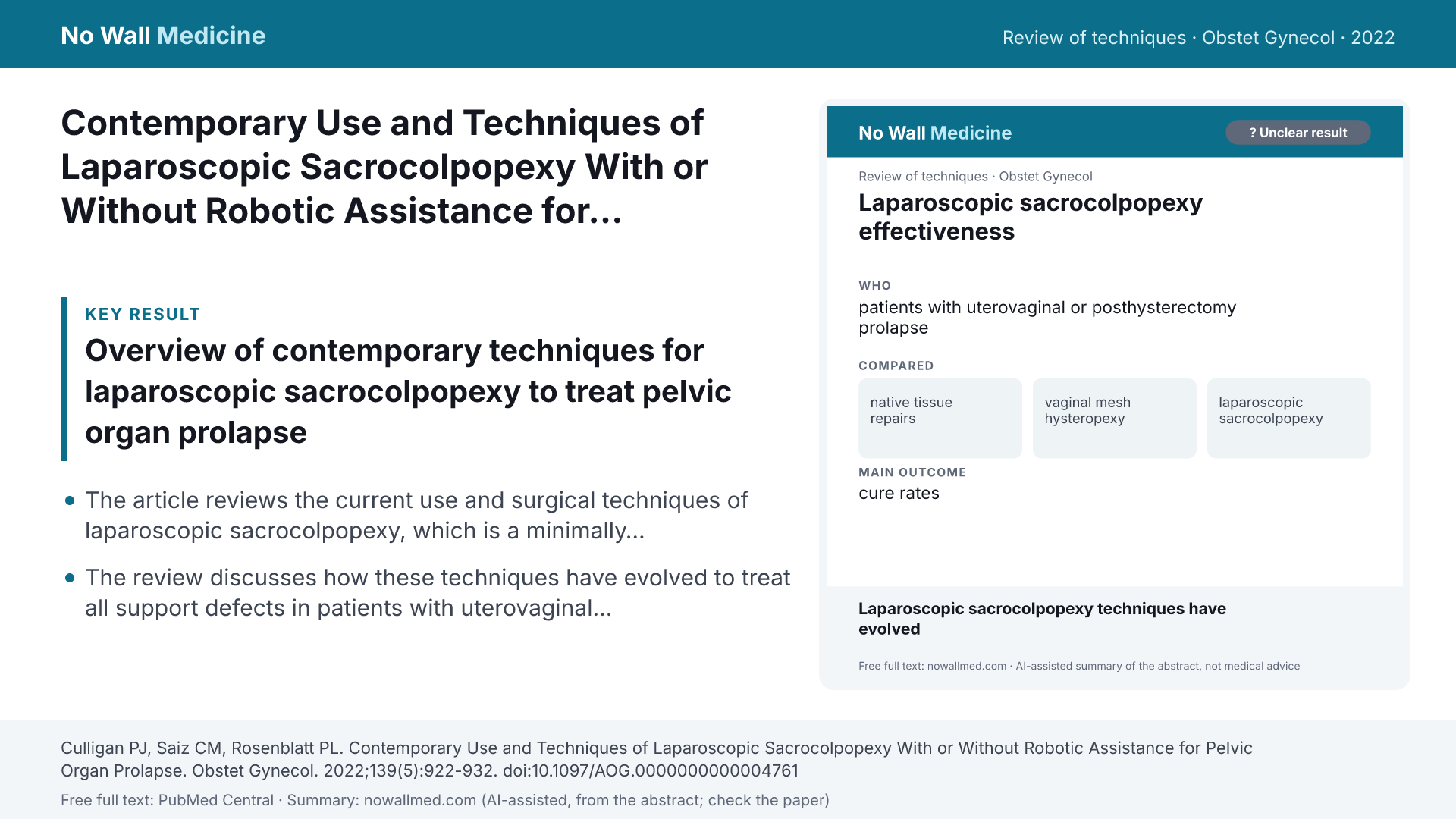
Overview of contemporary techniques for laparoscopic sacrocolpopexy to treat pelvic organ prolapse
Contemporary Use and Techniques of Laparoscopic Sacrocolpopexy With or Without Robotic Assistance for Pelvic Organ Prolapse
Review of techniquesUnclear result
Laparoscopic sacrocolpopexy effectiveness
Who
patients with uterovaginal or posthysterectomy prolapse
Compared
native tissue repairs
vaginal mesh hysteropexy
laparoscopic sacrocolpopexy
Main outcome
cure rates
Bottom line: Laparoscopic sacrocolpopexy techniques have evolved
Obstet Gynecol · 2022-04-05Download image

Why it matters: Traditional native tissue repairs have shown disappointing cure rates at 5 years or more, and the use of robotic assistance in sacrocolpopexy has evolved.
Key points
- The article reviews the current use and surgical techniques of laparoscopic sacrocolpopexy, which is a minimally invasive surgery to repair pelvic organ prolapse.
- The review discusses how these techniques have evolved to treat all support defects in patients with uterovaginal or posthysterectomy prolapse.
Headline and key points written with AI from the paper’s abstract, with every number checked against it. Read the paper before relying on them.
Was this summary helpful?
Subject terms
Cite this article
Culligan PJ, Saiz CM, Rosenblatt PL. Contemporary Use and Techniques of Laparoscopic Sacrocolpopexy With or Without Robotic Assistance for Pelvic Organ Prolapse. Obstet Gynecol. 2022. doi:10.1097/AOG.0000000000004761
Spotted a mistake? Suggest a correction