Continuing ixekizumab treatment was associated with fewer disease flares in patients with axial spondyloarthritis
Continuing versus withdrawing ixekizumab treatment in patients with axial spondyloarthritis who achieved remission: efficacy and safety results from a placebo-controlled, randomised withdrawal study (COAST-Y)
Double-blind, placebo-controlled, randomised withdrawal studyBenefit found
Does continuing or withdrawing ixekizumab affect flare rates in axial spondyloarthritis patients in remission?
Who
155
Patients with axial spondyloarthritis who achieved remission
Compared
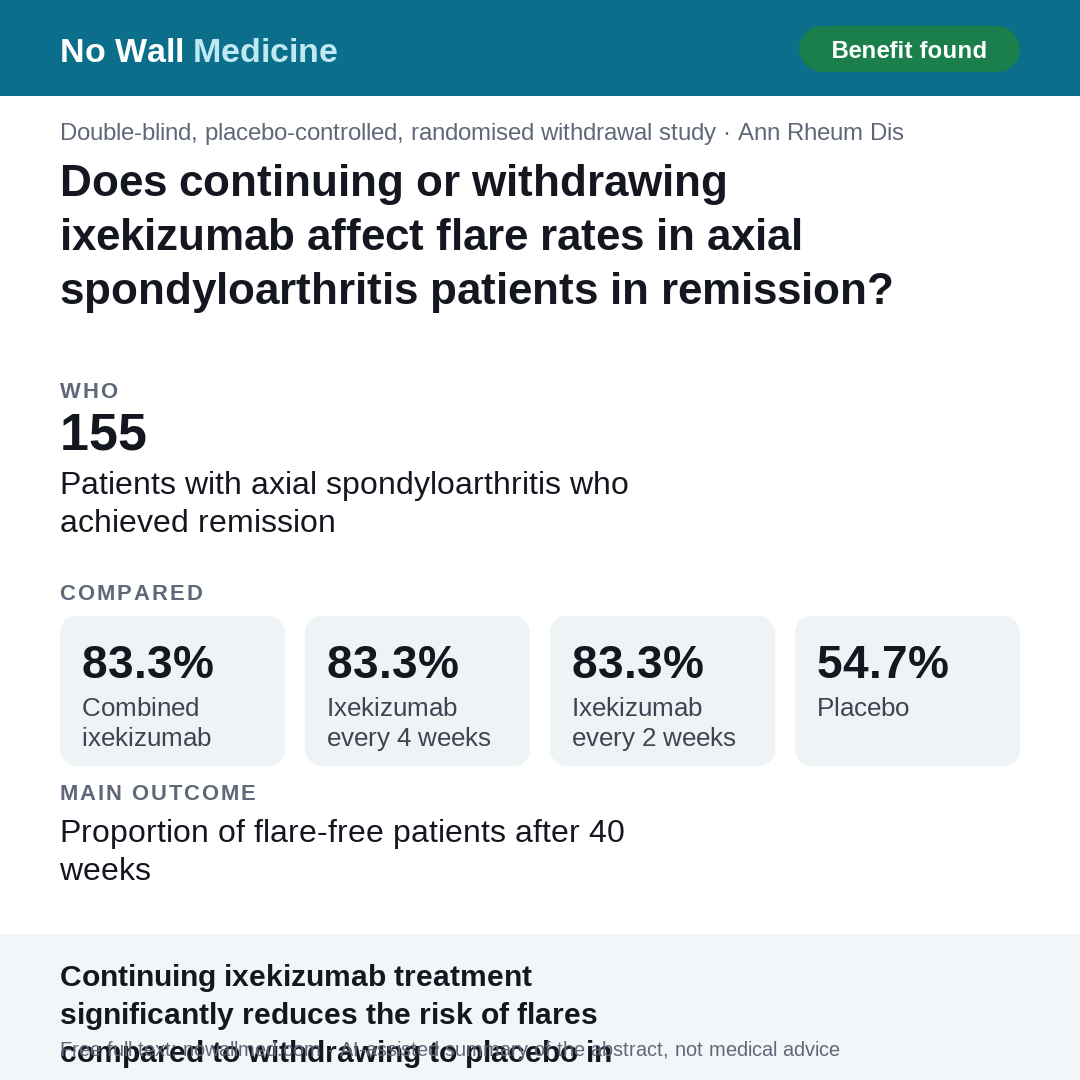
83.3%Combined ixekizumab (85/102)
83.3%Ixekizumab every 4 weeks (40/48)
83.3%Ixekizumab every 2 weeks (45/54)
54.7%Placebo (29/53)
Main outcome
Proportion of flare-free patients after 40 weeks
Bottom line: Continuing ixekizumab treatment significantly reduces the risk of flares compared to withdrawing to placebo in patients in remission.
Ann Rheum Dis · 2021-05-06Download image
Clinical question: Does continuing or withdrawing ixekizumab affect flare rates in axial spondyloarthritis patients in remission?
Why it matters: It is unknown whether patients with axial spondyloarthritis who have achieved remission can safely withdraw from ixekizumab treatment without experiencing disease flares.
Key points
- The study followed 155 patients with axial spondyloarthritis who had achieved remission and were randomized to continue ixekizumab or switch to a placebo.
- After 40 weeks, 83.3% of patients in the combined ixekizumab groups remained flare-free compared to 54.7% in the placebo group.
- Continuing ixekizumab was associated with a delayed time-to-flare compared to the placebo group.
Headline and key points written with AI from the paper’s abstract, with every number checked against it. Read the paper before relying on them.
Was this summary helpful?
Abstract
Objectives
The objective of COAST-Y was to evaluate the effect of continuing versus withdrawing ixekizumab (IXE) in patients with axial spondyloarthritis (axSpA) who had achieved remission. Methods
COAST-Y is an ongoing, phase III, long-term extension study that included a double-blind, placebo (PBO)-controlled, randomised withdrawal-retreatment period (RWRP). Patients who completed the originating 52-week COAST-V, COAST-W or COAST-X studies entered a 24-week lead-in period and continued either 80 mg IXE every 2 (Q2W) or 4 weeks (Q4W). Patients who achieved remission (an Ankylosing Spondylitis Disease Activity Score (ASDAS)<1.3 at least once at week 16 or week 20, and <2.1 at both visits) were randomly assigned equally at week 24 to continue IXE Q4W, IXE Q2W or withdraw to PBO in a blinded fashion. The primary endpoint was the proportion of flare-free patients (flare: ASDAS≥2.1 at two consecutive visits or ASDAS>3.5 at any visit) after the 40-week RWRP, with time-to-flare as a major secondary endpoint. Results
Of 773 enrolled patients, 741 completed the 24-week lead-in period and 155 entered the RWRP. Forty weeks after randomised withdrawal, 83.3% of patients in the combined IXE (85/102, p<0.001), IXE Q4W (40/48, p=0.003) and IXE Q2W (45/54, p=0.001) groups remained flare-free versus 54.7% in the PBO group (29/53). Continuing IXE significantly delayed time-to-flare versus PBO, with most patients remaining flare-free for up to 20 weeks after IXE withdrawal. Conclusions
Patients with axSpA who continued treatment with IXE were significantly less likely to flare and had significantly delayed time-to-flare compared with patients who withdrew to PBO.
Abstract reproduced under the article’s CC BY NC licence.
Subject terms
Cite this article
Landewé RB, Gensler LS, Poddubnyy D, Rahman P, Hojnik M, Li X. Continuing versus withdrawing ixekizumab treatment in patients with axial spondyloarthritis who achieved remission: efficacy and safety results from a placebo-controlled, randomised withdrawal study (COAST-Y). Ann Rheum Dis. 2021. doi:10.1136/annrheumdis-2020-219717
Spotted a mistake? Suggest a correction
Top studies every Monday
The week’s key trials and guidelines in your specialties, plus any topics you follow. By email, free.
Get the weekly digest