oXiris filter use was associated with lower 28-day mortality in patients with sepsis
Continuous renal replacement therapy with the adsorptive oXiris filter may be associated with the lower 28-day mortality in sepsis: a systematic review and meta-analysis
Systematic review and meta-analysisUnclear result
Does the oXiris filter reduce 28-day mortality in sepsis patients?
Who
695
Patients with sepsis
Compared
oXiris filter
other filters
Main outcome
28-day mortality
Result: odds ratio 0.53 (95% CI 0.36-0.77)
Bottom line: oXiris filter may reduce 28-day mortality, but evidence certainty is low or very low.
Limitation: Mainly observational studies and randomized controlled trials had unclear risk of bias and small sample size.
Crit Care · 2023-07-09Download image
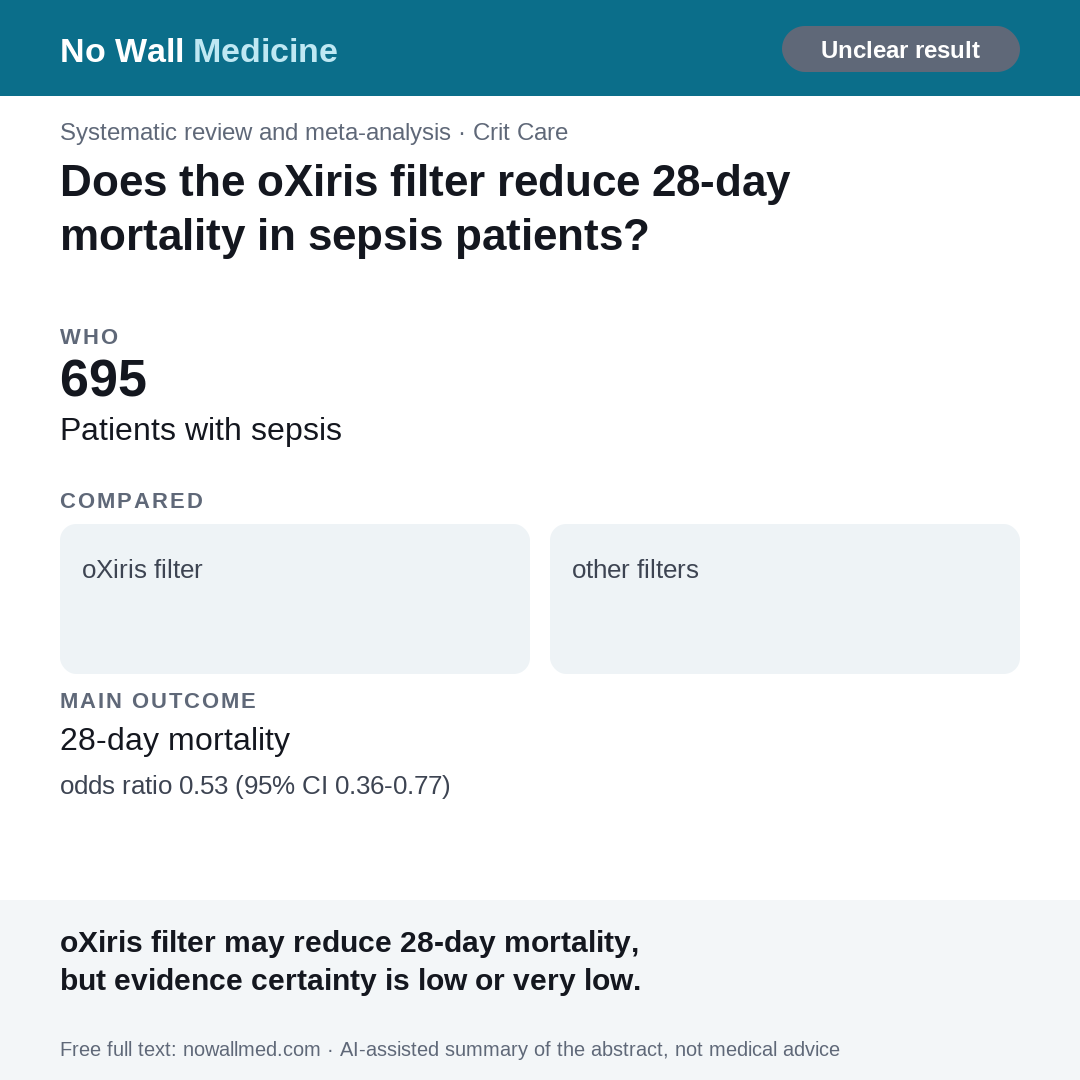
Clinical question: Does the oXiris filter reduce 28-day mortality in sepsis patients?
Why it matters: No consensus has been reached regarding the potential benefits of using the oXiris filter to adsorb endotoxins and remove inflammatory mediators in patients with sepsis.
Key points
- Researchers analyzed 14 studies involving 695 patients to compare the oXiris filter during continuous renal replacement therapy, a type of blood cleaning treatment, against other filters.
- The oXiris filter was associated with an odds ratio of 0.53 for 28-day mortality and a weighted mean difference of -1.91 days for intensive care unit stay.
- Lower levels of interleukin-6, lactate, and norepinephrine doses, as well as lower Sequential Organ Failure Assessment scores, were also associated with the oXiris filter.
Limitation the authors note: The evidence had a low or very low level of certainty because the included randomized controlled trials had an unclear risk of bias and a small sample size.
Headline and key points written with AI from the paper’s abstract, with every number checked against it. Read the paper before relying on them.
Was this summary helpful?
Subject terms
Cite this article
Wang G, He Y, Guo Q, Zhao Y, He J, Chen Y. Continuous renal replacement therapy with the adsorptive oXiris filter may be associated with the lower 28-day mortality in sepsis: a systematic review and meta-analysis. Crit Care. 2023. doi:10.1186/s13054-023-04555-x
Spotted a mistake? Suggest a correction
Top studies every Monday
The week’s key trials and guidelines in your specialties, plus any topics you follow. By email, free.
Get the weekly digest