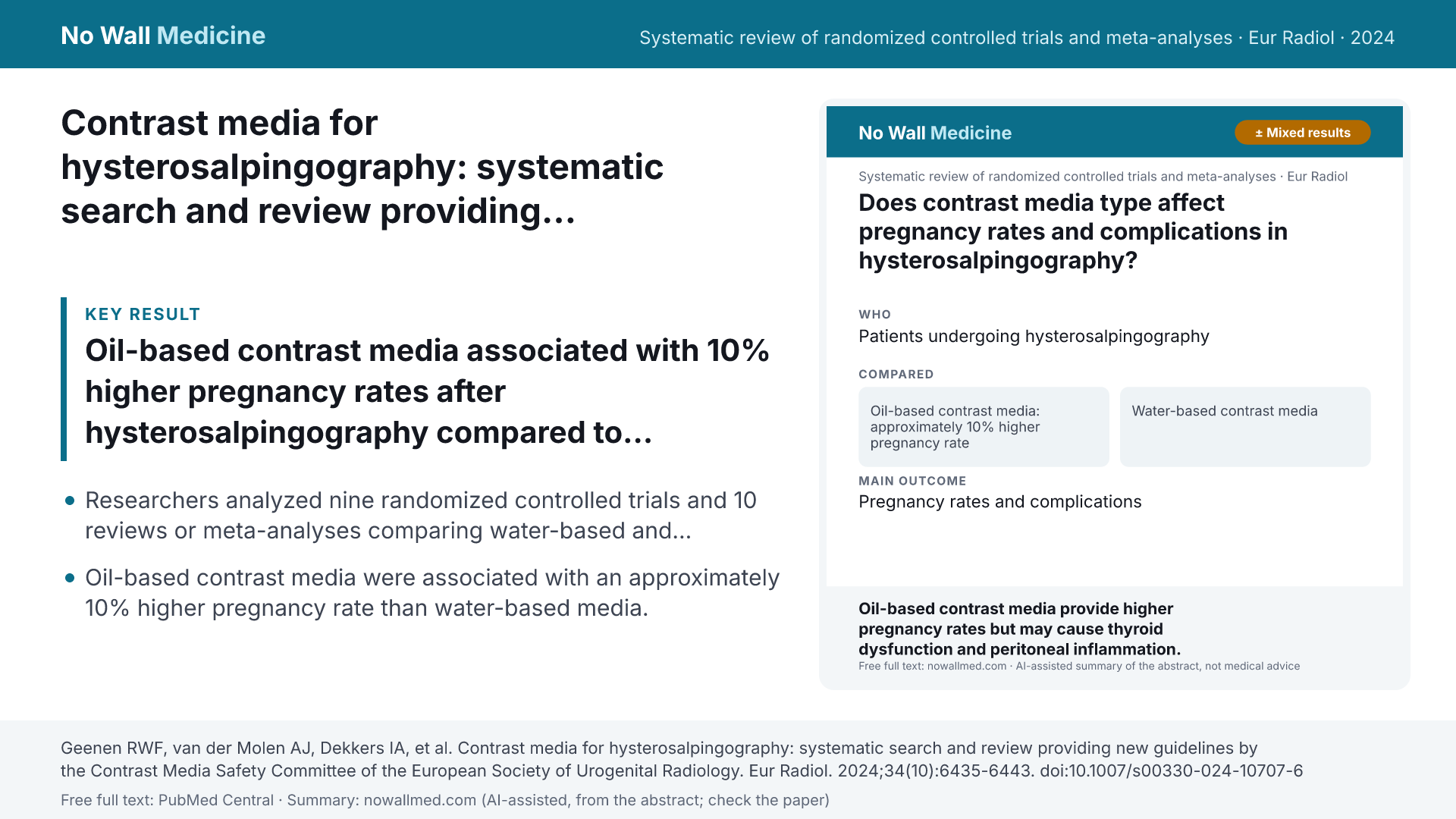
Oil-based contrast media associated with 10% higher pregnancy rates after hysterosalpingography compared to water-based media
Contrast media for hysterosalpingography: systematic search and review providing new guidelines by the Contrast Media Safety Committee of the European Society of Urogenital Radiology
Systematic review of randomized controlled trials and meta-analysesMixed results
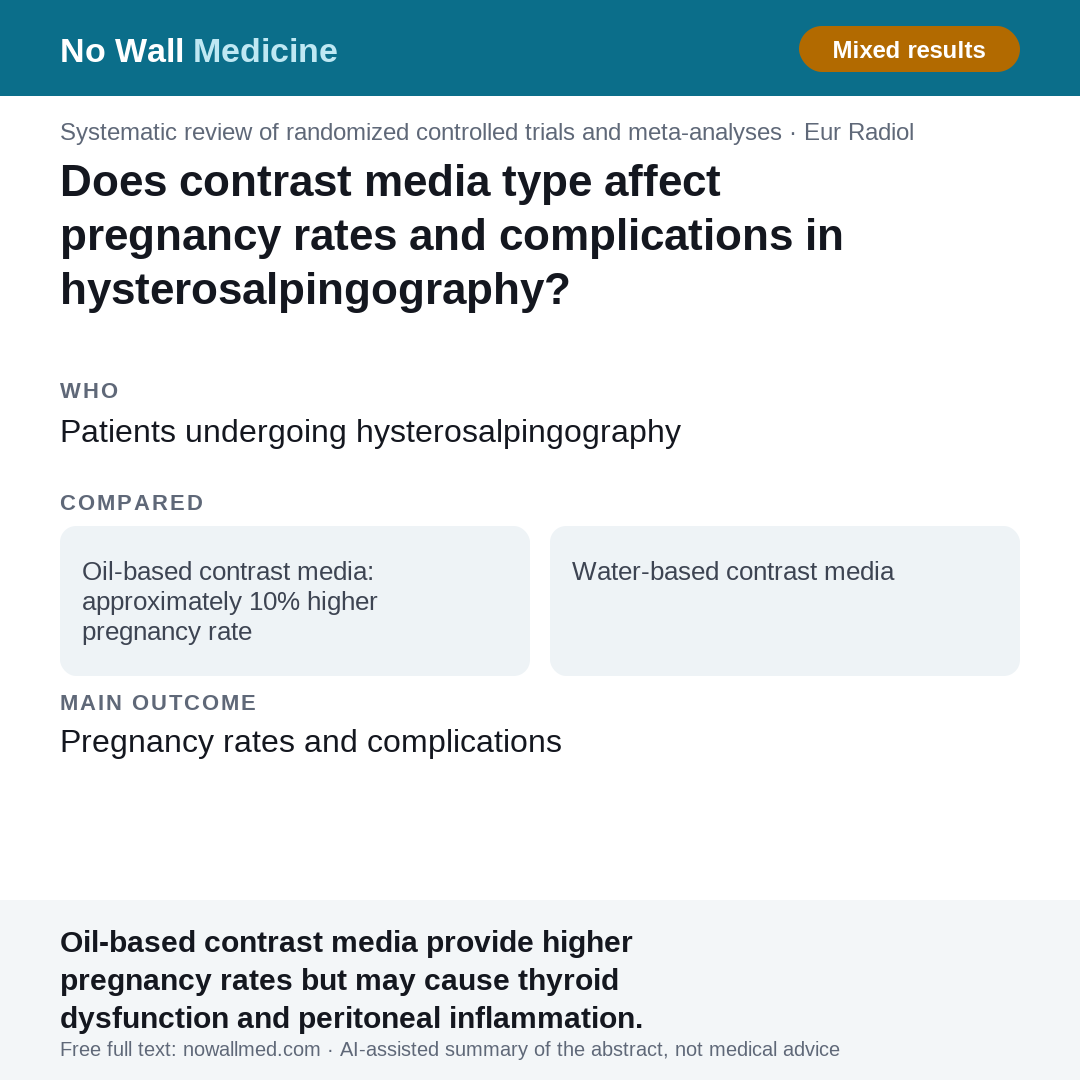
Does contrast media type affect pregnancy rates and complications in hysterosalpingography?
Who
Patients undergoing hysterosalpingography
Compared
Oil-based contrast media: approximately 10% higher pregnancy rate
Water-based contrast media
Main outcome
Pregnancy rates and complications
Bottom line: Oil-based contrast media provide higher pregnancy rates but may cause thyroid dysfunction and peritoneal inflammation.
Limitation: In five of nine randomized controlled trials, the contrast media used is no longer on the market.
Eur Radiol · 2024-04-04Download image
Clinical question: Does contrast media type affect pregnancy rates and complications in hysterosalpingography?
Why it matters: It is unknown which type of contrast medium, oil-based or water-based, is the optimal choice for hysterosalpingography.
Key points
- Researchers analyzed nine randomized controlled trials and 10 reviews or meta-analyses comparing water-based and oil-based iodine-based contrast media used during hysterosalpingography, a procedure to evaluate fallopian tubes.
- Oil-based contrast media were associated with an approximately 10% higher pregnancy rate than water-based media.
- Oil-based media were linked to potential side effects including maternal thyroid function disturbance and peritoneal inflammation or granuloma formation.
Limitation the authors note: External validity is limited because the contrast media used in five of the nine randomized controlled trials are no longer on the market.
Headline and key points written with AI from the paper’s abstract, with every number checked against it. Read the paper before relying on them.
Was this summary helpful?
Subject terms
Cite this article
Geenen RWF, van der Molen AJ, Dekkers IA, Bellin MF, Bertolotto M, Correas JM. Contrast media for hysterosalpingography: systematic search and review providing new guidelines by the Contrast Media Safety Committee of the European Society of Urogenital Radiology. Eur Radiol. 2024. doi:10.1007/s00330-024-10707-6
Spotted a mistake? Suggest a correction