Contrast media for hysterosalpingography: systematic search and review providing new guidelines by the Contrast Media Safety Committee of the European Society of Urogenital Radiology
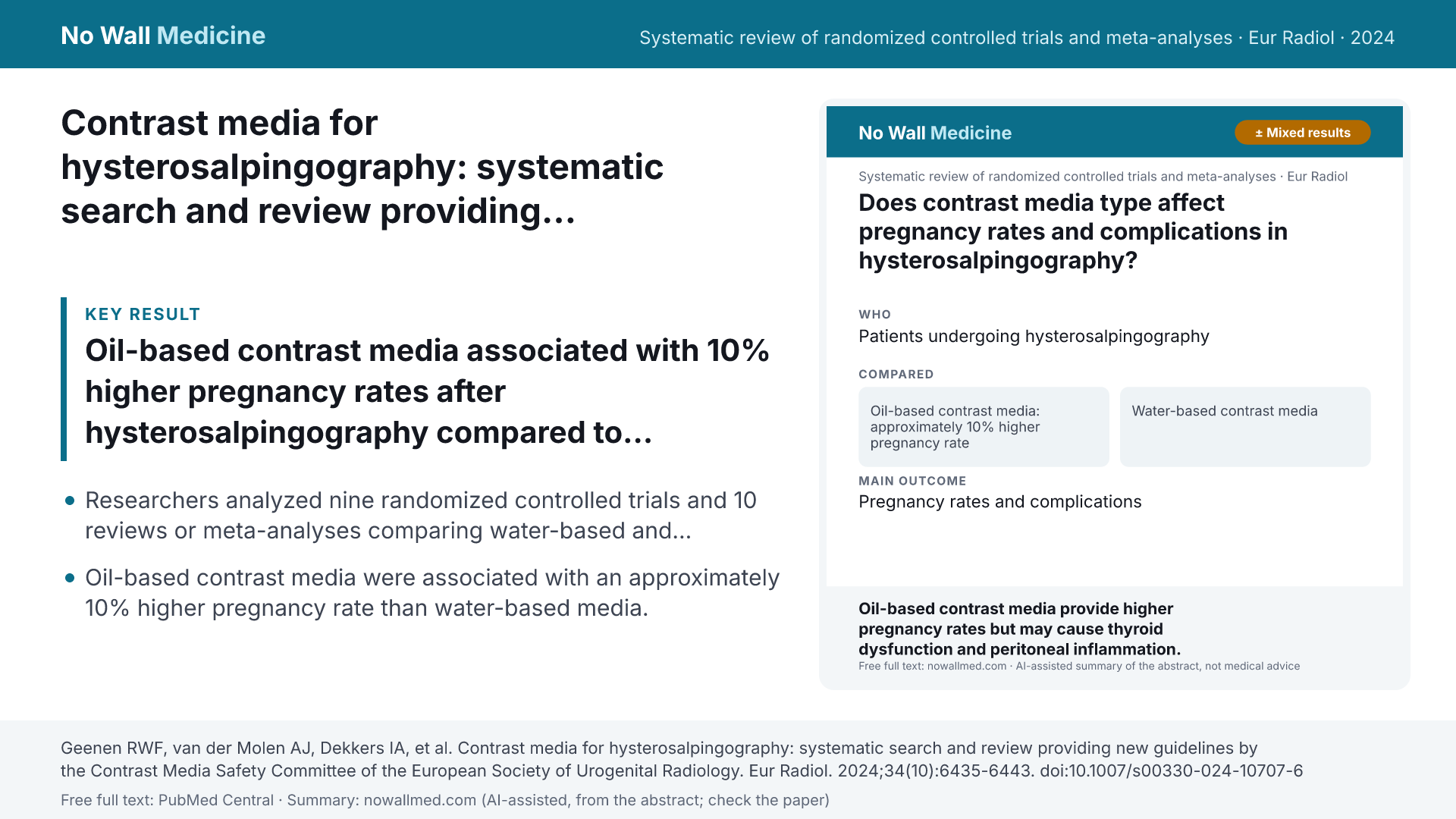
Key result: Oil-based contrast media associated with 10% higher pregnancy rates after hysterosalpingography compared to water-based media
Key points
- Researchers analyzed nine randomized controlled trials and 10 reviews or meta-analyses comparing water-based and oil-based iodine-based contrast media used during hysterosalpingography, a procedure to evaluate fallopian tubes.
- Oil-based contrast media were associated with an approximately 10% higher pregnancy rate than water-based media.
- Oil-based media were linked to potential side effects including maternal thyroid function disturbance and peritoneal inflammation or granuloma formation.
Limitation the authors note: External validity is limited because the contrast media used in five of the nine randomized controlled trials are no longer on the market.
Discussion prompts
- Would these patients look like yours? Who was left out?
- Is the main outcome one that matters to patients?
- Is the difference large enough to change what you do?
Cite: Geenen RWF, van der Molen AJ, Dekkers IA, et al. Contrast media for hysterosalpingography: systematic search and review providing new guidelines by the Contrast Media Safety Committee of the European Society of Urogenital Radiology. Eur Radiol. 2024;34(10):6435-6443. doi:10.1007/s00330-024-10707-6
Free full text: PubMed Central · Summary and visual abstract: nowallmed.com/a/contrast-media-for-hysterosalpingography-systematic-search-and-review-vjthg8/ (AI-assisted from the abstract; check the paper before relying on it).