Augmented reality needle guidance was associated with faster kidney puncture and lower stone recurrence
Conventional ultrasonography enabled with augmented reality needle guidance for percutaneous kidney access: an innovative methodologies randomized controlled trial
Single-center randomized controlled trialBenefit found
Is augmented reality needle guidance feasible and safe for percutaneous kidney access?
Who
58
Patients with renal pelvis or caliceal calculi larger than 2.0 cm · Peking University First Hospital, Beijing, China
Compared
Augmented reality navigation system: 3.12 min
Standard ultrasound-guided: 7.58 min
Main outcome
Puncture success rate and puncture time
Bottom line: Augmented reality needle guidance provides faster puncture times and lower stone recurrence rates compared to standard ultrasound guidance.
Int J Surg · 2025-01-01Download image
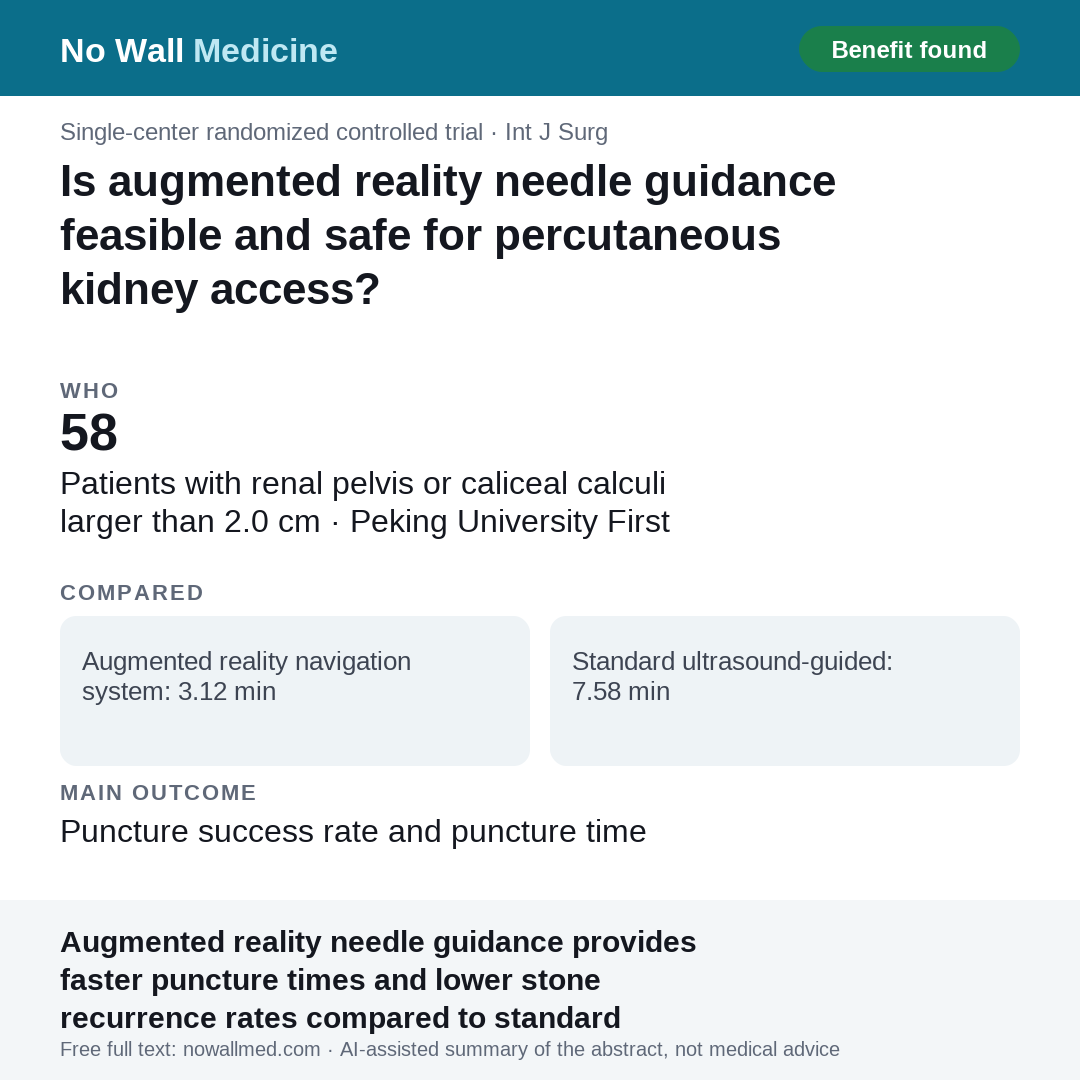
Clinical question: Is augmented reality needle guidance feasible and safe for percutaneous kidney access?
Why it matters: Standard imaging techniques like fluoroscopy and ultrasound have known limitations when guiding needle puncture into the renal collecting system during kidney stone surgery.
Key points
- Researchers compared 58 patients undergoing percutaneous nephrolithotomy, a procedure to remove kidney stones, between a new augmented reality navigation system and standard ultrasound guidance.
- The navigation system group had a mean puncture time of 3.12 min compared to 7.58 min in the standard group, and 1-year stone recurrence was 3.4% versus 24.1%.
- The 3-year stone recurrence rate was 6.9% in the navigation group compared to 41.4% in the standard ultrasound group.
Headline and key points written with AI from the paper’s abstract, with every number checked against it. Read the paper before relying on them.
Topics
Cite this article
Xu C, Li A, Peng Y, Li L, Xiong G, Fan Y. Conventional ultrasonography enabled with augmented reality needle guidance for percutaneous kidney access: an innovative methodologies randomized controlled trial. Int J Surg. 2025. doi:10.1097/JS9.0000000000002033
Spotted a mistake? Suggest a correction