Immersive virtual reality improved stone removal rates and reduced complications in kidney stone surgery
Preoperative Immersive Virtual Reality Applied to Percutaneous Nephrolithotomy: A Prospective Randomized Clinical Study of Surgical Planning and Clinical Outcomes
Prospective randomized clinical studyBenefit found
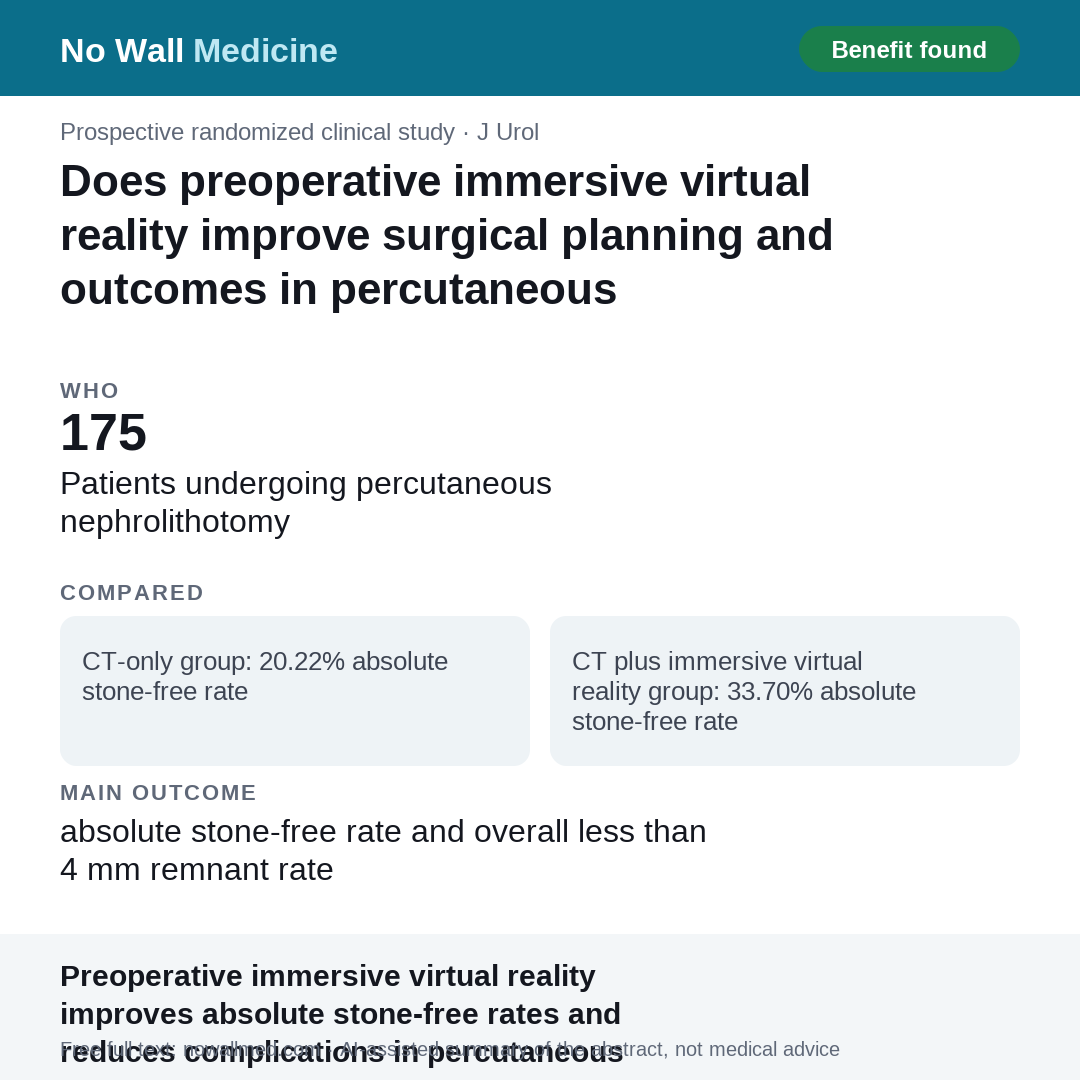
Does preoperative immersive virtual reality improve surgical planning and outcomes in percutaneous nephrolithotomy?
Who
175
Patients undergoing percutaneous nephrolithotomy
Compared
CT-only group: 20.22% absolute stone-free rate
CT plus immersive virtual reality group: 33.70% absolute stone-free rate
Main outcome
absolute stone-free rate and overall less than 4 mm remnant rate
Bottom line: Preoperative immersive virtual reality improves absolute stone-free rates and reduces complications in percutaneous nephrolithotomy.
J Urol · 2024-10-31Download image
Clinical question: Does preoperative immersive virtual reality improve surgical planning and outcomes in percutaneous nephrolithotomy?
Why it matters: Surgeons face challenges when trying to turn nearly 2000 static images from a computed tomography scan into a functional mental image for surgical planning.
Key points
- Researchers randomized 175 patients undergoing percutaneous nephrolithotomy, a procedure to remove kidney stones, into either a computed tomography (CT) scan only group or a CT plus immersive virtual reality group.
- The group using immersive virtual reality had an absolute stone-free rate of 33.70% compared to 20.22% in the CT-only group, and a rate of less than 4 mm remnants of 62.79% versus 48.20%.
- Complications classified as Clavien-Dindo II+IIIa were 3.48% in the immersive virtual reality group compared to 12.30% in the CT-only group.
Headline and key points written with AI from the paper’s abstract, with every number checked against it. Read the paper before relying on them.
Topics
Cite this article
Cumpanas AD, Hernandez MC, McCormac A, Ericson M, Lee J, Altamirano-Villarroel J. Preoperative Immersive Virtual Reality Applied to Percutaneous Nephrolithotomy: A Prospective Randomized Clinical Study of Surgical Planning and Clinical Outcomes. J Urol. 2024. doi:10.1097/JU.0000000000004284
Spotted a mistake? Suggest a correction