Shared immune signaling pathways may explain how ketamine and psychedelics provide rapid antidepressant effects
Convergent neuroimmune signaling underlying rapid antidepressant response to ketamine and psychedelics
Integrated proteomics, transcriptomics, and clinical characterization studyMixed results
What are the shared neuroimmune biomarkers of rapid antidepressant response to ketamine and psychedelics?
Who
Healthy volunteers and participants with treatment-resistant depression
Compared
Ketamine responders: decreased IL-15 and elevated B-cell signaling pathways at baseline
Ketamine non-responders: MCP-1/IL-7 pFDR < 0.009
Main outcome
Shared biomarkers of rapid antidepressant response
Bottom line: Rebalancing within the interleukin-7 and interleukin-15 axis may contribute to therapeutic efficacy for antidepressant response.
Mol Psychiatry · 2026-07-28Download image
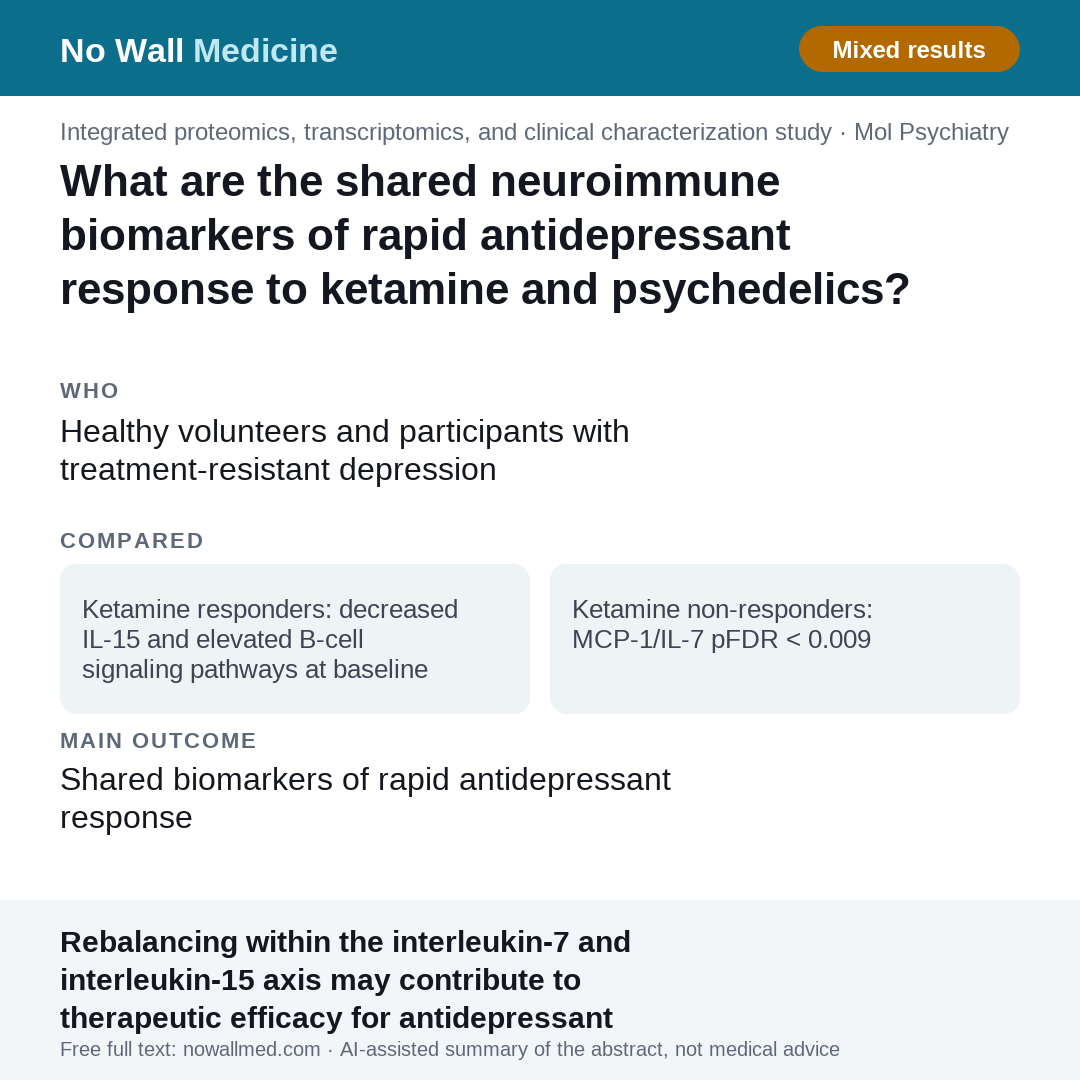
Clinical question: What are the shared neuroimmune biomarkers of rapid antidepressant response to ketamine and psychedelics?
Why it matters: Researchers sought to identify shared biological markers for the rapid antidepressant effects seen in both ketamine and serotonergic psychedelics despite their different receptor targets.
Key points
- Researchers studied healthy volunteers and people with treatment-resistant depression using cerebrospinal fluid, blood, and stem cells to compare responses to ketamine and psychedelics.
- The study identified interleukin-15 and monocyte chemoattractant protein-1 as key regulatory hubs in immune pathways shared by ketamine and psychedelics.
- Specific cytokine ratios, such as interleukin-4 to interferon gamma, were linked to predicting antidepressant response in participants.
Headline and key points written with AI from the paper’s abstract, with every number checked against it. Read the paper before relying on them.
Topics
Cite this article
Jones GH, Gilbert JR, Johnston JN, Akula N, Schulmann A, Arakelian M. Convergent neuroimmune signaling underlying rapid antidepressant response to ketamine and psychedelics. Mol Psychiatry. 2026. doi:10.1038/s41380-026-03777-z
Spotted a mistake? Suggest a correction