Conversational agents show short-term benefits for various mental health symptoms in meta-analysis
Conversational Agent Interventions for Mental Health Problems: Systematic Review and Meta-analysis of Randomized Controlled Trials
Systematic review and meta-analysis of randomized controlled trialsBenefit found
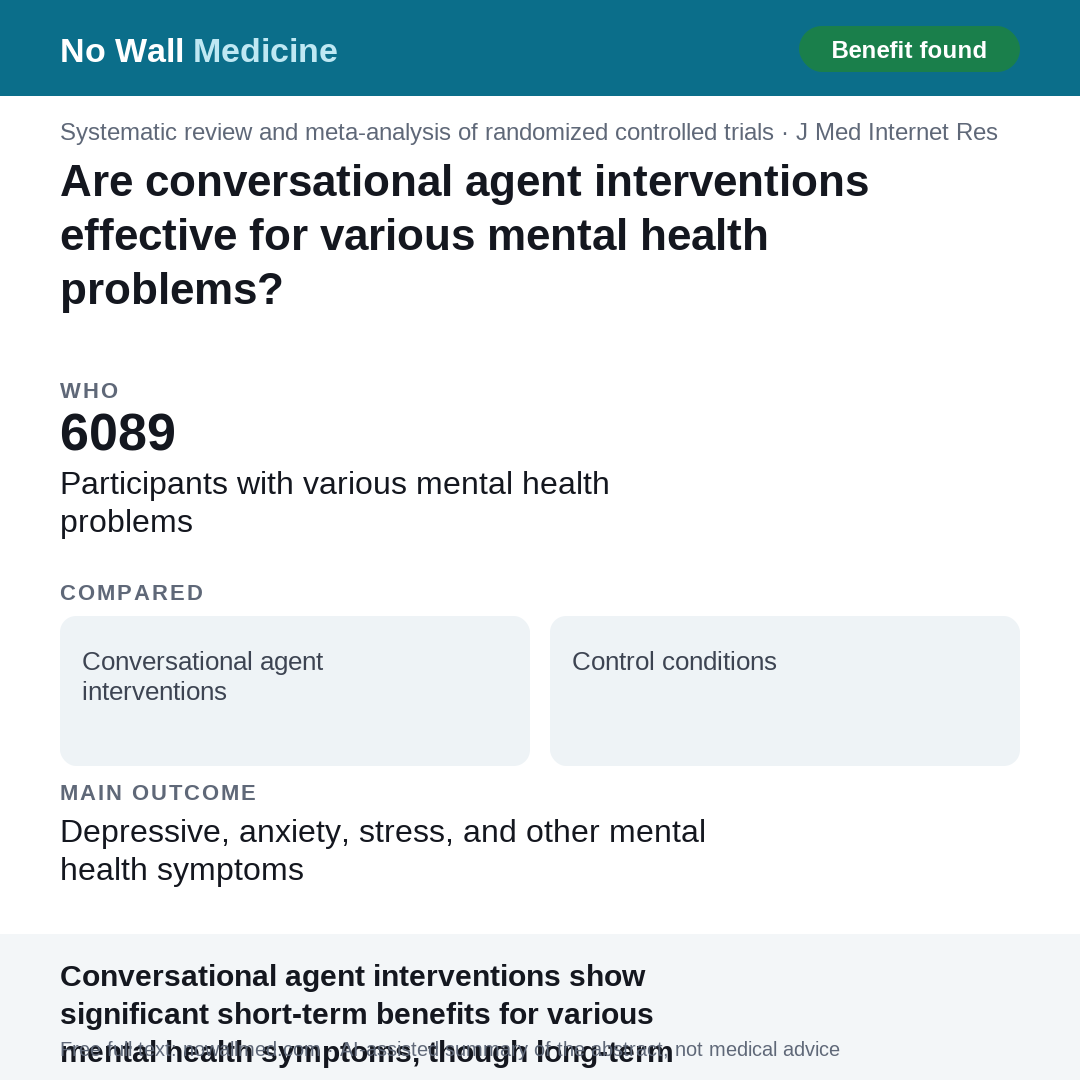
Are conversational agent interventions effective for various mental health problems?
Who
6089
Participants with various mental health problems
Compared
Conversational agent interventions
Control conditions
Main outcome
Depressive, anxiety, stress, and other mental health symptoms
Result: Hedges g ranges from -0.04 to 0.39 for long-term effects
Bottom line: Conversational agent interventions show significant short-term benefits for various mental health symptoms, though long-term effects were not statistically significant.
J Med Internet Res · 2023-04-28Download image
Clinical question: Are conversational agent interventions effective for various mental health problems?
Why it matters: The efficacy and specific characteristics of conversational agent interventions for a wide range of mental health problems were not fully summarized.
Key points
- Researchers analyzed 32 randomized controlled trials involving 6089 participants to evaluate conversational agent interventions, which are digital tools that use natural language to interact with users.
- These digital tools showed statistically significant short-term effects for depressive symptoms (g=0.29), generalized anxiety (g=0.29), specific anxiety (g=0.47), and psychosomatic disease symptoms (g=0.62).
- Long-term effects for most mental health outcomes were not statistically significant, with effect sizes ranging from g=-0.04 to 0.39.
Headline and key points written with AI from the paper’s abstract, with every number checked against it. Read the paper before relying on them.
Was this summary helpful?
Subject terms
Cite this article
He Y, Yang L, Qian C, Li T, Su Z, Zhang Q. Conversational Agent Interventions for Mental Health Problems: Systematic Review and Meta-analysis of Randomized Controlled Trials. J Med Internet Res. 2023. doi:10.2196/43862
Spotted a mistake? Suggest a correction
Top studies every Monday
The week’s key trials and guidelines in your specialties, plus any topics you follow. By email, free.
Get the weekly digest