Magnetic resonance imaging of coronary flow reserve is lower in patients with heart disease
Coronary flow reserve evaluated by phase-contrast cine cardiovascular magnetic resonance imaging of coronary sinus: a meta-analysis
Meta-analysis of 47 studiesBenefit found
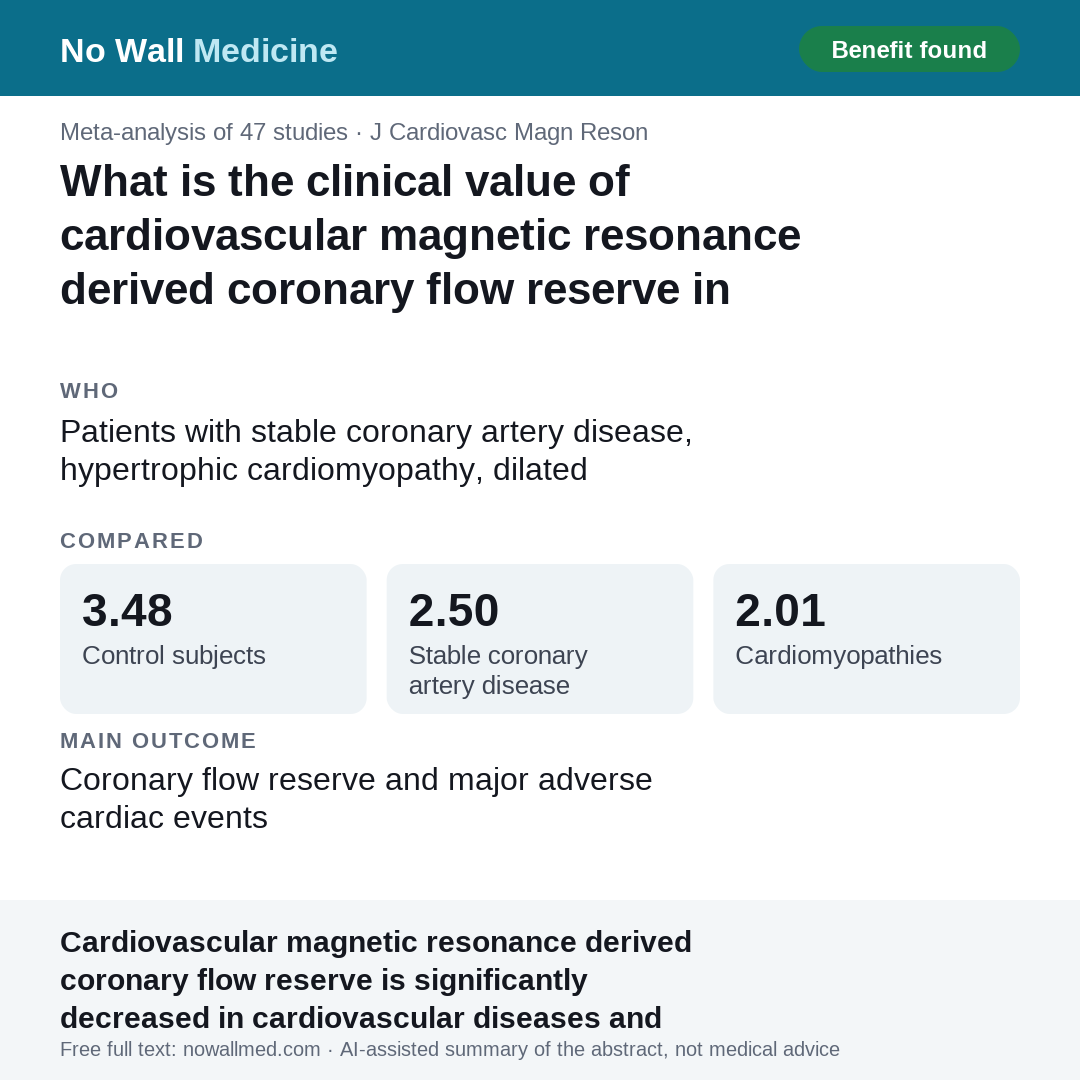
What is the clinical value of cardiovascular magnetic resonance derived coronary flow reserve in cardiovascular diseases?
Who
Patients with stable coronary artery disease, hypertrophic cardiomyopathy, dilated cardiomyopathy, and control subjects
Compared
3.48Control subjects (95% confidence interval 2.98-3.98)
2.50Stable coronary artery disease (95% CI 2.38-2.61)
2.01Cardiomyopathies (95% CI 1.70-2.32)
Main outcome
Coronary flow reserve and major adverse cardiac events
Result: hazard ratio 0.52 per unit increase (95% CI 0.37-0.73)
Bottom line: Cardiovascular magnetic resonance derived coronary flow reserve is significantly decreased in cardiovascular diseases and predicts major adverse cardiac events.
J Cardiovasc Magn Reson · 2023-02-20Download image
Clinical question: What is the clinical value of cardiovascular magnetic resonance derived coronary flow reserve in cardiovascular diseases?
Why it matters: The clinical utility of using magnetic resonance imaging to measure coronary flow reserve in various cardiovascular diseases has not been established.
Key points
- Researchers analyzed 47 studies comparing coronary flow reserve, a measure of blood flow capacity, in control subjects and patients with stable coronary artery disease, hypertrophic cardiomyopathy, and dilated cardiomyopathy.
- The pooled coronary flow reserve was 3.48 in controls, 2.50 in stable coronary artery disease, and 2.01 in patients with cardiomyopathies.
- In patients with stable coronary artery disease, lower coronary flow reserve was associated with a higher risk of major adverse cardiac events.
Headline and key points written with AI from the paper’s abstract, with every number checked against it. Read the paper before relying on them.
Topics
Cite this article
Tanigaki T, Kato S, Azuma M, Ito M, Horita N, Utsunomiya D. Coronary flow reserve evaluated by phase-contrast cine cardiovascular magnetic resonance imaging of coronary sinus: a meta-analysis. J Cardiovasc Magn Reson. 2023. doi:10.1186/s12968-023-00912-5
Spotted a mistake? Suggest a correction
Top studies every Monday
The week’s key trials and guidelines in your specialties, plus any topics you follow. By email, free.
Get the weekly digest