Increased brain folding in frontal regions was associated with better treatment response in adults with ADHD
Cortical gyrification predicts initial treatment response in adults with ADHD
Randomized trialBenefit found
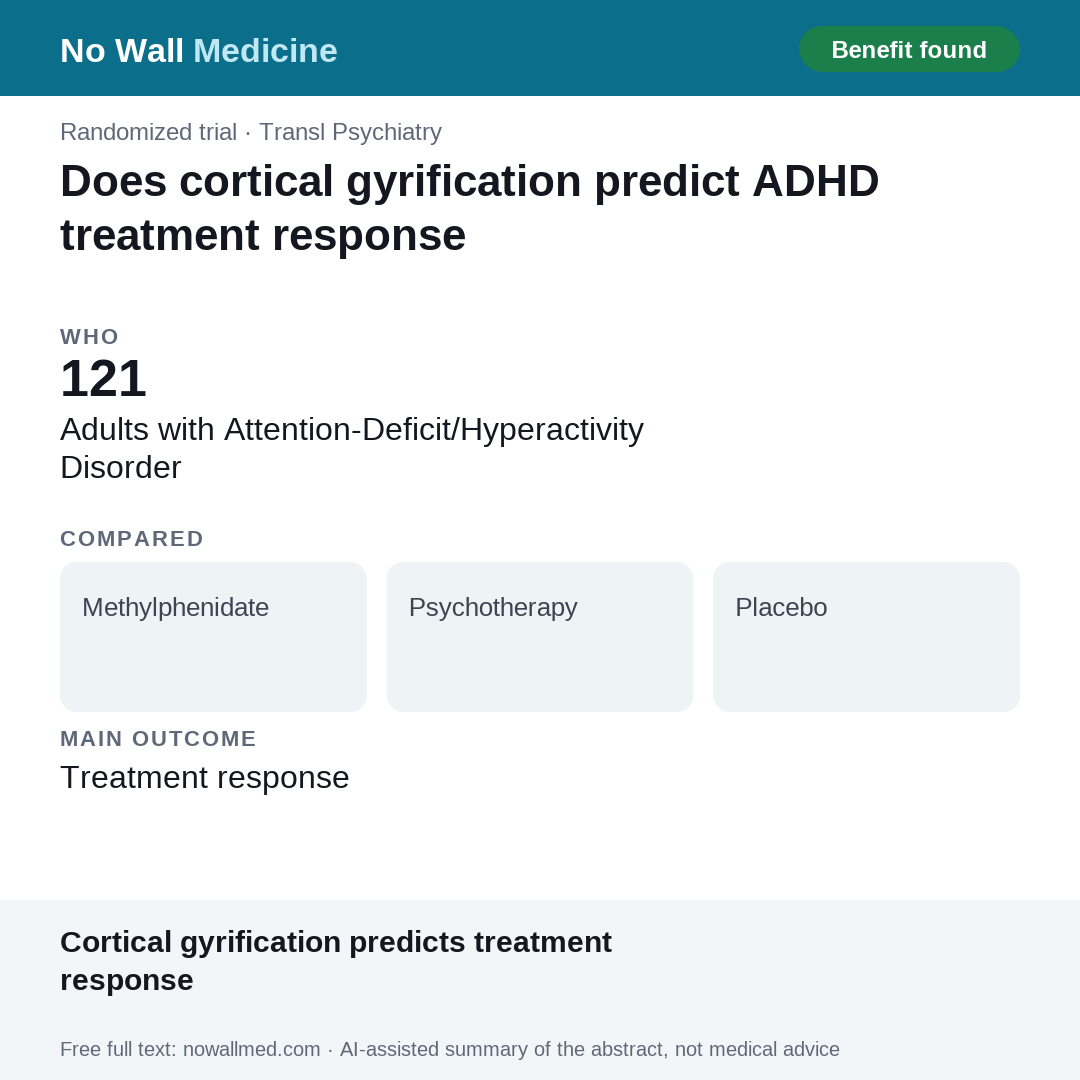
Does cortical gyrification predict ADHD treatment response
Who
121
Adults with Attention-Deficit/Hyperactivity Disorder
Compared
Methylphenidate
Psychotherapy
Placebo
Main outcome
Treatment response
Bottom line: Cortical gyrification predicts treatment response
Transl Psychiatry · 2025-10-17Download image
Why it matters: Predicting how adults with Attention-Deficit/Hyperactivity Disorder will respond to specific treatments remains underexplored in current medical practice.
Key points
- Researchers analyzed 121 anatomical brain scans to see if cortical gyrification, or the folding of the brain's surface, could predict responses to 12 weeks of treatment.
- Higher levels of cortical gyrification in specific frontal regions of the left hemisphere were associated with better treatment response across three symptom dimensions.
- The study looked at responses to psychotherapy or clinical management combined with either methylphenidate, a stimulant medication, or a placebo.
Headline and key points written with AI from the paper’s abstract, with every number checked against it. Read the paper before relying on them.
Topics
Cite this article
Laatsch J, Stein F, Maier S, Matthies S, Sobanski E, Alm B. Cortical gyrification predicts initial treatment response in adults with ADHD. Transl Psychiatry. 2025. doi:10.1038/s41398-025-03681-0
Spotted a mistake? Suggest a correction
Top studies every Monday
The week’s key trials and guidelines in your specialties, plus any topics you follow. By email, free.
Get the weekly digest