Methylphenidate was associated with brain network controllability levels similar to typically developing children
Effect of methylphenidate on functional controllability: a preliminary study in medication-naïve children with ADHD
Double-blind crossover trialBenefit found
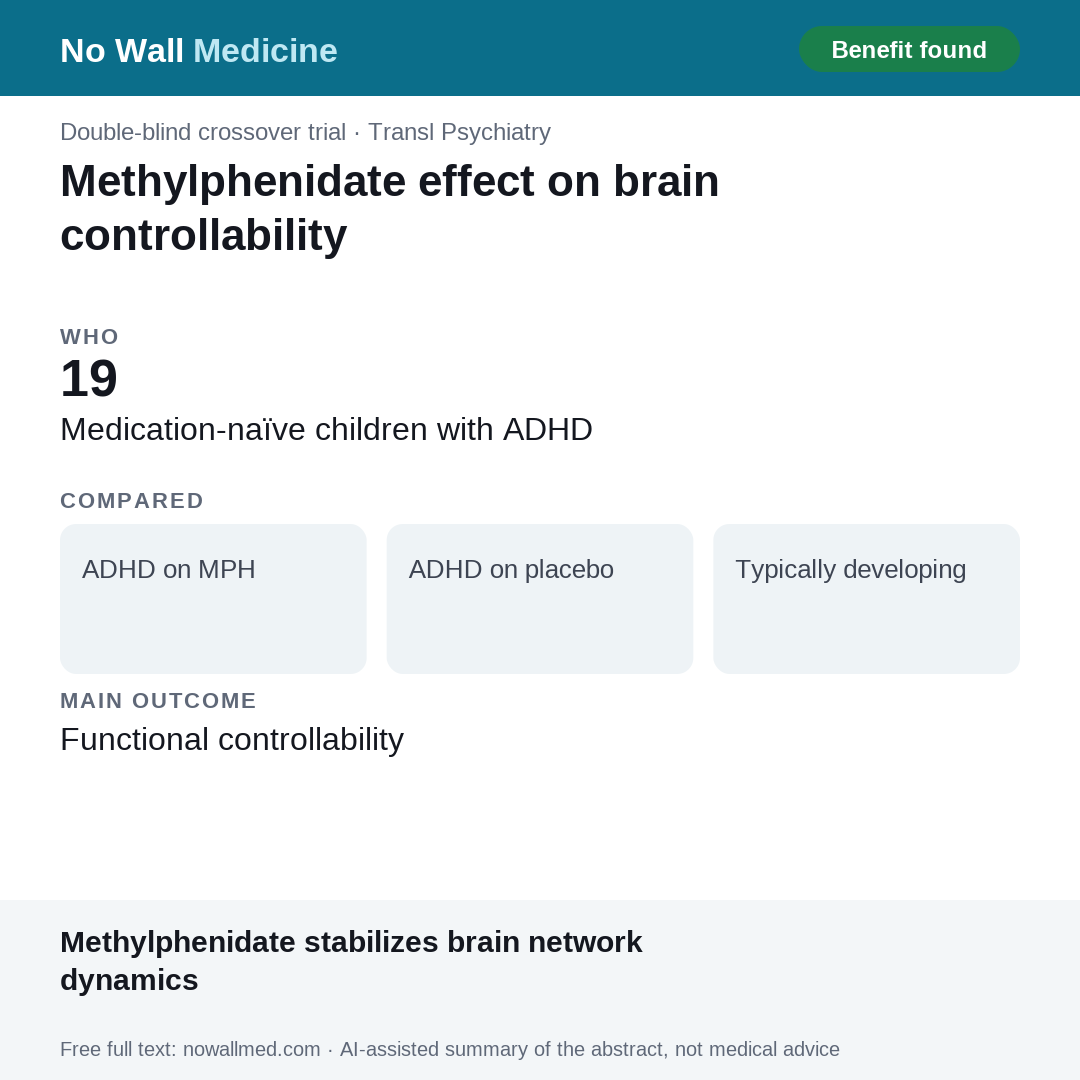
Methylphenidate effect on brain controllability
Who
19
Medication-naïve children with ADHD
Compared
ADHD on MPH
ADHD on placebo
Typically developing
Main outcome
Functional controllability
Bottom line: Methylphenidate stabilizes brain network dynamics
Transl Psychiatry · 2022-12-17Download image
Why it matters: It is unclear how methylphenidate's action as a dopamine and noradrenaline transporter blocker translates to the mitigation of attention-deficit/hyperactivity disorder symptoms through brain network dynamics.
Key points
- The study compared 19 medication-naïve children with attention-deficit/hyperactivity disorder and 27 typically developing children using functional magnetic resonance imaging scans.
- Children with attention-deficit/hyperactivity disorder on a placebo showed higher average controllability and lower modal controllability in attention, reward, and somatomotor networks than typically developing children.
- Children with attention-deficit/hyperactivity disorder taking methylphenidate were statistically indistinguishable from typically developing children across almost all measured controllability metrics.
Headline and key points written with AI from the paper’s abstract, with every number checked against it. Read the paper before relying on them.
Topics
Cite this article
Henry TR, Fogleman ND, Nugiel T, Cohen JR. Effect of methylphenidate on functional controllability: a preliminary study in medication-naïve children with ADHD. Transl Psychiatry. 2022. doi:10.1038/s41398-022-02283-4
Spotted a mistake? Suggest a correction
Top studies every Monday
The week’s key trials and guidelines in your specialties, plus any topics you follow. By email, free.
Get the weekly digest