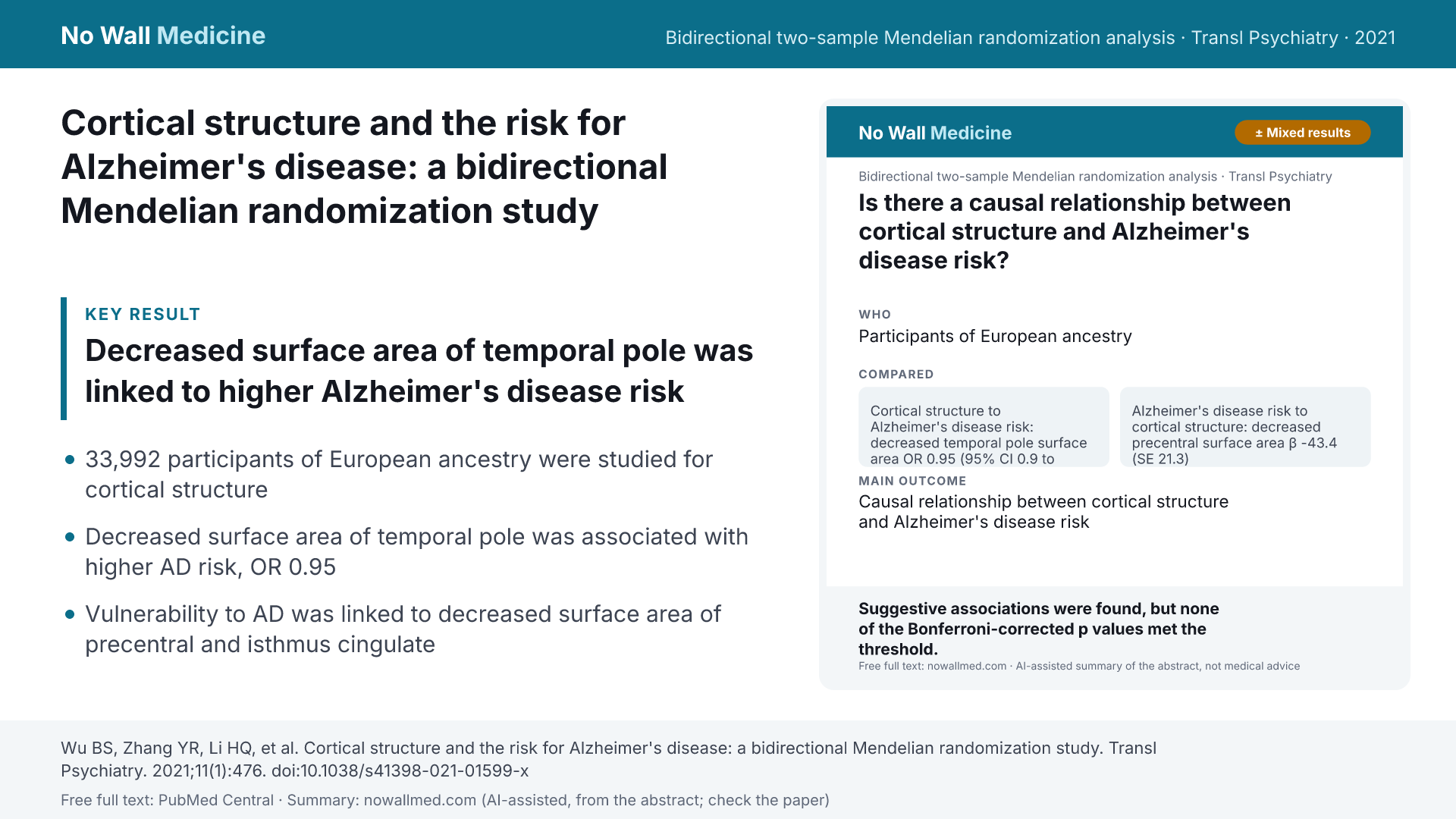
Decreased surface area of temporal pole was linked to higher Alzheimer's disease risk
Cortical structure and the risk for Alzheimer's disease: a bidirectional Mendelian randomization study
Bidirectional two-sample Mendelian randomization analysisMixed results
Is there a causal relationship between cortical structure and Alzheimer's disease risk?
Who
Participants of European ancestry
Compared
Cortical structure to Alzheimer's disease risk: decreased temporal pole surface area OR 0.95 (95% CI 0.9 to 0.997)
Alzheimer's disease risk to cortical structure: decreased precentral surface area β -43.4 (SE 21.3)
Main outcome
Causal relationship between cortical structure and Alzheimer's disease risk
Bottom line: Suggestive associations were found, but none of the Bonferroni-corrected p values met the threshold.
Limitation: None of the Bonferroni-corrected p values met the threshold.
Transl Psychiatry · 2021-09-15Download image

Clinical question: Is there a causal relationship between cortical structure and Alzheimer's disease risk?
Why it matters: The causal relationship between cortical structure and Alzheimer's disease risk was unclear
Key points
- 33,992 participants of European ancestry were studied for cortical structure.
- Decreased surface area of temporal pole was associated with higher AD risk, OR 0.95.
- Vulnerability to AD was linked to decreased surface area of precentral and isthmus cingulate.
Headline and key points written with AI from the paper’s abstract, with every number checked against it. Read the paper before relying on them.
Was this summary helpful?
Subject terms
Cite this article
Wu BS, Zhang YR, Li HQ, et al. Cortical structure and the risk for Alzheimer's disease: a bidirectional Mendelian randomization study. Transl Psychiatry. 2021. doi:10.1038/s41398-021-01599-x
Spotted a mistake? Suggest a correction