Cost-effectiveness analysis of endovascular vs surgical arteriovenous fistula creation in the United States
Decision tree and probabilistic cohort state-transition modelNo clear difference
Is endovascular versus surgical arteriovenous fistula creation cost-effective in the United States?
Who
Patients requiring arteriovenous fistula creation · United States
Compared
Endovascular arteriovenous fistula: $30,129 average per-person costs
Surgical arteriovenous fistula: $12.987 average per-person costs
Main outcome
Cost-effectiveness measured by incremental cost-effectiveness ratio
Result: incremental cost-effectiveness ratio of $227,504 per QALY gained
Bottom line: Endovascular arteriovenous fistula creation is not cost-effective compared with surgical creation when modeling five-year outcomes.
J Vasc Surg · 2023-11-11Download image
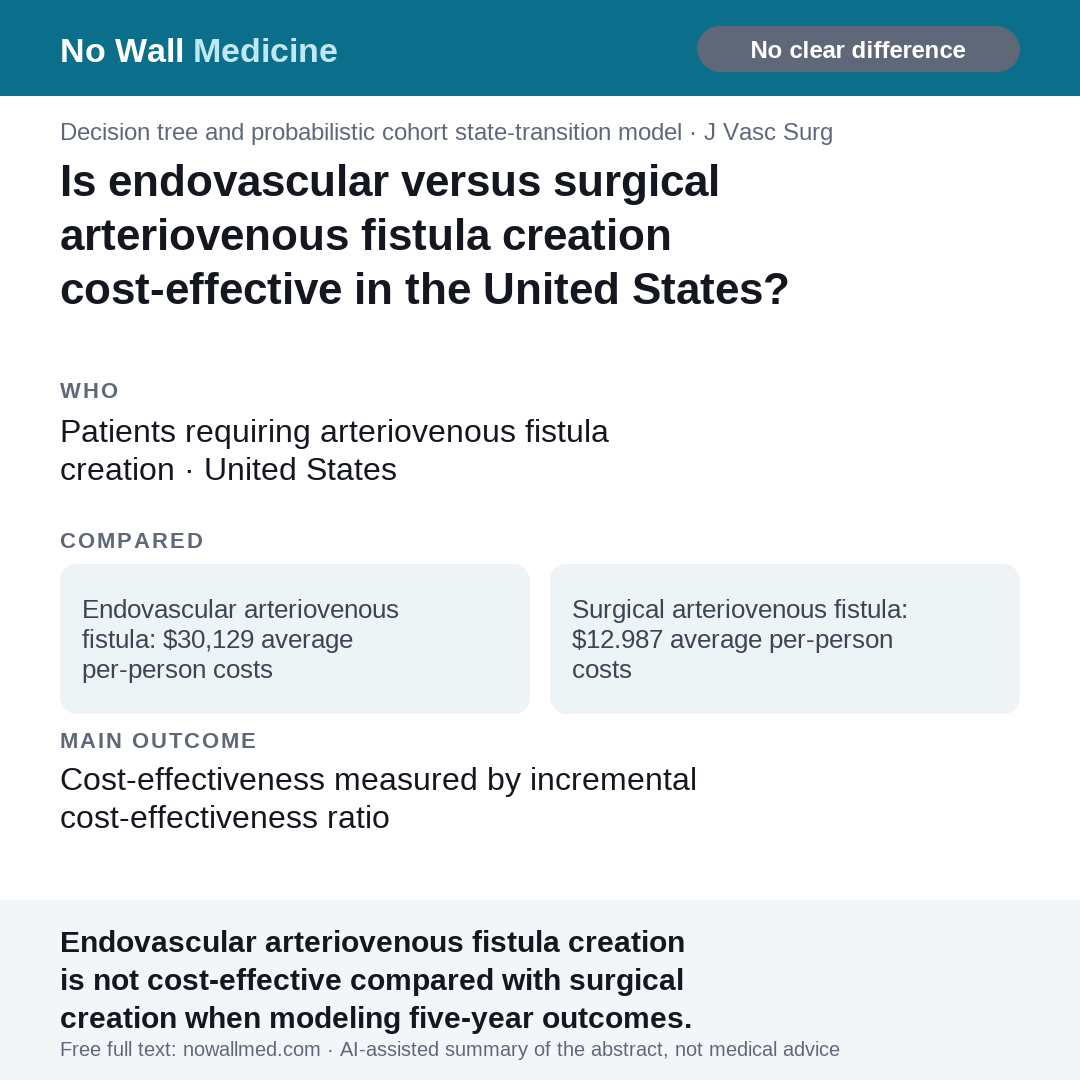
Clinical question: Is endovascular versus surgical arteriovenous fistula creation cost-effective in the United States?
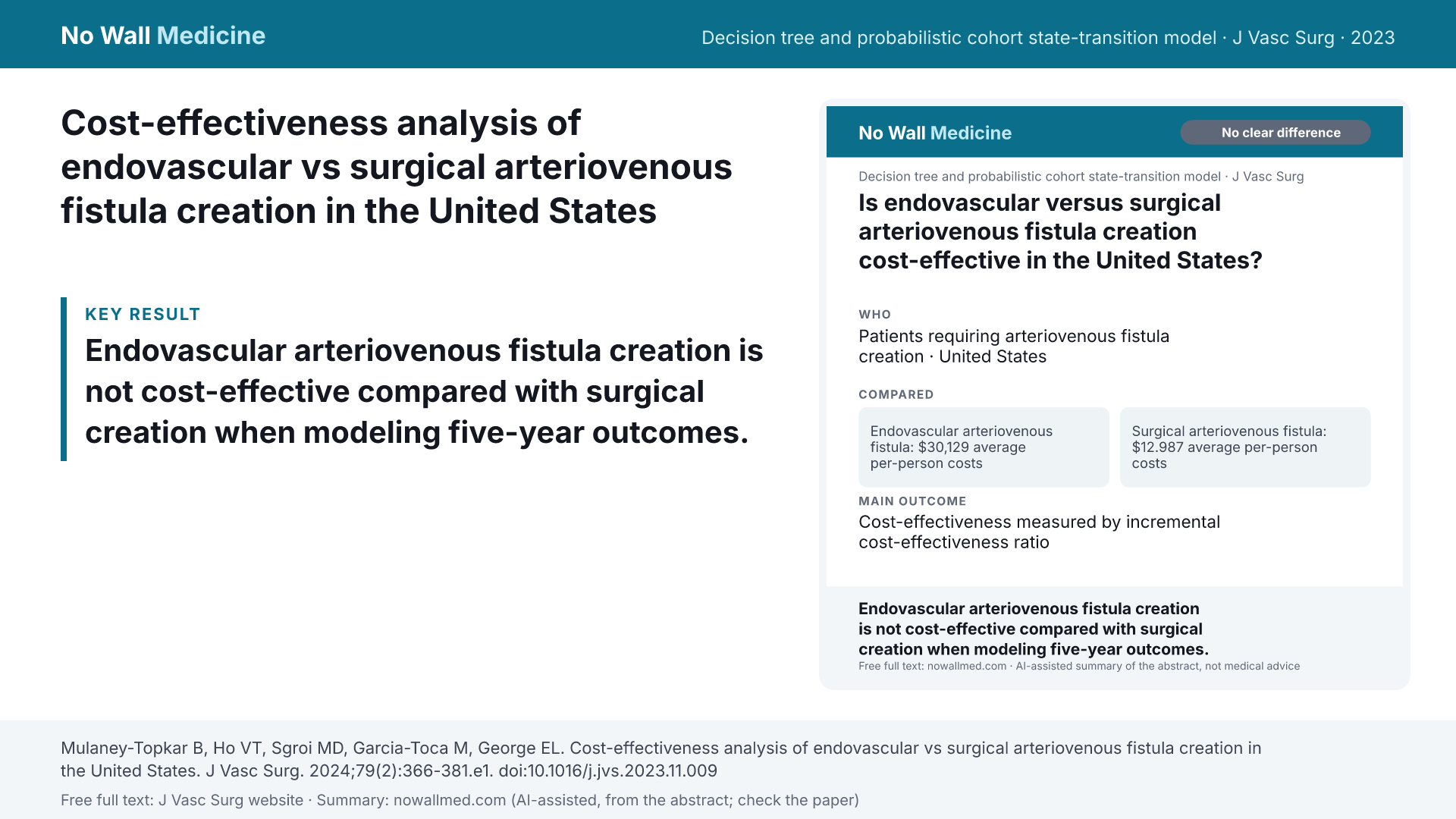
Abstract
Objective
In the United States, an estimated $2.8 billion annually is spent on vascular access and its complications. Endovascular arteriovenous fistula (endoAVF) creation is a novel, minimally invasive alternative to traditional surgical AV fistula (sAVF) creation in ≤60% of patients. Although cost effective in single-payer systems, the clinical and financial impact of endoAVF in the United States remains uncertain. Methods
We constructed a decision tree followed by a probabilistic cohort state-transition model to study the cost effectiveness of endoAVF vs sAVF creation. We conducted a systematic review to obtain input parameters including technical success, maturation, patency, and utility values. We derived costs from the Medicare 2022 fee schedule and from the literature. We used a 5-year time horizon, an annual discount rate of 3% for costs and utilities (measured in quality-adjusted life-years [QALYs]), and the common willingness-to-pay threshold of $50,000. One-way and Monte Carlo probabilistic sensitivity analyses were performed varying technical success, patency, reintervention, cost, and utility parameters. Results
In the base-case scenario, endoAVF ($30,129 average per-person costs, 2.19 QALYs gained, 65% patent at 5 years) was not cost effective compared with sAVF ($12.987 average per-person costs, 2.11 QALYs gained, 66% patent at 5 years), generating an incremental cost-effectiveness ratio of $227,504 per QALY gained. In one-way sensitivity analyses, endoAVF becomes cost effective when the initial cost of sAVF creation exceeds endoAVF by ≥$600 (eg, if endoAVF creation costs ≤$3000 relative to the base-case sAVF cost of $3600), the additional QALYs gained from endoAVF exceeds 0.12 QALYs/year (eg, 0.81 QALYs gained/year from endoAVF compared with base-case sAVF 0.69 QALYs/year), the endoAVF maturation rate is >90% (base case 78%), or the sAVF maturation rate is <65% (base case 78%). Probabilistic sensitivity analysis demonstrated that sAVF remained the optimal strategy in 71% of iterations. Conclusions
EndoAVF is not cost effective compared with sAVF when modeling 5-year outcomes. The main driver of sAVF remaining cost effective is the four times higher up-front cost for endoAVF creation, as well as a relatively low additional increase in quality of life for endoAVF. It will be important to establish how the endoAVF learning curve contributes to upfront costs and, given the annual cost attributed to vascular access nationally, a randomized controlled trial is warranted.
Subject terms
Headline, design, result, key points, caveat and citation as plain text.
Cite this article
Mulaney-Topkar B, Ho VT, Sgroi MD, Garcia-Toca M, George EL. Cost-effectiveness analysis of endovascular vs surgical arteriovenous fistula creation in the United States. J Vasc Surg. 2023. doi:10.1016/j.jvs.2023.11.009
Spotted a mistake? Suggest a correction