Group-based parenting programs in rural Kenya show high economic returns for child development
Cost-effectiveness and economic returns of group-based parenting interventions to promote early childhood development: Results from a randomized controlled trial in rural Kenya
Randomized controlled trialBenefit found
What are the cost-effectiveness and economic returns of group-based parenting interventions in rural Kenya?
Who
1152
Mothers with children aged 6 to 24 months · 60 villages in rural western Kenya
Compared
Group-only delivery model: US$140 total costs per child
Mixed-delivery model: US$145 total costs per child
Control group
Main outcome
Cognitive, receptive language, and socioemotional development
Result: ICER of 0.37 standard deviation improvement in cognition per US$100 invested
Bottom line: The group-only model was the most cost-effective, showing a benefit-cost ratio of 15.5 and 127% return on investment.
Limitation: Estimates make assumptions about discount rates, income tax rates, and future wages and schooling.
PLOS Med · 2021-09-28Download image
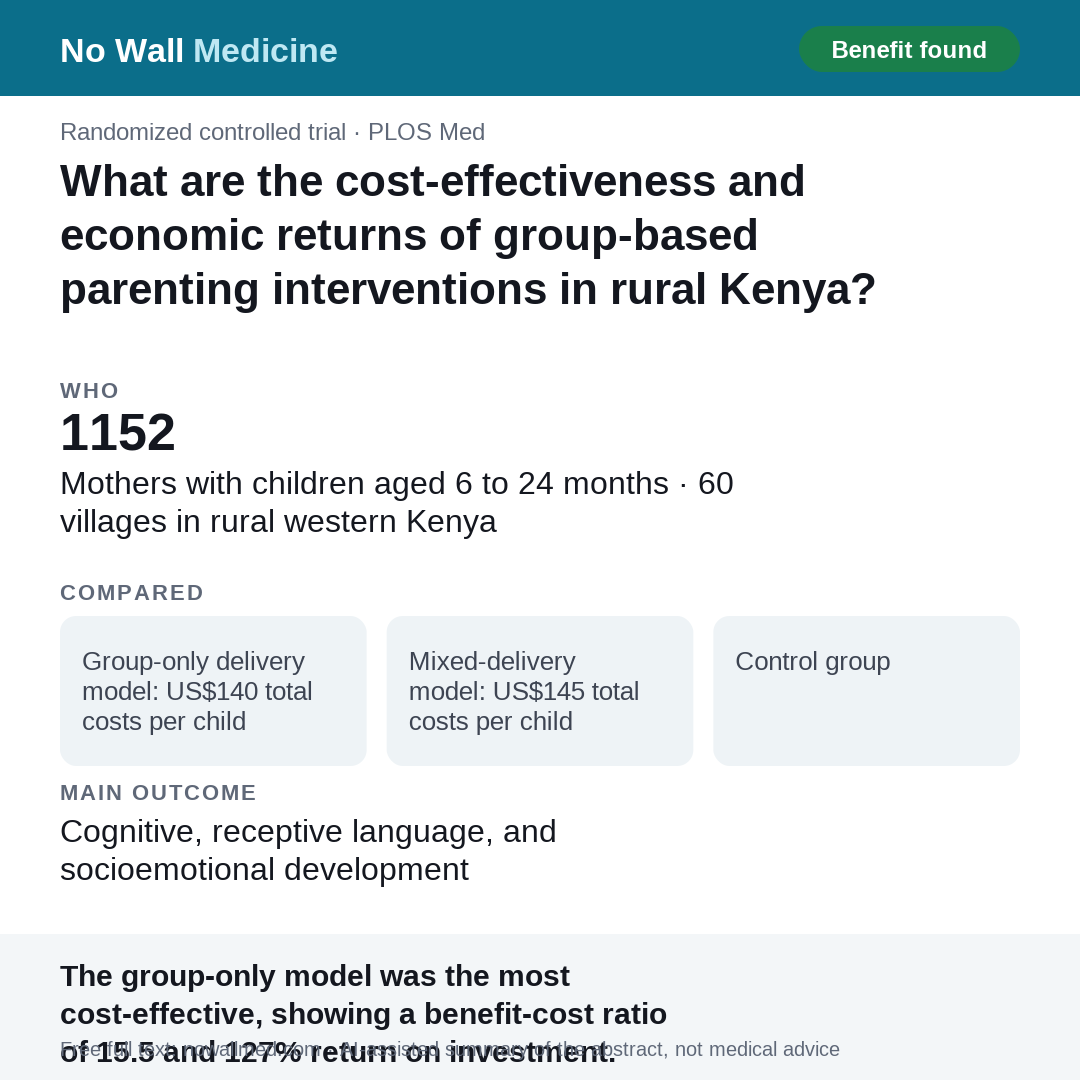
Clinical question: What are the cost-effectiveness and economic returns of group-based parenting interventions in rural Kenya?
Why it matters: Information on the cost-effectiveness and potential economic returns of early childhood development parenting interventions in low- and middle-income countries is very limited.
Key points
- Researchers studied 1,152 mothers and their children in rural Kenya, comparing a group-only session model, a mixed group and home visit model, and a control group.
- The group-only model cost US$140 per child and was the most cost-effective, showing a benefit-cost ratio of 15.5 and a return on investment of 127%.
- Children in both intervention arms showed better cognitive, language, and socioemotional development than those in the control group.
Limitation the authors note: The estimated benefit-cost ratio and return on investment rely on assumptions regarding discount rates, income tax rates, and predictions of future wages and schooling.
Headline and key points written with AI from the paper’s abstract, with every number checked against it. Read the paper before relying on them.
Was this summary helpful?
Subject terms
Cite this article
Lopez Garcia I, Saya UY, Luoto JE. Cost-effectiveness and economic returns of group-based parenting interventions to promote early childhood development: Results from a randomized controlled trial in rural Kenya. PLOS Med. 2021. doi:10.1371/journal.pmed.1003746
Spotted a mistake? Suggest a correction
Top studies every Monday
The week’s key trials and guidelines in your specialties, plus any topics you follow. By email, free.
Get the weekly digest