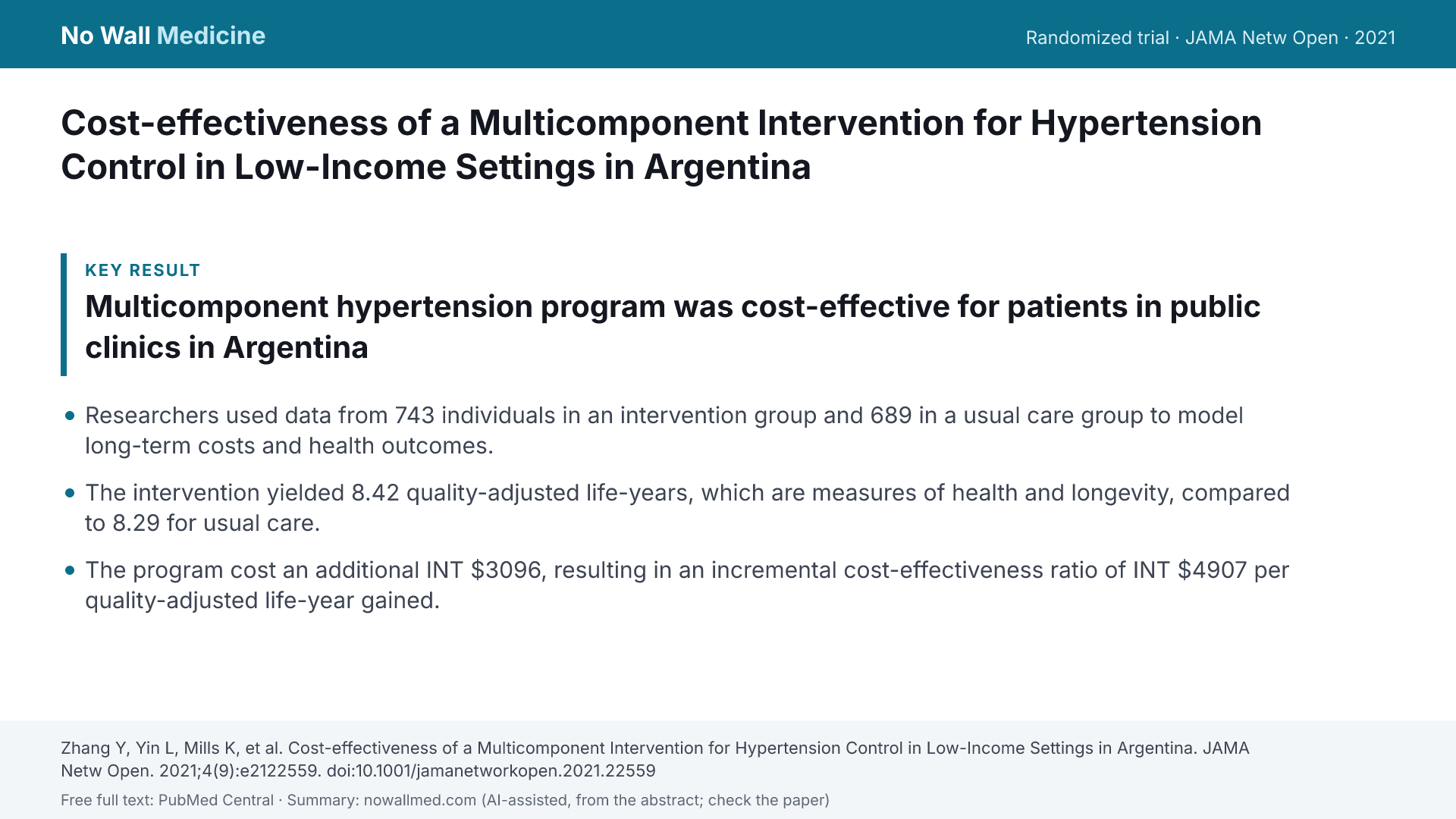
Multicomponent hypertension program was cost-effective for patients in public clinics in Argentina
Cost-effectiveness of a Multicomponent Intervention for Hypertension Control in Low-Income Settings in Argentina
Why it matters: The economic benefits of hypertension management programs in low-income settings are unknown to decision-makers.
Key points
- Researchers used data from 743 individuals in an intervention group and 689 in a usual care group to model long-term costs and health outcomes.
- The intervention yielded 8.42 quality-adjusted life-years, which are measures of health and longevity, compared to 8.29 for usual care.
- The program cost an additional INT $3096, resulting in an incremental cost-effectiveness ratio of INT $4907 per quality-adjusted life-year gained.
Headline and key points written with AI from the paper’s abstract, with every number checked against it. Read the paper before relying on them.
Was this summary helpful?
Subject terms
Cite this article
Zhang Y, Yin L, Mills K, et al. Cost-effectiveness of a Multicomponent Intervention for Hypertension Control in Low-Income Settings in Argentina. JAMA Netw Open. 2021. doi:10.1001/jamanetworkopen.2021.22559
Spotted a mistake? Suggest a correction