Cost-effectiveness of a Multicomponent Intervention for Hypertension Control in Low-Income Settings in Argentina
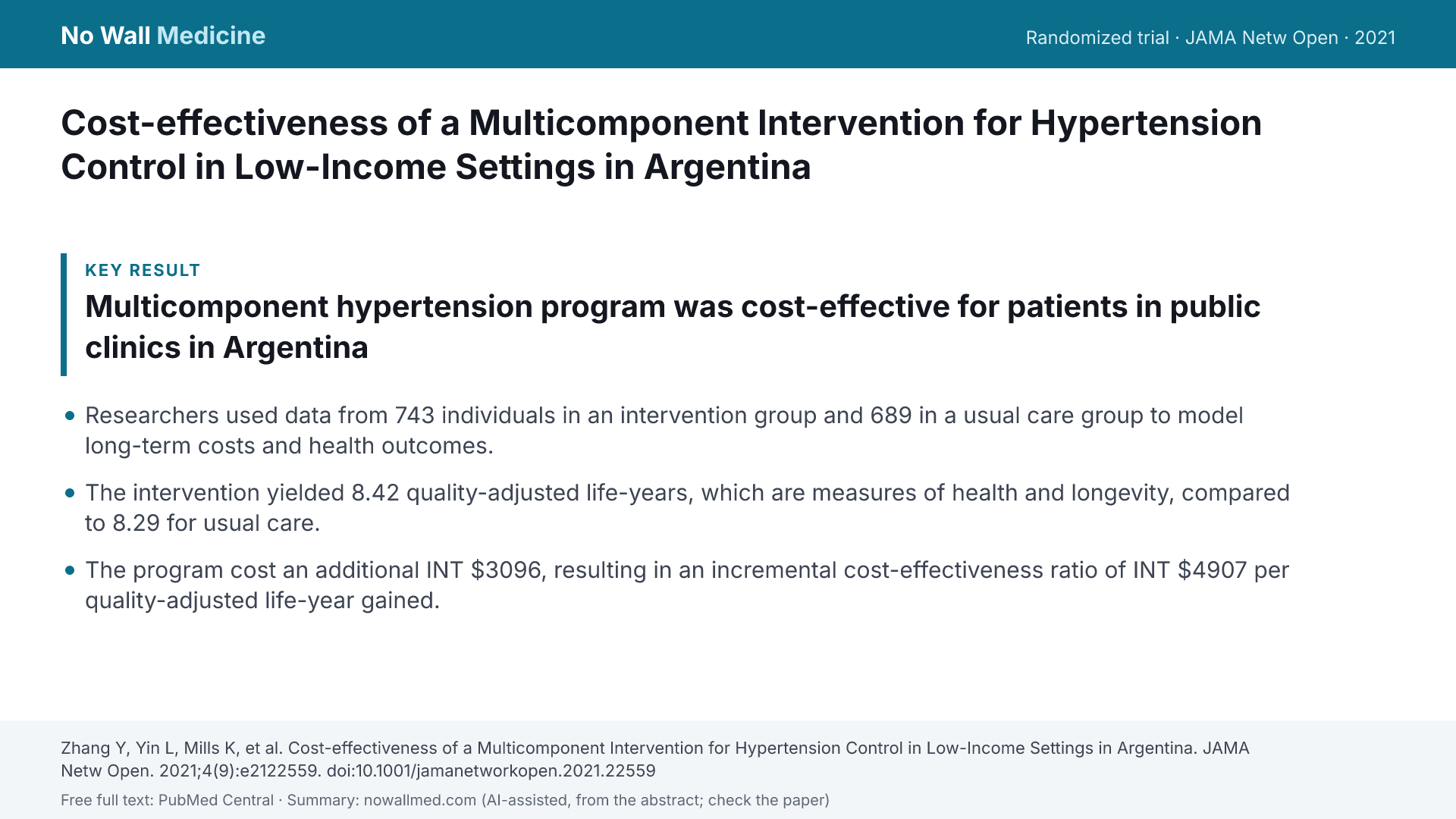
Key result: Multicomponent hypertension program was cost-effective for patients in public clinics in Argentina
Key points
- Researchers used data from 743 individuals in an intervention group and 689 in a usual care group to model long-term costs and health outcomes.
- The intervention yielded 8.42 quality-adjusted life-years, which are measures of health and longevity, compared to 8.29 for usual care.
- The program cost an additional INT $3096, resulting in an incremental cost-effectiveness ratio of INT $4907 per quality-adjusted life-year gained.
Why it matters: The economic benefits of hypertension management programs in low-income settings are unknown to decision-makers.
Discussion prompts
- Would these patients look like yours? Who was left out?
- Is the main outcome one that matters to patients?
- Is the difference large enough to change what you do?
Cite: Zhang Y, Yin L, Mills K, et al. Cost-effectiveness of a Multicomponent Intervention for Hypertension Control in Low-Income Settings in Argentina. JAMA Netw Open. 2021. doi:10.1001/jamanetworkopen.2021.22559
Free full text: PubMed Central · Summary and visual abstract: nowallmed.com/a/cost-effectiveness-of-a-multicomponent-intervention-for-hypertension-1xduwby/ (AI-assisted from the abstract; check the paper before relying on it).