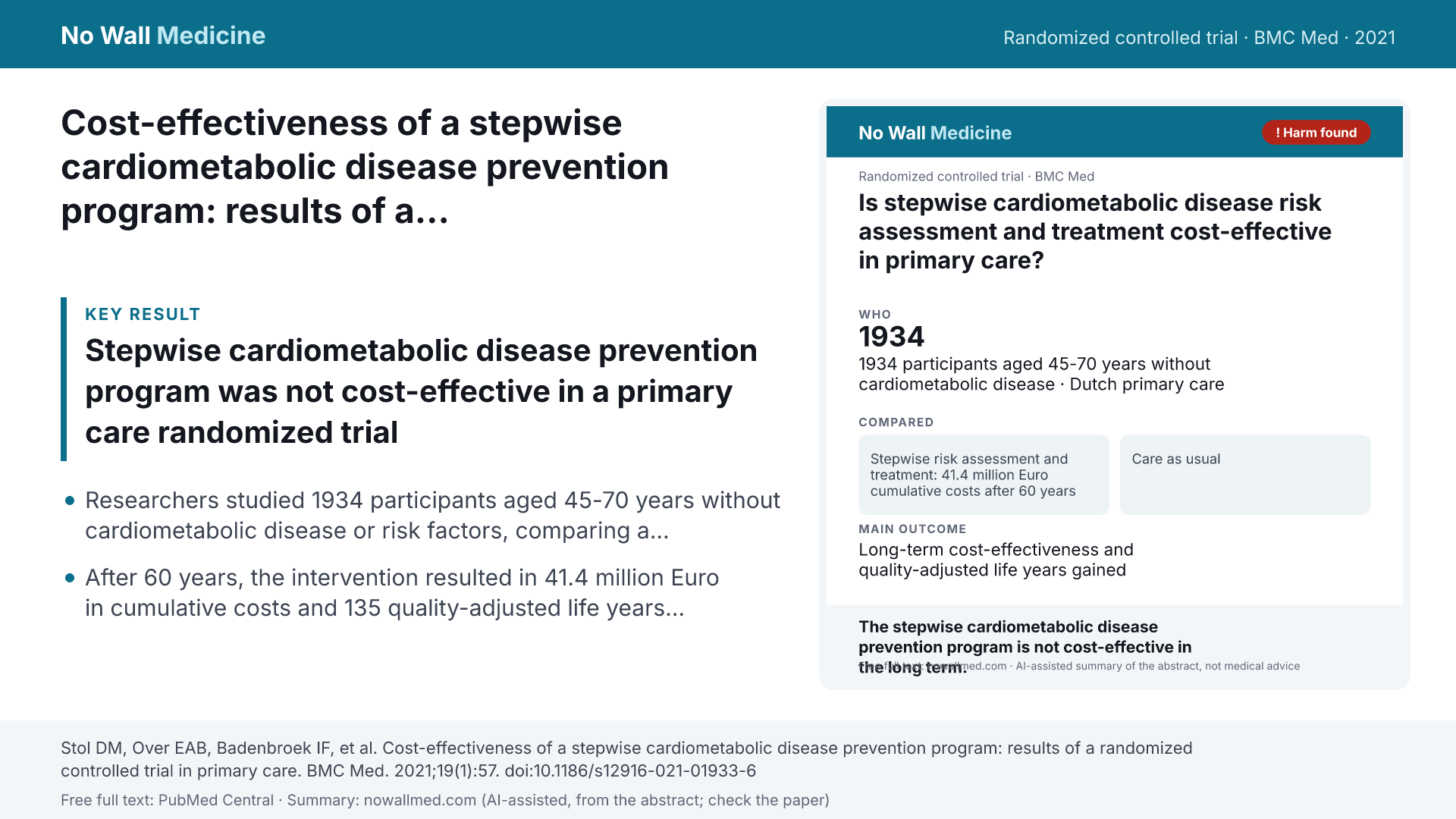
Stepwise cardiometabolic disease prevention program was not cost-effective in a primary care randomized trial
Cost-effectiveness of a stepwise cardiometabolic disease prevention program: results of a randomized controlled trial in primary care
Randomized controlled trialHarm found
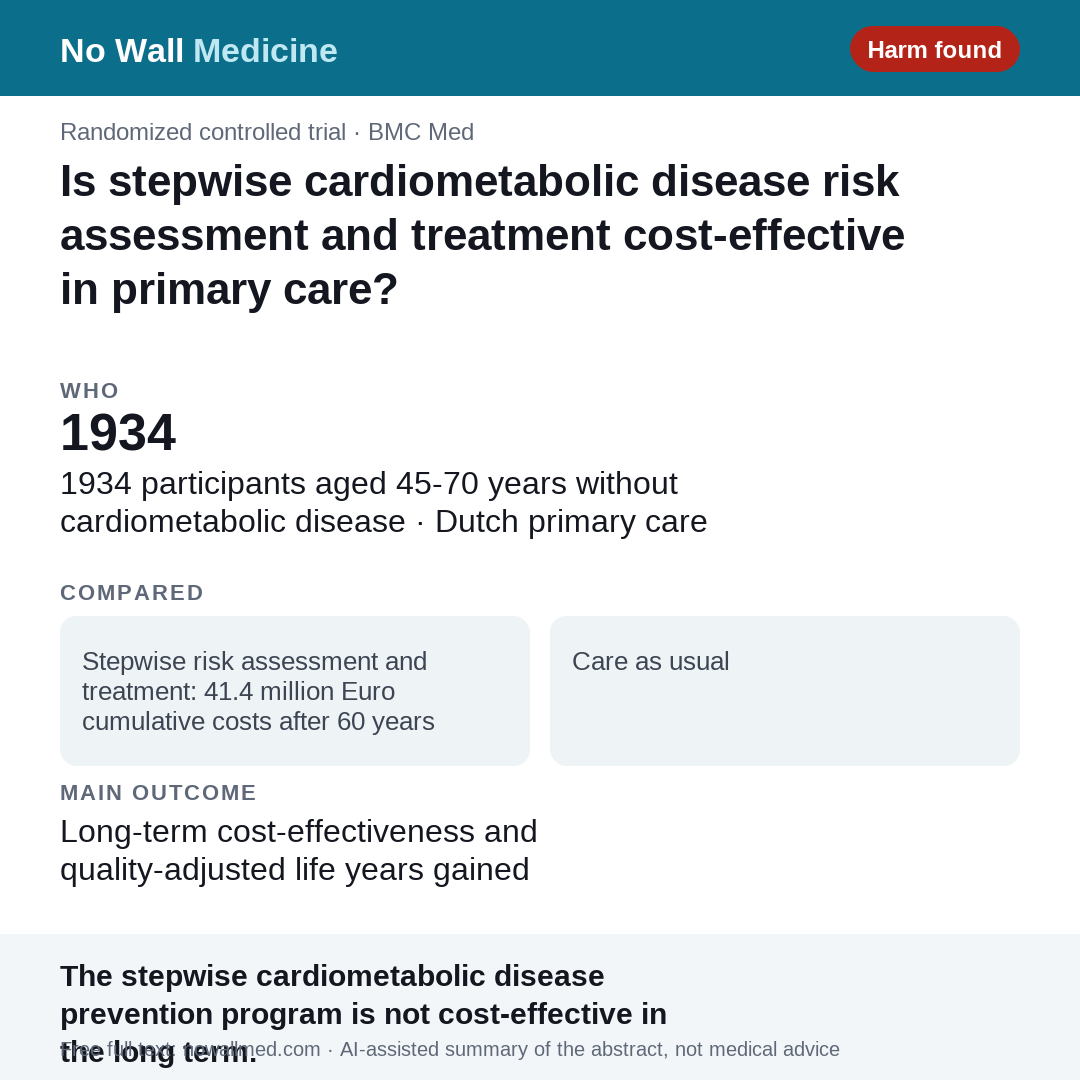
Is stepwise cardiometabolic disease risk assessment and treatment cost-effective in primary care?
Who
1934
1934 participants aged 45-70 years without cardiometabolic disease · Dutch primary care
Compared
Stepwise risk assessment and treatment: 41.4 million Euro cumulative costs after 60 years
Care as usual
Main outcome
Long-term cost-effectiveness and quality-adjusted life years gained
Result: ICER of 306,000 Euro/QALY after 60 years
Bottom line: The stepwise cardiometabolic disease prevention program is not cost-effective in the long term.
BMC Med · 2021-03-11Download image
Clinical question: Is stepwise cardiometabolic disease risk assessment and treatment cost-effective in primary care?
Key points
- Researchers studied 1934 participants aged 45-70 years without cardiometabolic disease or risk factors, comparing a three-step risk assessment and treatment program to usual care.
- After 60 years, the intervention resulted in 41.4 million Euro in cumulative costs and 135 quality-adjusted life years gained, but was not cost-effective.
- The intervention group had an incremental cost-effectiveness ratio of 306,000 Euro per quality-adjusted life year after 60 years.
Headline and key points written with AI from the paper’s abstract, with every number checked against it. Read the paper before relying on them.
Was this summary helpful?
Subject terms
Cite this article
Stol DM, Over EAB, Badenbroek IF, et al. Cost-effectiveness of a stepwise cardiometabolic disease prevention program: results of a randomized controlled trial in primary care. BMC Med. 2021. doi:10.1186/s12916-021-01933-6
Spotted a mistake? Suggest a correction