Cost-effectiveness of a stepwise cardiometabolic disease prevention program: results of a randomized controlled trial in primary care
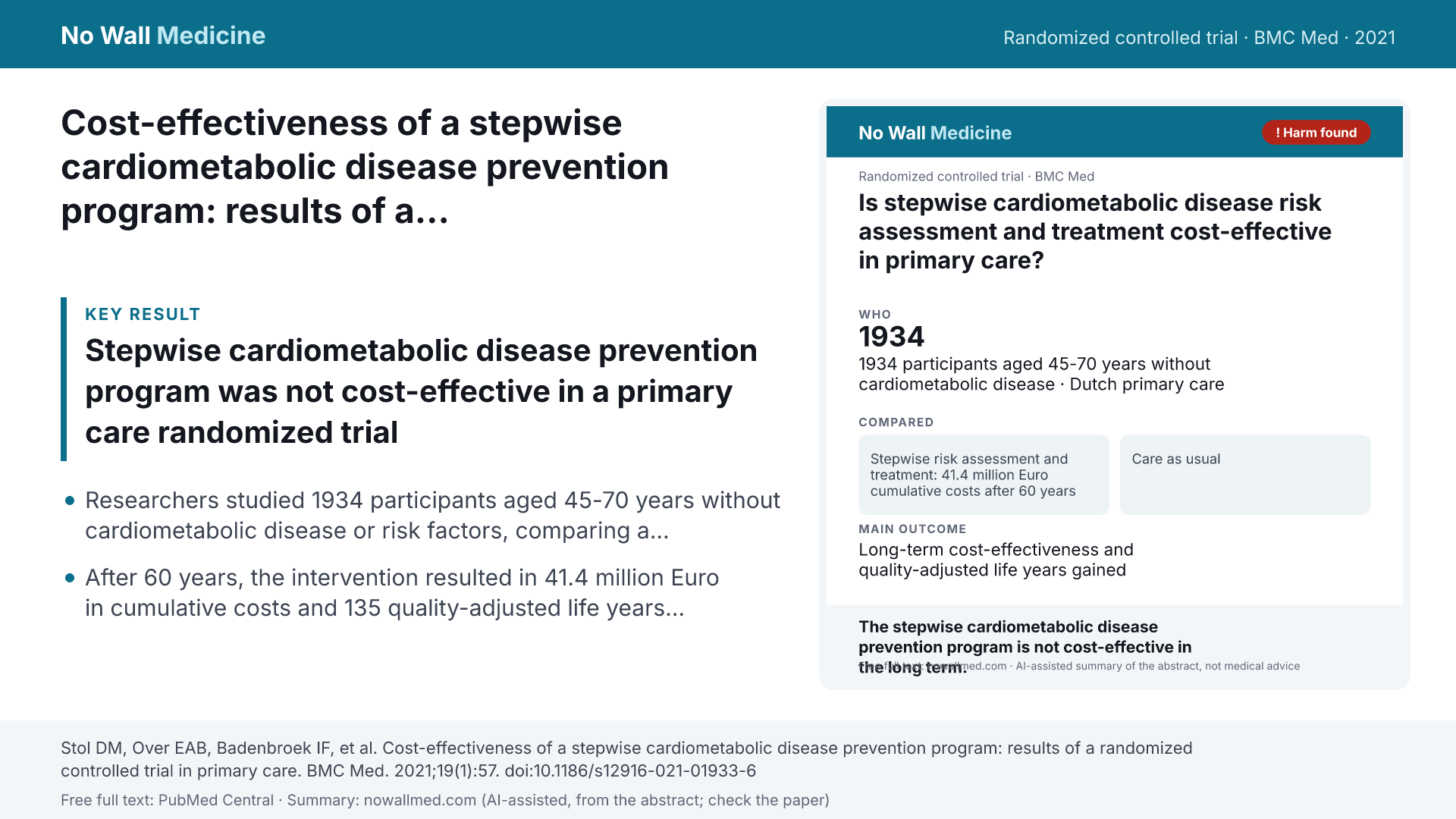
Key result: Stepwise cardiometabolic disease prevention program was not cost-effective in a primary care randomized trial
Randomized controlled trialHarm found
Is stepwise cardiometabolic disease risk assessment and treatment cost-effective in primary care?
Who
1934
1934 participants aged 45-70 years without cardiometabolic disease · Dutch primary care
Compared
Stepwise risk assessment and treatment: 41.4 million Euro cumulative costs after 60 years
Care as usual
Main outcome
Long-term cost-effectiveness and quality-adjusted life years gained
Result: ICER of 306,000 Euro/QALY after 60 years
Bottom line: The stepwise cardiometabolic disease prevention program is not cost-effective in the long term.
BMC Med · 2021-03-11
Key points
- Researchers studied 1934 participants aged 45-70 years without cardiometabolic disease or risk factors, comparing a three-step risk assessment and treatment program to usual care.
- After 60 years, the intervention resulted in 41.4 million Euro in cumulative costs and 135 quality-adjusted life years gained, but was not cost-effective.
- The intervention group had an incremental cost-effectiveness ratio of 306,000 Euro per quality-adjusted life year after 60 years.
Discussion prompts
- Would these patients look like yours? Who was left out?
- Is the main outcome one that matters to patients?
- Is the difference large enough to change what you do?
Cite: Stol DM, Over EAB, Badenbroek IF, et al. Cost-effectiveness of a stepwise cardiometabolic disease prevention program: results of a randomized controlled trial in primary care. BMC Med. 2021;19(1):57. doi:10.1186/s12916-021-01933-6
Free full text: PubMed Central · Summary and visual abstract: nowallmed.com/a/cost-effectiveness-of-a-stepwise-cardiometabolic-disease-prevention-1xuoag3/ (AI-assisted from the abstract; check the paper before relying on it).