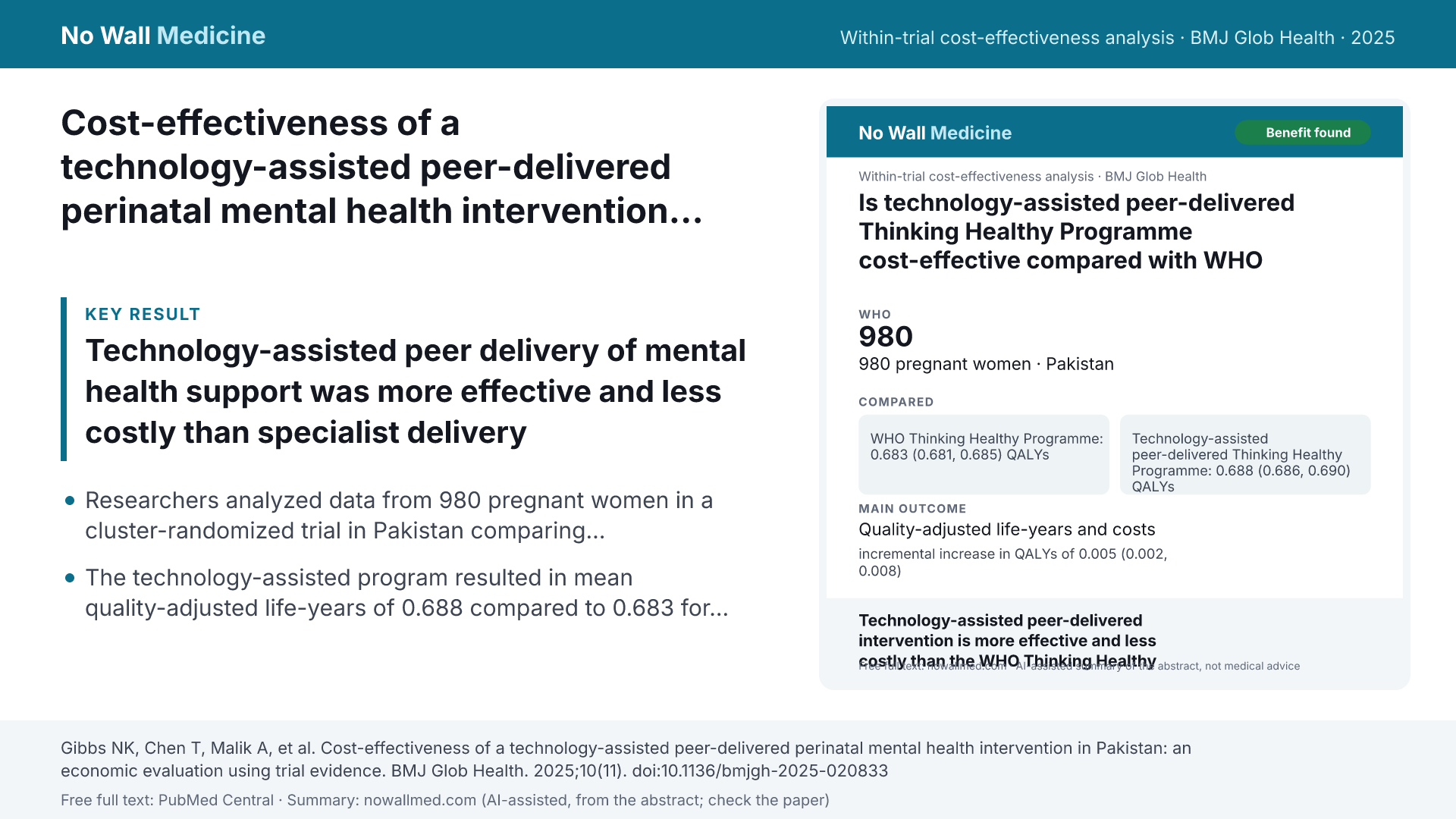
Technology-assisted peer delivery of mental health support was more effective and less costly than specialist delivery
Cost-effectiveness of a technology-assisted peer-delivered perinatal mental health intervention in Pakistan: an economic evaluation using trial evidence
Within-trial cost-effectiveness analysisBenefit found
Is technology-assisted peer-delivered Thinking Healthy Programme cost-effective compared with WHO Thinking Healthy Programme?
Who
980
980 pregnant women · Pakistan
Compared
WHO Thinking Healthy Programme: 0.683 (0.681, 0.685) QALYs
Technology-assisted peer-delivered Thinking Healthy Programme: 0.688 (0.686, 0.690) QALYs
Main outcome
Quality-adjusted life-years and costs
Result: incremental increase in QALYs of 0.005 (0.002, 0.008)
Bottom line: Technology-assisted peer-delivered intervention is more effective and less costly than the WHO Thinking Healthy Programme in Pakistan.
BMJ Glob Health · 2025-11-13Download image
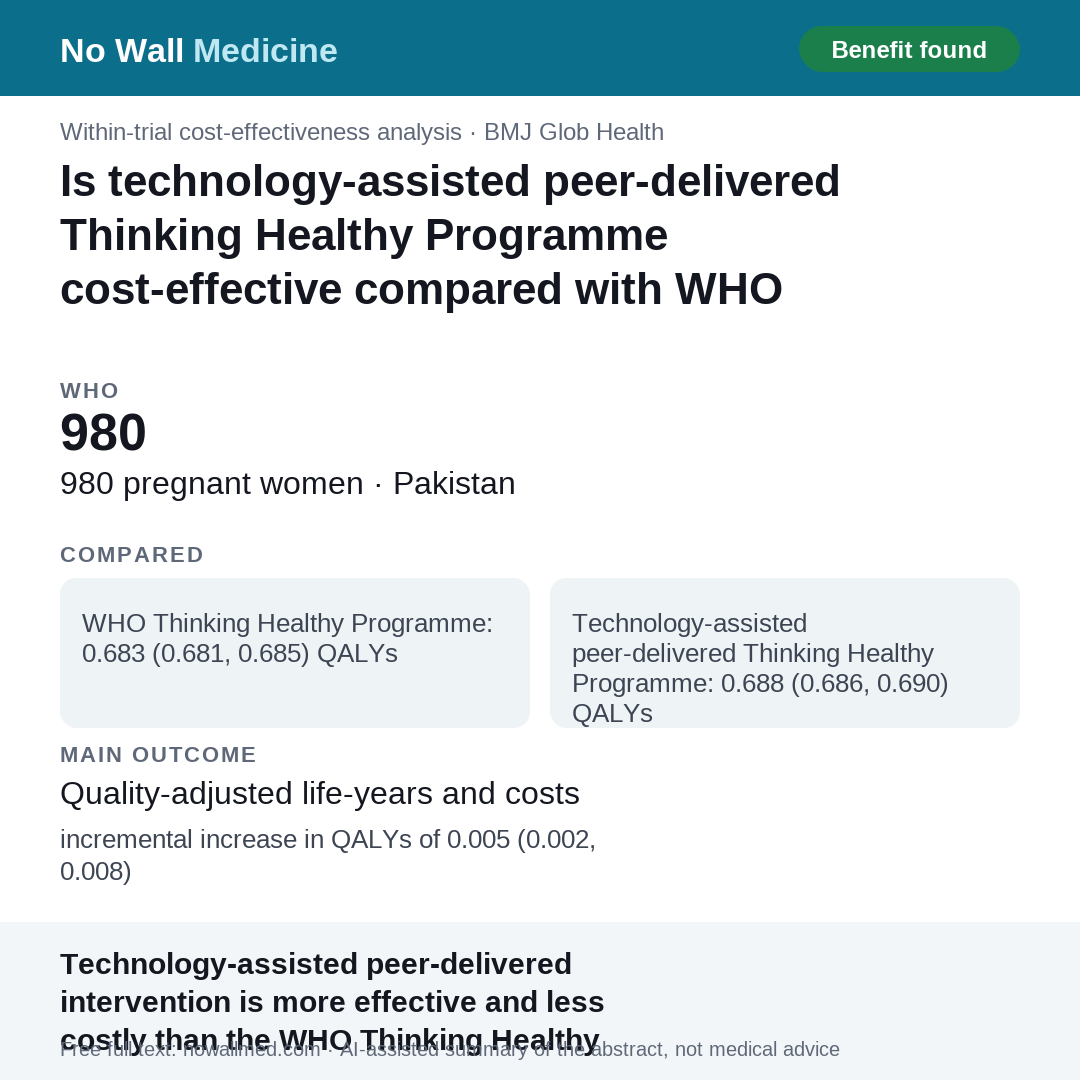
Clinical question: Is technology-assisted peer-delivered Thinking Healthy Programme cost-effective compared with WHO Thinking Healthy Programme?
Why it matters: Mental health specialists may not be scalable in resource-constrained settings to support women suffering from perinatal depression.
Key points
- Researchers analyzed data from 980 pregnant women in a cluster-randomized trial in Pakistan comparing a technology-assisted peer-delivered program to a specialist-delivered program.
- The technology-assisted program resulted in mean quality-adjusted life-years of 0.688 compared to 0.683 for the specialist program, an increase of 0.005.
- The technology-assisted program had mean per patient costs of $227 compared to $279 for the specialist program, an incremental cost of -$52.
Headline and key points written with AI from the paper’s abstract, with every number checked against it. Read the paper before relying on them.
Was this summary helpful?
Abstract
Introduction
Perinatal depression in low- and middle-income countries is a global health concern. Interventions to support women suffering from perinatal depression using mental health specialists, such as the WHO Thinking Healthy Programme (WHO-THP), are established but may not be scalable in resource-constrained settings. The technology-assisted peer-delivered THP (THP-TAP) has been developed as a potential solution to deliver an intervention at scale. This study assesses whether the THP-TAP is cost-effective compared with the WHO-THP in Pakistan. Method
Using data for 980 pregnant women from a cluster-randomised non-inferiority trial in Pakistan, we conducted a within-trial cost-effectiveness analysis of THP-TAP compared with WHO-THP. Health outcomes are quality-adjusted life-years (QALY) and costs in US$ (2022). Costs collected included intervention delivery costs and wider healthcare resource use costs. The trial intervention delivery costs were adapted to 'real-world' intervention delivery costs using evidence and assumptions. Uncertainty was explored through scenario and sensitivity analyses. Results
During the trial, the mean patient QALYs were 0.683 (0.681, 0.685) for WHO-THP and 0.688 (0.686, 0.690) for THP-TAP, resulting in an incremental increase in QALYs of 0.005 (0.002, 0.008). The mean per patient costs were $279 ($268, $290) for WHO-THP and $227 for THP-TAP ($218, $236), resulting in an incremental cost of -$52 (-67, -$38). The per patient delivery costs were estimated at $44 and $24 in the real-world scenario, whereas in the trial they were $59 and $69, for WHO-THP and THP-TAP, respectively.THP-TAP is both more effective and less costly than WHO-THP. These results were robust when considering parameter uncertainty and across various scenarios. Conclusions
Our analysis suggests that THP-TAP could represent a scalable, health-improving and cost-saving intervention to support those with perinatal depression, when compared with WHO-THP.
Abstract reproduced under the article’s CC BY licence.
Subject terms
Cite this article
Gibbs NK, Chen T, Malik A, et al. Cost-effectiveness of a technology-assisted peer-delivered perinatal mental health intervention in Pakistan: an economic evaluation using trial evidence. BMJ Glob Health. 2025. doi:10.1136/bmjgh-2025-020833
Spotted a mistake? Suggest a correction