Cost-effectiveness of a technology-assisted peer-delivered perinatal mental health intervention in Pakistan: an economic evaluation using trial evidence
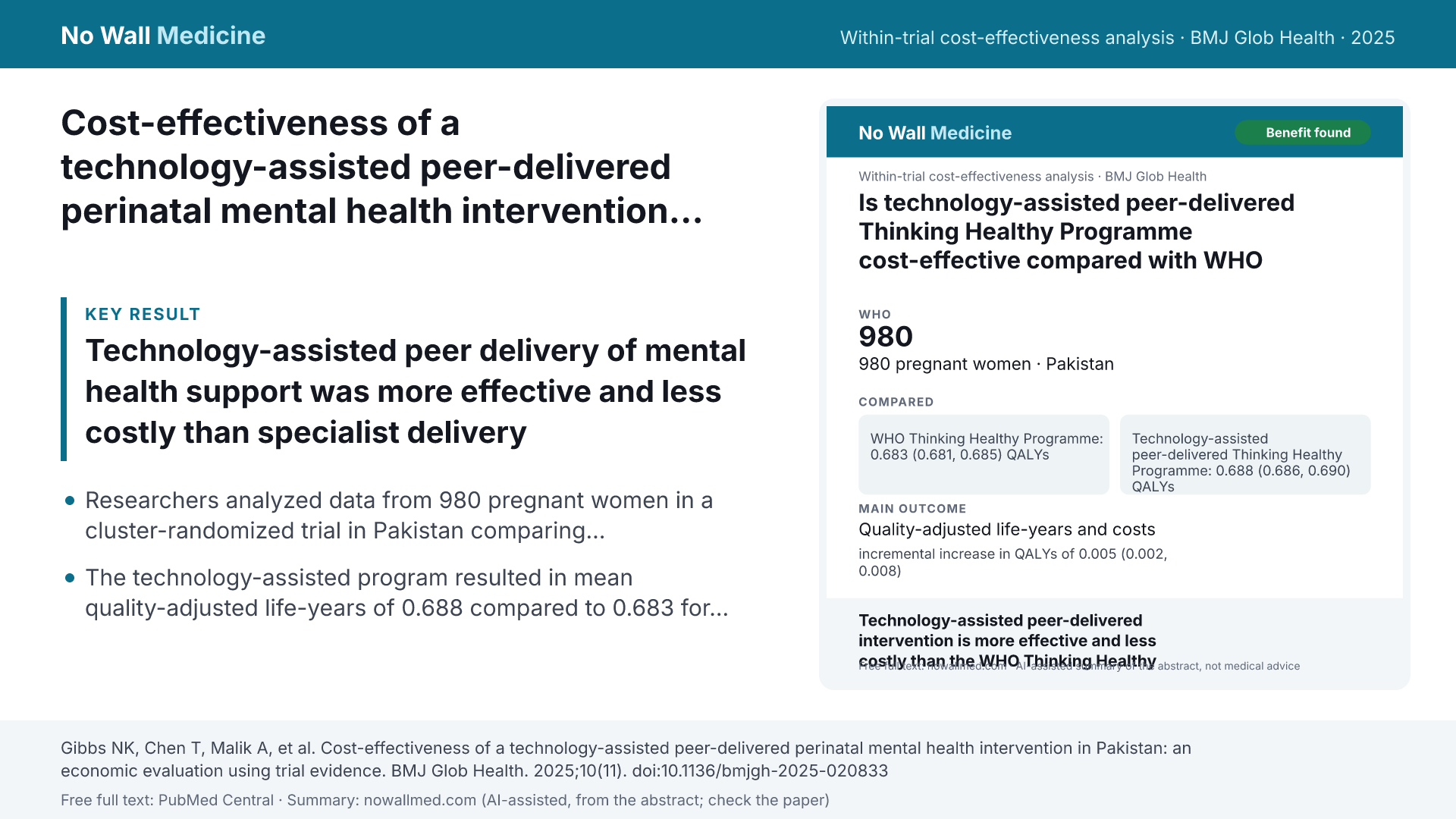
Key result: Technology-assisted peer delivery of mental health support was more effective and less costly than specialist delivery
Key points
- Researchers analyzed data from 980 pregnant women in a cluster-randomized trial in Pakistan comparing a technology-assisted peer-delivered program to a specialist-delivered program.
- The technology-assisted program resulted in mean quality-adjusted life-years of 0.688 compared to 0.683 for the specialist program, an increase of 0.005.
- The technology-assisted program had mean per patient costs of $227 compared to $279 for the specialist program, an incremental cost of -$52.
Why it matters: Mental health specialists may not be scalable in resource-constrained settings to support women suffering from perinatal depression.
Discussion prompts
- Would these patients look like yours? Who was left out?
- Is the main outcome one that matters to patients?
- Is the difference large enough to change what you do?
Cite: Gibbs NK, Chen T, Malik A, et al. Cost-effectiveness of a technology-assisted peer-delivered perinatal mental health intervention in Pakistan: an economic evaluation using trial evidence. BMJ Glob Health. 2025;10(11). doi:10.1136/bmjgh-2025-020833
Free full text: PubMed Central · Summary and visual abstract: nowallmed.com/a/cost-effectiveness-of-a-technology-assisted-peer-delivered-perinatal-1v6w8j/ (AI-assisted from the abstract; check the paper before relying on it).