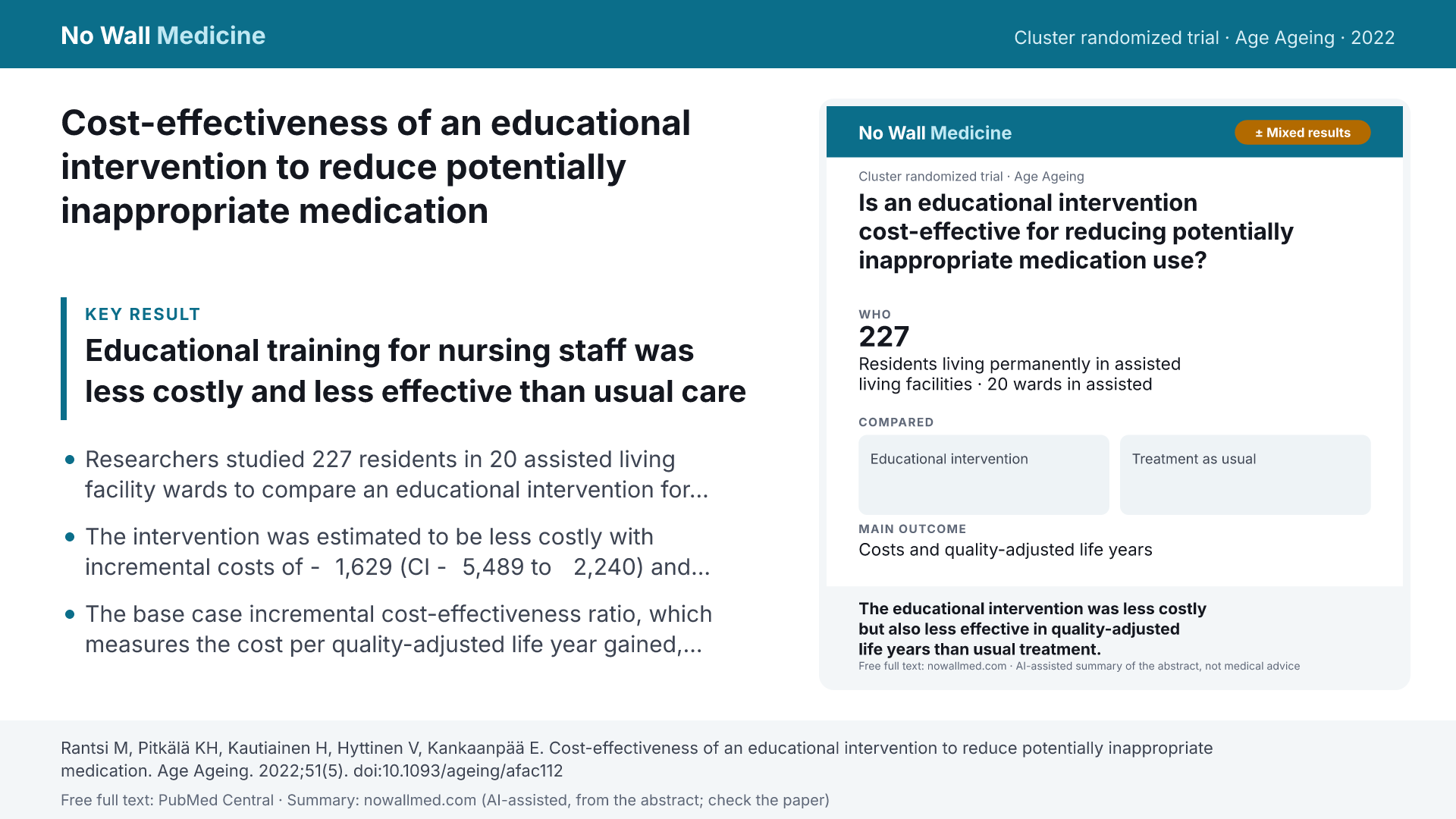
Educational training for nursing staff was less costly and less effective than usual care
Cost-effectiveness of an educational intervention to reduce potentially inappropriate medication
Cluster randomized trialMixed results
Is an educational intervention cost-effective for reducing potentially inappropriate medication use?
Who
227
Residents living permanently in assisted living facilities · 20 wards in assisted living facilities
Compared
Educational intervention
Treatment as usual
Main outcome
Costs and quality-adjusted life years
Result: incremental costs -€1,629, confidence interval -€5,489 to €2,240; incremental effect -0.02, CI -0.06 to 0.02
Bottom line: The educational intervention was less costly but also less effective in quality-adjusted life years than usual treatment.
Age Ageing · 2022-05-23Download image
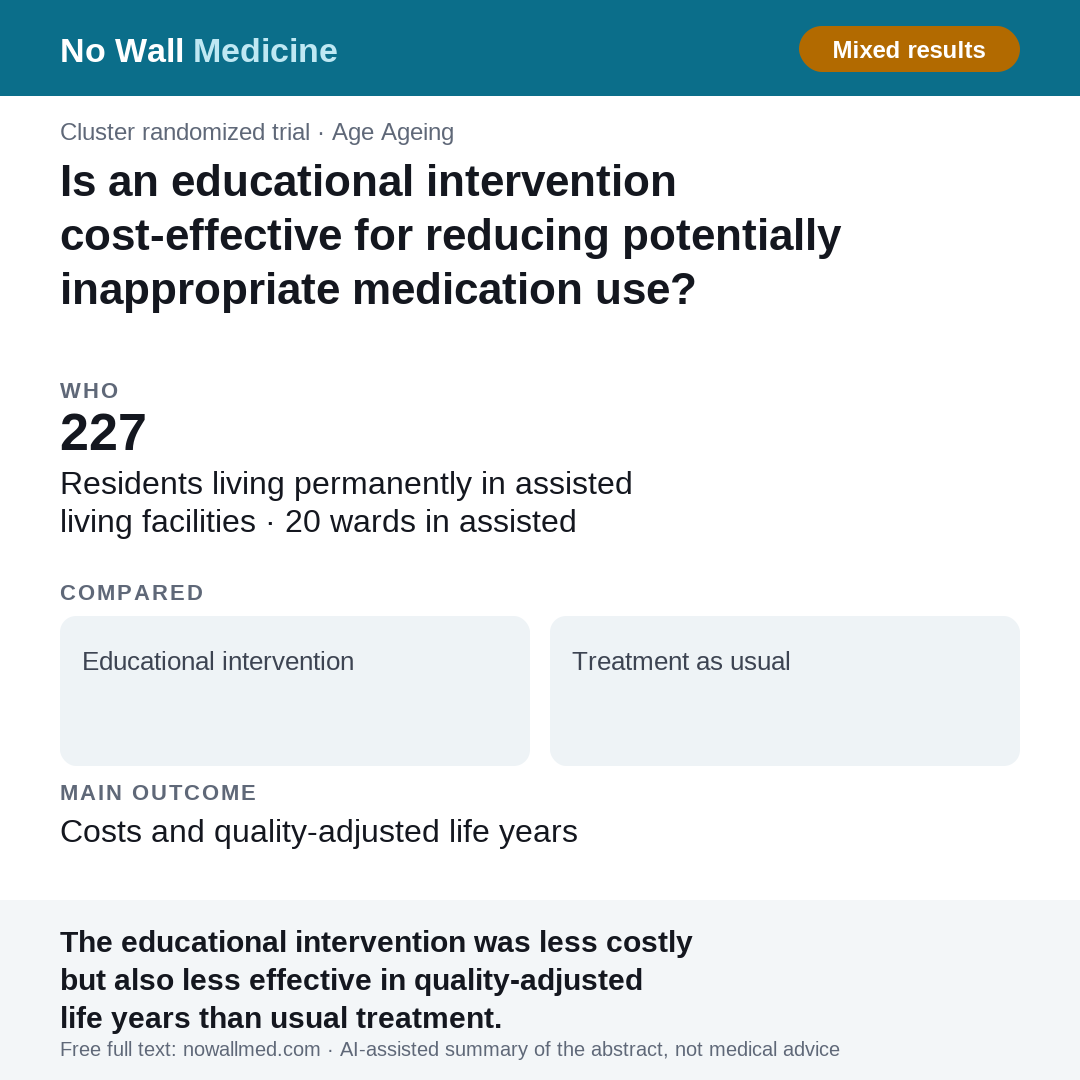
Clinical question: Is an educational intervention cost-effective for reducing potentially inappropriate medication use?
Key points
- Researchers studied 227 residents in 20 assisted living facility wards to compare an educational intervention for staff against treatment as usual.
- The intervention was estimated to be less costly with incremental costs of -€1,629 (CI -€5,489 to €2,240) and less effective with an incremental effect of -0.02 (CI -0.06 to 0.02).
- The base case incremental cost-effectiveness ratio, which measures the cost per quality-adjusted life year gained, was >€80,000/QALY.
Headline and key points written with AI from the paper’s abstract, with every number checked against it. Read the paper before relying on them.
Was this summary helpful?
Subject terms
Headline, design, result, key points, caveat and citation as plain text.
Cite this article
Rantsi M, Pitkälä KH, Kautiainen H, Hyttinen V, Kankaanpää E. Cost-effectiveness of an educational intervention to reduce potentially inappropriate medication. Age Ageing. 2022. doi:10.1093/ageing/afac112
Spotted a mistake? Suggest a correction